

The growing concern in Greece over the spread of the silver-cheeked pufferfish has once again highlighted a problem Cyprus has been dealing with for nearly 20 years: the presence of a toxic invasive species that threatens marine life, damages fishing equipment and should never be consumed.
Athens is preparing to follow Cyprus’ example by considering a financial support scheme for professional fishermen aimed at catching and removing the species from Greek waters in an effort to limit its spread. In Cyprus, a similar programme has already led to the removal of more than 100 tonnes of pufferfish from local waters.
According to information obtained by Phileleftheros from the Department of Fisheries and Marine Research (DFMR), the presence of the silver-cheeked pufferfish (Lagocephalus sceleratus) in Cyprus is widespread, with its population increasing rapidly since 2006.
The species is found along the entire Cypriot coastline throughout the year. Statistics from the Department show that most targeted catches linked to the subsidy scheme occur during the summer months and mainly in the southern and south-eastern coastal areas of the island. The species occupies a wide range of depths and is most commonly caught at depths of between 20 and 100 metres.
The spread of the pufferfish throughout the Mediterranean is attributed to its ecological characteristics. It has a broad diet, can adapt to various environmental conditions and has very few natural predators in the region. Originally from the Indo-Pacific, it entered the Mediterranean through the Suez Canal.
Key characteristics
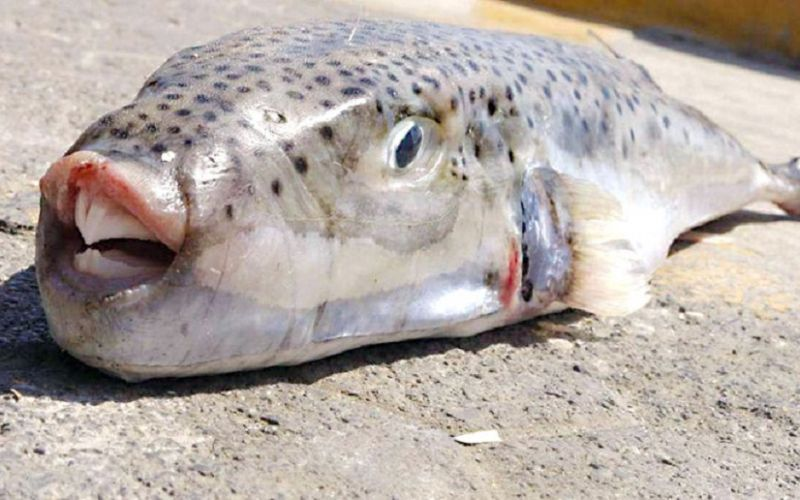
The pufferfish can be identified by:
- Its elongated and partially flattened body.
- A greenish-brown back covered with evenly distributed black spots.
- A silver stripe extending from the mouth to the tail.
- A white underside.
- A distinctive silver patch in front of each eye.
The species is also recognised by its powerful jaw, which contains four strong fused teeth — two upper and two lower — that form a beak-like structure. Its rabbit-like teeth are the reason behind its Greek name, which translates to “rabbitfish” or “harehead”.
The fish can also significantly inflate its body by taking in water or air. During this process, it emits a distinctive sound caused by friction between its upper and lower teeth.
Although it can be confused with other pufferfish species due to its shape and colouring, its characteristic beak, black spots and silver stripe make it relatively easy to identify.
Poisoning risks and symptoms
The fish is extremely poisonous if consumed.
It contains tetrodotoxin, a potent neurotoxin found in its tissues that can cause severe food poisoning and even death. The toxin is not destroyed by cooking and there is no antidote.
Anyone who accidentally consumes the fish should seek immediate medical attention. Until treatment is received, symptoms should be carefully monitored and reported to doctors.
The first signs of poisoning usually appear within minutes or a few hours after consumption and include numbness or tingling around the mouth and extremities, nausea, vomiting, diarrhoea and dizziness.
In severe cases, symptoms can progress rapidly to muscle weakness, paralysis and respiratory distress, potentially becoming life-threatening.
It is important to note that there is no risk of poisoning through external contact or a bite. However, its powerful jaws can cause injury. Authorities therefore advise against touching, disturbing or feeding the fish, just as they would with any wild species.
Only one poisoning incident recorded in Cyprus
During the species’ 20-year presence in Cyprus, there have been no recorded attacks on people.
Only one poisoning incident has been documented, involving two individuals who consumed the fish in 2016. Both recovered.
There have been no recorded injuries resulting from bites, although the Department of Fisheries recommends avoiding all contact with the species.
Handling of the fish should be limited exclusively to fishermen and authorised personnel familiar with its characteristics and associated risks.
Impact on fisheries and marine ecosystems
According to the Department of Fisheries and Marine Research, the pufferfish is one of the Mediterranean’s most significant invasive species.
It damages catches and fishing gear, increasing costs for professional fishermen. Ecologically, it is a highly effective predator that feeds on fish, crustaceans and molluscs, placing considerable pressure on native species while competing with them for food and habitat.
Its spread has the potential to disrupt food chains and negatively affect biodiversity in Mediterranean coastal ecosystems.
In short, it represents a serious threat to both fisheries and the ecological balance of the Mediterranean.
The Cyprus model and the subsidy scheme
The Department of Fisheries systematically monitors the species and its impact through fisheries data and landing statistics. The pufferfish has also been included among the species monitored under the European Union’s Data Collection Framework for fisheries.
The Department implemented mitigation measures during the previous programming periods of 2007-2013 and 2014-2020.
Under the current programming period, a subsidy scheme to limit the spread of the pufferfish in Cyprus’ coastal waters has been in operation since June 2024.
The programme aims to reduce pufferfish populations through targeted fishing pressure applied by collective groups of professional coastal fishermen.
The scheme has a budget of €1.395 million and is co-funded by the European Maritime, Fisheries and Aquaculture Fund and the Republic of Cyprus.
Eligible beneficiaries include professional fishermen holding Category A, Category B or polyvalent fishing licences.
Participants receive €4.73 per kilogramme of pufferfish caught.
To date, 11 collective groups representing approximately 150 fishermen have joined the scheme. Around €487,000 has already been paid, corresponding to approximately 103,000 kilograms of pufferfish removed from Cypriot waters.
The fishermen participating in the scheme follow strict handling and management procedures established under the programme.
Greece is now preparing to adopt a similar approach. Following a bounty of €5.33 per kilogramme for catching the invasive fish, the Greek government is considering a permanent incentive system to encourage fishermen to continue removing pufferfish populations, recognising that complete eradication is impossible.
Initially, the fish caught by fishermen will be weighed, inspected under strict procedures and transported in specialised vehicles to industrial furnaces for destruction.
Message to the public
The Department of Fisheries stresses that the species primarily affects professional fishermen by damaging fishing equipment and catches.
Swimmers and beachgoers face no particular danger on Cyprus’ beaches. Nevertheless, the public is advised not to disturb or feed the fish if encountered.
Authorities also encourage citizens to seek information from reliable sources, such as the Department of Fisheries and Marine Research website, in order to avoid unnecessary concern or panic regarding the presence of the pufferfish in Cypriot waters.
Source: Ioanna Kyriakou- Philenews
Also read: Cheap state plots return after 15 years: Where they will be made available
