

Signed on 24 July 1923, the landmark agreement established the Greek-Turkish frontier, confirmed sovereignty over the eastern Aegean islands and formally recognised Britain’s annexation of Cyprus.
On a summer day in Lausanne, diplomats turned years of warfare, imperial collapse and mass displacement into borders, legal clauses and new national realities.
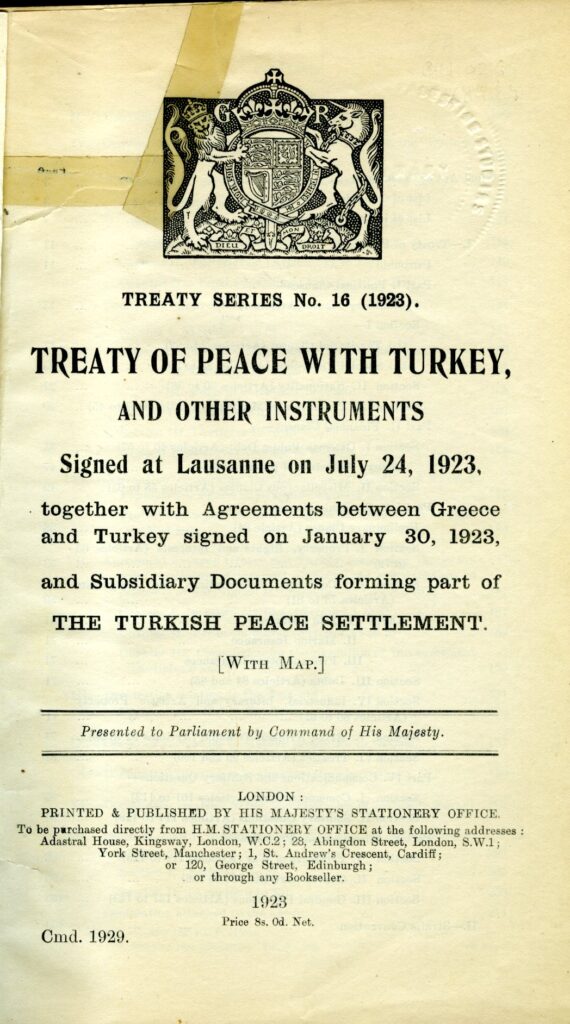
On 24 July 1923, representatives of Turkey and the Allied and Associated Powers, including Greece, signed the Treaty of Lausanne. The agreement formally re-established peace and laid the international foundations of the new order that emerged from the ruins of the Ottoman Empire. The Republic of Turkey would be proclaimed three months later.
The treaty replaced the unratified Treaty of Sèvres of 1920, which had envisaged the extensive partition of Ottoman territory. The military victories of the Turkish nationalist movement under Mustafa Kemal had rendered that earlier settlement unworkable, forcing the powers to return to the negotiating table. Unlike Sèvres, Lausanne was the result of months of difficult negotiations rather than terms imposed on a defeated government.
The Greek-Turkish land border
For Greece, one of the treaty’s most consequential provisions was the definition of the frontier in Thrace.
From the meeting point of the Greek, Turkish and Bulgarian borders, the line followed sections of the Arda and Maritsa rivers before continuing towards the Aegean Sea along the Maritsa, known in Greece as the Evros. Where a river formed the frontier, the treaty defined the boundary as the median line of the waterway or, in navigable sections, the middle of its principal channel.
There was, however, a significant exception. Karaağaç, opposite Edirne on the western side of the Evros, and the surrounding territory were transferred to Turkey. The accompanying protocol required Greece to hand the area to the Turkish authorities, while its Greek inhabitants were included in the population exchange. The territorial concession formed part of the compromise through which Turkey abandoned its demand for monetary reparations from Greece.
That exception explains why the modern border does not follow the river uninterruptedly at every point.
The islands of the Aegean
At sea, the treaty confirmed Greek sovereignty over major eastern Aegean islands, specifically naming Lemnos, Samothrace, Lesbos, Chios, Samos and Ikaria. Imbros and Tenedos, together with the Rabbit Islands, remained under Turkish sovereignty.
The text also established that, unless another provision applied, islands situated within three miles of the coast of Asia Minor would remain under Turkish sovereignty.
The Dodecanese and Castellorizo were treated separately. Turkey renounced its rights over them in favour of Italy, not Greece. The islands remained under Italian sovereignty until the 1947 Paris Peace Treaty, under which Italy ceded the Dodecanese, including Castellorizo, to Greece.
What Lausanne meant for Cyprus
Cyprus appeared in a brief but highly significant section of the treaty.
Britain had administered the island since 1878, while sovereignty had formally remained with the Ottoman Empire. When the Ottoman Empire entered the First World War against Britain in November 1914, the British government unilaterally annexed Cyprus.
Article 20 of the Treaty of Lausanne formally recorded Turkey’s recognition of that annexation. The treaty therefore did not begin British rule on the island; it gave international legal recognition to a change Britain had proclaimed nine years earlier. Cyprus subsequently became a British Crown colony in 1925 and remained under British rule until the establishment of the Republic of Cyprus in 1960.
The following article also addressed nationality. Turkish nationals who had been ordinarily resident in Cyprus when Britain announced the annexation were to acquire British nationality under local law and lose their Turkish nationality. They could instead opt for Turkish nationality, but were required to leave Cyprus within the period specified by the treaty.
Borders drawn, communities uprooted
The wider Lausanne settlement also carried an immense human cost.
A separate convention signed during the negotiations ordered the compulsory exchange of Turkish nationals belonging to the Greek Orthodox religion and Greek nationals belonging to the Muslim religion. The exchange was based primarily on religious identity rather than language or ethnicity.
Greek Orthodox residents of Constantinople and Muslim residents of Western Thrace were exempted, while the inhabitants of Imbros and Tenedos were also excluded under the peace treaty. Hundreds of thousands of people were permanently separated from homes, communities and landscapes their families had inhabited for generations.
The Treaty of Lausanne did not heal the wounds left by war or displacement. It did, however, transform the military realities of the period into an international legal order whose borders continue to shape Greece, Turkey, Cyprus and the wider eastern Mediterranean.
Also read: ON THIS DAY: Antarctic Treaty enacted (1961)
Featured Photo source: Gamma-Keystone via Getty Images, Creator: Keystone-France
