

Nearly a month into the Israeli-US war against Iran, it is clear that the environmental costs for Iran and the wider region have been substantial and are continuing to mount. The primary environmental threat during this stage of the war is conflict-linked pollution, which has the potential to impact public health, as well as terrestrial and marine ecosystems, and natural resources such as soils and aquifers. Contamination of water bodies is of particular concern for Iran, where drought and mismanagement have depleted water resources.
The war’s environmental footprint is closely tied to its duration and intensity, with several escalatory trends of concern. And, while attention is currently focused on the damage in the present, it is vital that the future resources, technical capacities and political conditions for environmental assessment and remediation in the affected countries are considered. Greater attention is also needed on the impact of the war in Lebanon, and on conditions for people and the environment in Gaza, left devastated by Israeli bombing.
Recording and assessing incidents
CEOBS continues to remotely track and assess environmentally problematic incidents across the region using its Wartime IncidentS to ENvironment (WISEN) methodology. For more detailed coverage of the war’s impacts see our three and ten day assessments, and the analysis of the Tehran oil fires.
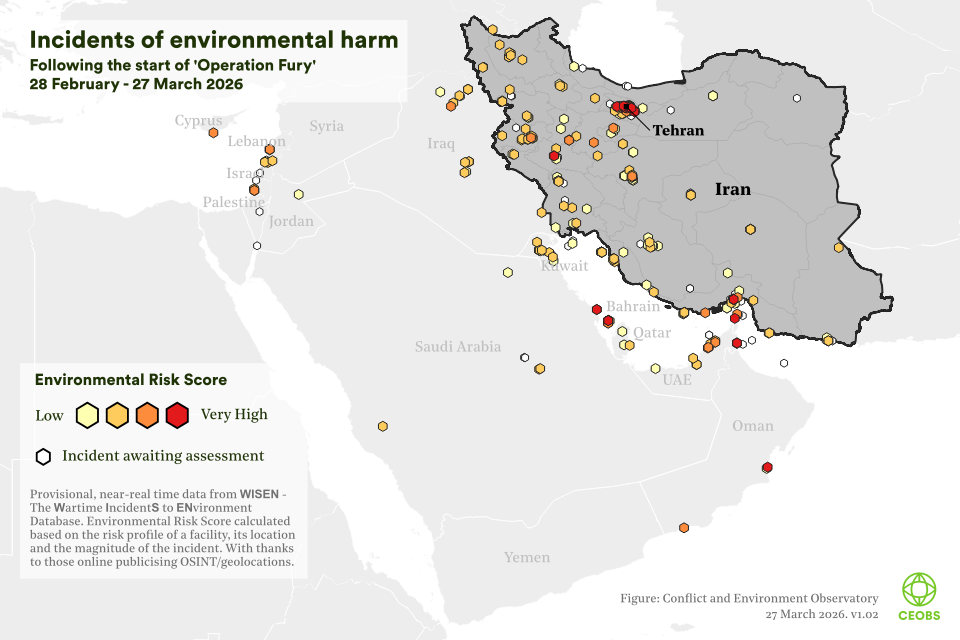
Health warning: incidents are largely identified through social media monitoring. While vetted, they require more comprehensive verification and peer review to fully assess their environmental impacts. Many additional incidents will need to be retrospectively added because of the speed, geographic spread, and chaotic online information environment.
Watchlist of environmental trends
The following trends have the potential to impact public health and terrestrial and marine ecosystems in the region; some also have the potential to cause environmentally-relevant outcomes globally.
- Expanding strike list expands health and environmental risks:
As the bombing campaign continues there are signs that it is beginning to encompass more civilian and industrial infrastructure. Attacks on industrial sites such as metallurgical plants can create substantial pollution risks, as can damaged transport facilities. Similarly, while a number of industrial, energy and military targets have been attacked in and around populated areas, as Israeli and US airstrikes continue we expect to see an increasing proportion of strikes in urban areas. Blast damage to residential and commercial infrastructure can result in the contamination of air, soil and water, releasing pollutants, pulverising building materials such as asbestos, and triggering fires generating toxic combustion products. Many of the constituents of explosive weapons, including energetic materials, propellants and heavy metals, are also environmentally problematic. - Nuclear risks:
Israeli strikes on Iran’s Natanz enrichment facility — and repeated strikes in proximity to the Bushehr reactor — triggered retaliatory missile attacks on the two towns closest to Israel’s nuclear weapons facility in the Negev desert, and to the Rotem Industrial Zone where uranium is extracted from phosphate deposits. The IAEA and WHO have been vocal in their concerns about the risks from a nuclear emergency and the prospects of responding to one during a conflict. Nuclear safety can be compromised by the loss of power supplies as well as direct damage to facilities housing nuclear materials. - Fossil fuel infrastructure:
With dozens of production, processing and storage sites already damaged or disrupted across the region, the environmental costs of escalation should already be clear. Beyond the oil storage fires, it’s important to consider the additional risks from fires or spills at facilities processing oil and gas products, and from the added GHG emissions of methane leaks and emergency flaring. - Persian Gulf:
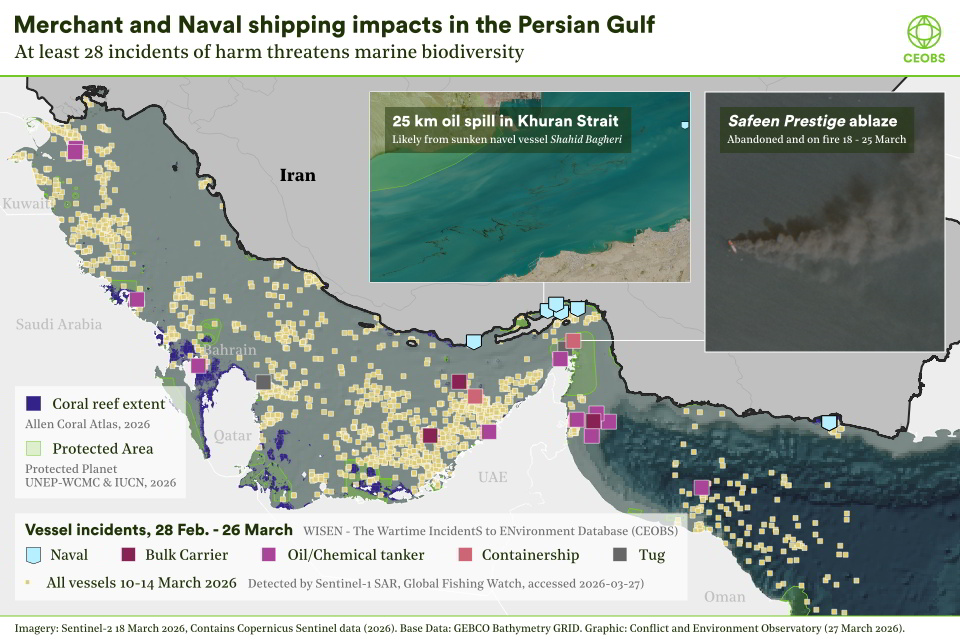
To date, most of the vessels attacked by Iran have been bulk cargo vessels, rather than oil tankers, yet with a few laden tankers from countries not directly associated with the US and Israel still passing through the Gulf, there is an ongoing risk of spills, and limited capacity to respond to them. Ports and coastal oil infrastructure, such as that at Bandar Abbas, as well as sunken Iranian naval vessels, are also potential pollution sources. In spite of anthropogenic pressures and a history of serious spills, the Persian Gulf retains important and sensitive coral and seagrass habitats that would be at risk. These risks would grow significantly in the event of any US attempt to occupy strategically important islands in the Gulf. - Red Sea:
Houthi attacks on shipping in recent years have led to serious pollution incidents. Any continuation or expansion of this policy poses threats to the Red Sea’s marine ecosystem and fisheries. Retaliatory strikes on port and energy infrastructure by Israel or the US also present coastal pollution threats.
- Desalination plants:
The region’s hundreds of desalination plants are at risk from direct attacks in the event of a serious escalation, as well as indirectly from disruption to energy supplies and major oil spill events. - Reverberating global consequences:
Complex and reverberating environmental effects are beginning to be felt far beyond the region. Gas prices and availability are seeing some countries revert to burning coal in the short-term; others including India have rationed fuel use. Longer term, this latest price shock may accelerate the energy transition in some countries. Reduced urea and fertiliser exports are driving up prices, this will undermine agricultural production in importing countries such as Sudan and Somalia, while benefitting Russian export revenues. Global reductions in use linked to high prices could also temporarily reduce GHG emissions and nitrate pollution.
The war’s environmental profile
Interest in the war’s environmental dimensions remains high, with extensive media coverage. Factors driving this attention include the nature of targets damaged — burning oil facilities provide visually arresting images, particularly when they occur in urban areas — and the pre-existing sensitisation of media platforms that have carried similar coverage on Ukraine.
A statement released by UNEP on March 13th echoed the concerns of those tracking damage; a task that has been challenging due to the challenging information space. The internet blackout in Iran has limited social media coverage of incidents, while many satellite imagery providers have delayed the release of imagery. That released by conflict parties and several affected countries, has been highly selective in its coverage. It is readily apparent that the understanding of the true extent of damage is partial and that it will be a long time before a more comprehensive picture emerges.
There are increasing signs of environmental information being politicised, with Iran publishing a rapid assessment of the Tehran oil fires in English via its network of embassies, while a complaint of ecocide was submitted to the UN Secretary General. All parties to the conflict appear to be targeting environmentally risky facilities.
Source: Conflict and Environment Observatory
Also read: Tanker hit in Dubai, oil spill warnings issued
For more videos and updates, check out our YouTube channel
