

The results for all 299 constituencies
Germany’s opposition conservatives won the national election on Sunday, putting leader Friedrich Merz on track to be the next chancellor while the far-right Alternative for Germany came in second, its best ever result, projections showed. This election saw the highest voter turnout since before German reunification in 1990, according to exit polls, with issues such as immigration, the rising cost of living and energy top of voters’ minds.
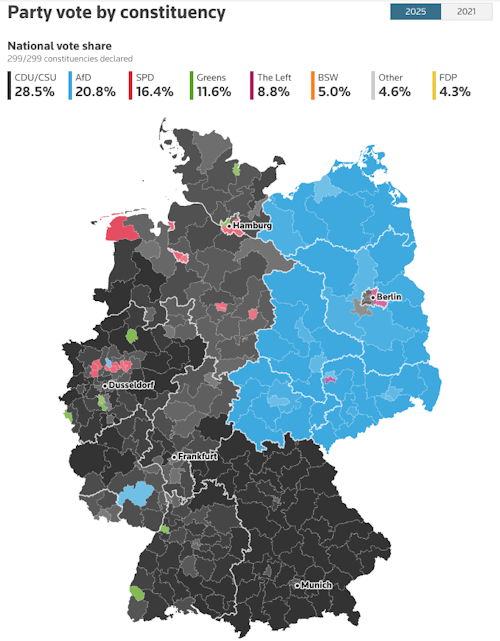
The map above shows the 2025 election results, and the one below shows the 2021 results.
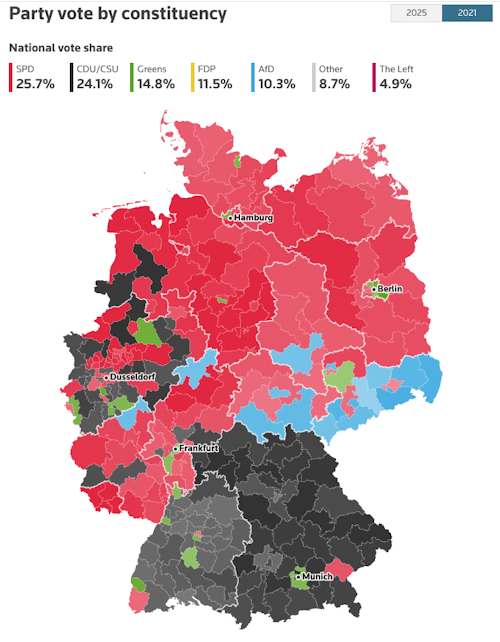
The outcome
Here is a breakdown in graphics showing trends between male and female voters as well as different age groups, according to the latest projected results. The CDU/CSU conservative bloc won followed by the far-right Alternative for Germany (AfD), while the Social Democrats (SPD) of Chancellor Olaf Scholz were dealt their worst-ever result.

By gender
Male voters tended more towards the centre-right CDU/CSU and far-right AfD, while female voters showed stronger support for the centre-left SPD and the hard-left Die Linke party.

By age group
The AfD saw its support weaken considerably among older age groups, while Die Linke performed well among younger voters.

German reactions to election result
First reactions:
Olaf Scholz, SPD Chancellor
“The result is very bitter for the SPD. We have lost the election.”
“I will not be a representative of the SPD in a federal government led by the CDU, nor will I negotiate for it.”
Friedrich Merz, CDU leader and Chancellor candidate
“Tonight we will celebrate, and from tomorrow we start working. … The world out there is not waiting for us.”
Alice Weidel, AfD Party leader
“We are open to coalition negotiations with the CDU.”
“We have arrived as a party of the people.”
Christian Lindner, FDP leader
“If the FDP leaves the Bundestag, it is quite clear that I will also leave politics … If my political career ends tomorrow, I will leave with only one feeling: gratitude.”
Boris Pistorius, SPD member and Defence Minister
“The decisive factor is that we have to soberly state that this is a devastating, catastrophic result.”
Robert Habeck, Greens Chancellor Candidate
“Germany is now facing a difficult task of forming a government. This must now be completed quickly and successfully.”
Alexander Dobrindt, CSU Chairman
“I am still convinced that there is no change of policy among the Greens and therefore I cannot imagine that a coalition (with the Greens) will be formed.”
International reaction to German election
US President Donald Trump
“Much like the USA, the people of Germany got tired of the no common sense agenda, especially on energy and immigration, that has prevailed for so many years. This is a great day for Germany.”
French President Emmanuel Macron
“I just spoke with Friedrich Merz to congratulate him on his victory in the German elections.
“I also had an exchange with Olaf Scholz to express my friendship on this evening.
“We are more determined than ever to achieve great things together for France and Germany and work towards a strong and sovereign Europe. In this time of uncertainty, we are united to face the major challenges of the world and our continent.”
Je viens de m'entretenir avec @_FriedrichMerz pour le féliciter de sa victoire aux élections allemandes.
— Emmanuel Macron (@EmmanuelMacron) February 23, 2025
J’ai aussi eu un échange avec @OlafScholz pour lui dire mon amitié en cette soirée.
Nous sommes plus que jamais déterminés à faire de grandes choses ensemble…
British Prime Minister Keir Starmer
“Congratulations to Friedrich Merz and CDU/CSU for the results in Germany’s election. I look forward to working with the new government to deepen our already strong relationship, enhance our joint security and deliver growth for both our countries.”
Congratulations to @_FriedrichMerz and @CDU/@CSU for the results in Germany’s election.
— Keir Starmer (@Keir_Starmer) February 23, 2025
I look forward to working with the new government to deepen our already strong relationship, enhance our joint security and deliver growth for both our countries.
Ukrain President Volodymyr Zelensky
“I congratulate the CDU/CSU and Friedrich Merz on their victory in the Bundestag elections. A clear voice from the voters, and we see how important this is for Europe.
“We look forward to continuing our joint work with Germany to protect lives, bring real peace closer to Ukraine, and strengthen Europe.
“Europe must be able to defend itself, develop its industries, and achieve the necessary results. Europe needs shared successes, and those success will bring even greater unity to Europe.”
I congratulate the CDU/CSU and @_FriedrichMerz on their victory in the Bundestag elections. A clear voice from the voters, and we see how important this is for Europe.
— Volodymyr Zelenskyy / Володимир Зеленський (@ZelenskyyUa) February 23, 2025
We look forward to continuing our joint work with Germany to protect lives, bring real peace closer to Ukraine,…
Israeli Prime Minister Benjamin Netanyahu
“Congratulations to Friedrich Merz and CDU/CSU on their clear election victory today. Looking forward to working closely with your upcoming government to further strengthen the partnership between our two countries.”
Congratulations to @_FriedrichMerz and @CDU/@CSU on their clear election victory today. Looking forward to working closely with your upcoming government to further strengthen the partnership between our two countries.
— Benjamin Netanyahu – בנימין נתניהו (@netanyahu) February 23, 2025
NATO Secretary General Mark Rutte
“Congrats to Friedrich Merz on today’s election victory in Germany.
“Looking forward to working with you in this crucial moment for our shared security. It’s vital that Europe step up on defence spending and your leadership will be key.”
Congrats to @_FriedrichMerz on today’s election victory in 🇩🇪
— Mark Rutte (@SecGenNATO) February 23, 2025
Looking forward to working with you in this crucial moment for our shared security. It’s vital that Europe step up on defence spending and your leadership will be key.
Herbert Kickl, Leader of Austria’s far-right Freedom party
“As of today, there is a gaping hole in the firewall of the parties of the system, which is really a wall of fear against the will of the people and of democratic change – caused by the hopes of people fed up with being patronised, with illegal mass immigration, and the Islamist terror and security chaos resulting from it, climate communism and the destruction of prosperity.
“Today, a gentle, soothing wind of the freedom of 1989 is blowing through Berlin and the entire Federal Republic.”
Nikos Christodoulides, President of the Republic of Cyprus
“Congratulations Friedrich Merz on this important victory, at a crucial time for Europe, for our Union.”
Congratulations @_FriedrichMerz on this important victory, at a crucial time for Europe, for our Union, 🇩🇪🇨🇾🇪🇺
— NikosChristodoulides (@Christodulides) February 23, 2025
Greek Prime Minister Kyriakos Mitsotakis
“A decisive victory for our political family, for Germany, and for Europe. Congratulations Friedrich Merz! One thing is clear: you will be Germany’s next chancellor.”
A decisive victory for our political family, for Germany, and for Europe. Congratulations @_FriedrichMerz! One thing is clear: you will be Germany’s next chancellor.
— Kyriakos Mitsotakis (@kmitsotakis) February 23, 2025
Czech Prime Minister Petr Fiala
“Congratulations to Friedrich Merz and the CDU/CSU on winning the German elections. I wish you a lot of strength and success in forming the federal government. I look forward to the further deepening of Czech-German cooperation and joint work on a stronger Europe.”
Herzlichen Glückwunsch an @_FriedrichMerz und die CDU/CSU zum Sieg bei den deutschen Wahlen. Ich wünsche Ihnen viel Kraft und Erfolg bei der Bildung der Bundesregierung. Ich freue mich darauf, die tschechisch-deutsche Zusammenarbeit weiter zu vertiefen und gemeinsam an einem…
— Petr Fiala (@P_Fiala) February 23, 2025
Matteo Salvini, Deputy Prime Minister of Italy
“Change is winning in Germany too! AfD doubles its votes, despite attacks and lies from the left: stop illegal immigration and Islamic fanaticism, enough with the eco-madness, prioritize peace and jobs, Europe must be radically changed.
“Well done (AfD co-leader) Alice Weidel, keep it up!”
🇩🇪 Die Veränderung siegt auch in Deutschland! Die @AfD verdoppelt ihre Stimmen trotz der Angriffe und Lügen der Linken. Schluss mit illegaler Einwanderung und islamischem Fanatismus, genug von ökologischen Verrücktheiten. Priorität für Frieden und Arbeit. Europa muss radikal… https://t.co/ALqYQdbUFh
— Matteo Salvini (@matteosalvinimi) February 23, 2025
What kind of coalition government could Germany have after the election?
Following a CDU/CSU win, Germany faces several months of uncertainty in forming a government amid a fractured parliament that could include up to seven parties. The eventual coalition depends on whether the FDP and Sahra Wagenknecht Bewegung (BSW) clear the 5% threshold.
Key coalition options:
- Grand coalition (CDU/CSU & SPD):
Combined, they hold 293 seats—short of the 316 needed—unless the FDP and BSW are excluded. Under Friedrich Merz, the CDU/CSU favours broad tax cuts and a tougher stance on migration, while the SPD prefers higher taxes on the wealthy.
Probability: 60% (Eurasia Group) - Kenya coalition (CDU/CSU, SPD & Greens):
This option, totalling around 374 seats if smaller parties make it in, faces challenges due to significant domestic policy differences, especially on migration.
Probability: 10% (Eurasia Group) - Germany coalition (CDU/CSU, SPD & FDP):
A slim majority of 326 seats, but past budget disputes between the SPD and FDP make it unlikely.
Probability: 10% (Eurasia Group) - Minority government:
While seen in state governments, a federal minority government would be unprecedented due to its potential instability.
What about the AfD:
Although combining the conservatives with the far-right AfD would yield a mathematical majority of 318 seats, all other parties have ruled out working with the AfD, further complicating coalition talks.
Also read: Germany election 2025: Party policies, opinion polls and key issues
Featured photo source: Euronews
Source: Reuters
