

Contracts of sale across Cyprus are running 14% ahead of 2025; Larnaca grows fastest, Limassol stays largest, and foreign buyers sign more than two in every five contracts.
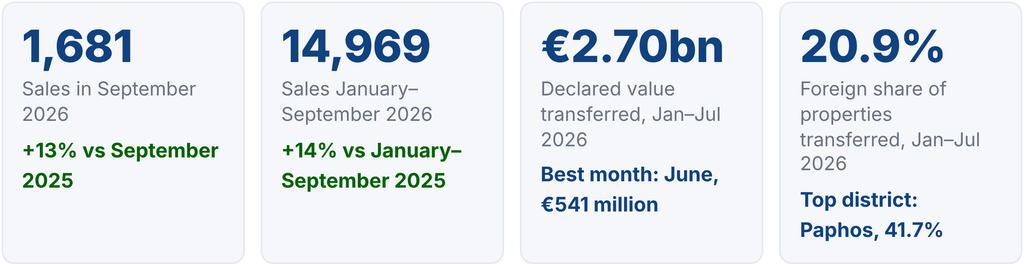
Buyers deposited 1,681 contracts of sale with the Department of Lands and Surveys in September 2026, the strongest September ever recorded and 13% more than the 1,484 of September 2025, according to analysis of Department of Lands and Surveys data by BuySell, Cyprus’s largest property platform. Nine months into the year the count stands at 14,969 — 1,796 more than in the same period of 2025 and already 83% of last year’s full-year total of 18,114.
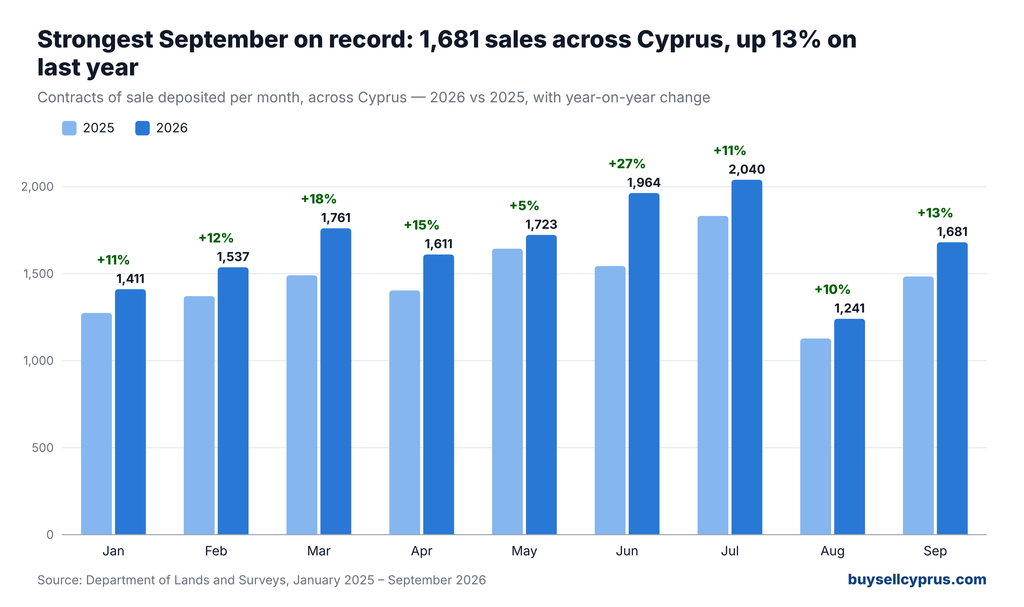
Every month of 2026 has beaten 2025 — eight of the nine by double digits
September’s 1,681 contracts extend an unbroken run: each month of 2026 has outsold the same month of 2025, and in eight of the nine the margin was 10% or more. Only May, at +5%, grew in single digits. June delivered the fastest growth (+27%) and July the largest single month on record, 2,040 contracts, before the usual August pause brought 1,241 — itself 10% above August 2025.
Across the nine months the market has averaged 1,663 contracts a month against 1,464 a year earlier. Sustained at that pace, 2026 would close near 20,000 contracts, comfortably ahead of the 18,114 recorded in 2025.
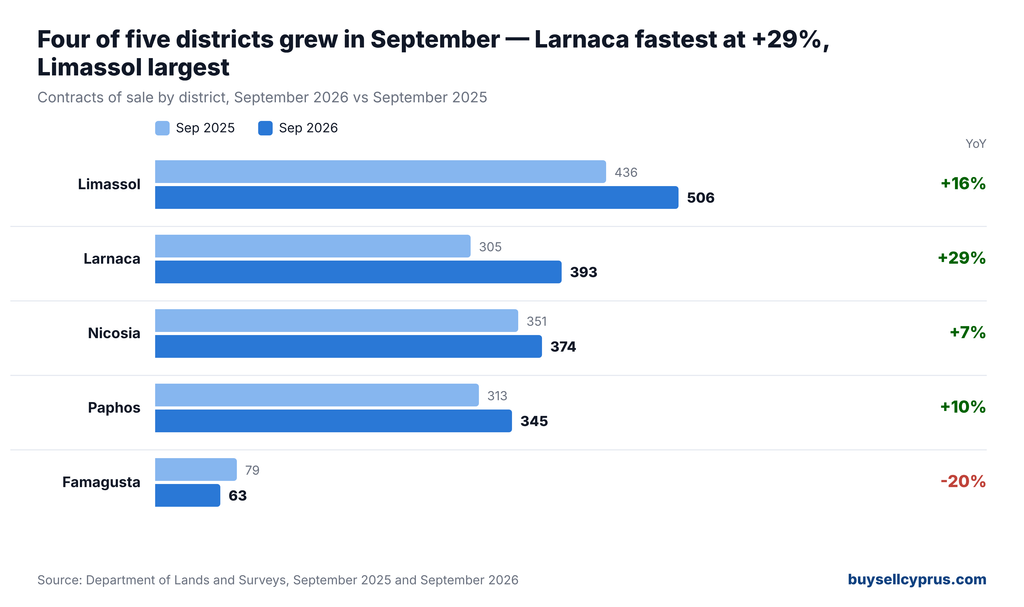
Four of five districts grew in September — Larnaca fastest at +29%, Limassol largest with 506
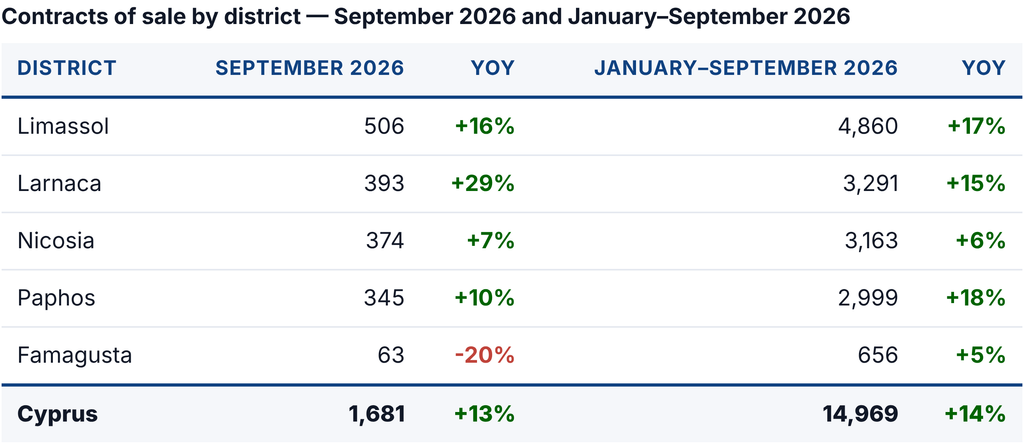
Larnaca posted the sharpest rise, 393 contracts against 305 a year earlier (+29%). Limassol remained the largest market with 506 contracts (+16%), almost one in every three sales across Cyprus. Paphos recorded 345 (+10%) and Nicosia 374 (+7%). The free Famagusta area was the only district to fall, from 79 to 63 (−20%).
Over nine months Limassol leads with 4,860 contracts (+17%), followed by Larnaca with 3,291 (+15%), Nicosia with 3,163 (+6%), Paphos with 2,999 (+18%) and Famagusta with 656 (+5%). Limassol and Paphos together supplied 1,172 of the 1,796 additional contracts this year — roughly two-thirds of all growth.
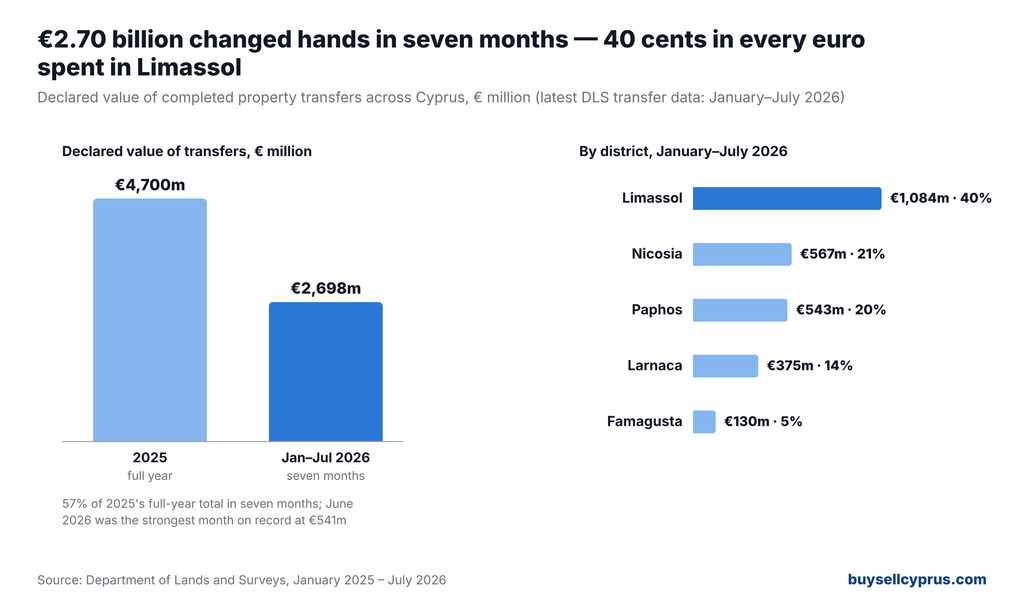
€2.70 billion changed hands in seven months — 57% of last year’s total, 40 cents in every euro in Limassol
Completed transfers tell the story of money actually changing hands. Between January and July 2026 the Department of Lands and Surveys registered 11,522 transfer transactions covering 12,857 properties, with a declared value of €2.70 billion — already 57% of the €4.7 billion transferred in the whole of 2025. June was the strongest month on record at €541 million, and July added a further €468 million.
Limassol accounted for €1,084 million, or 40 cents in every euro spent across Cyprus, followed by Nicosia (€567 million, 21%), Paphos (€543 million, 20%), Larnaca (€375 million, 14%) and Famagusta (€130 million, 5%). Transfer statistics are published with a longer lag than contracts of sale; the January–July figures are the latest available for this release.
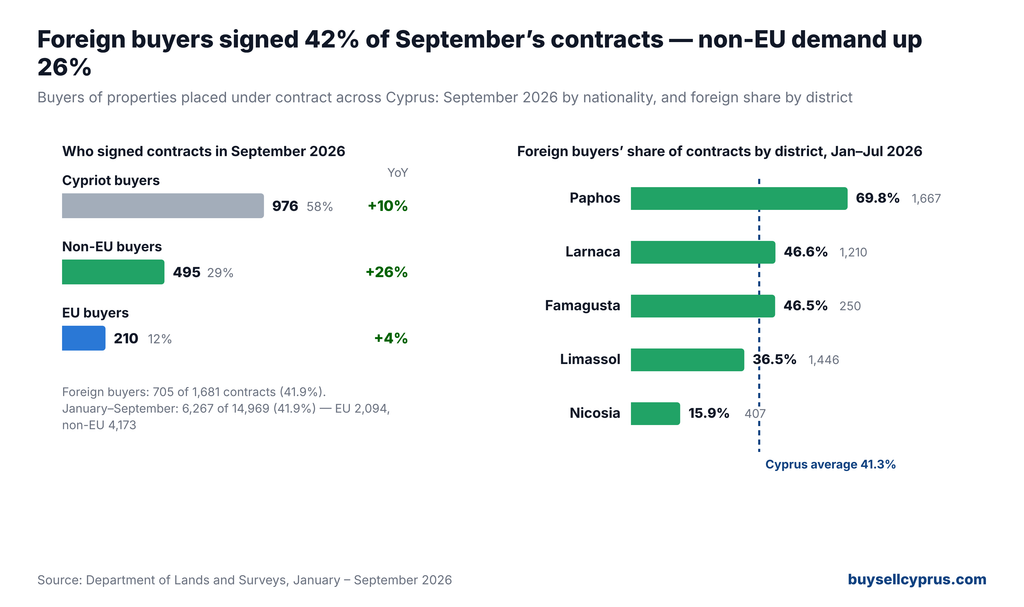
Foreign buyers sign 42% of contracts — non-EU purchases up 26% in September
Non-Cypriot buyers signed 705 of September’s 1,681 contracts, or 41.9%. Buyers from outside the European Union accounted for 495 of them (+26% year on year) and EU citizens for 210 (+4%), while purchases by Cypriots rose 10% to 976. Over nine months foreign buyers have signed 6,267 contracts — 2,094 by EU citizens and 4,173 by non-EU citizens — again 41.9% of all sales and roughly a fifth more than a year earlier.
The pattern varies sharply by district. In Paphos foreign buyers signed 69.8% of all contracts between January and July (1,667 of 2,387), compared with 46.6% in Larnaca, 46.5% in Famagusta, 36.5% in Limassol and 15.9% in Nicosia. Completed transfers to foreign buyers numbered 2,683 over the same period, 20.9% of all properties transferred, with Paphos at 41.7% and Nicosia at 9.0%. The gap between the foreign share of contracts and of transfers reflects off-plan purchases, where title changes hands only once construction is complete.
Prices up 8.5% in a year — apartments outpace houses, Famagusta and Larnaca lead
The Central Bank of Cyprus Residential Property Price Index for the second quarter of 2026 — the latest available — rose 8.5% year on year and 2.4% on the previous quarter, reaching 109.7. Apartments gained 8.9% and houses 5.8%, continuing the shift of demand towards apartments that has characterised the market since 2023.
Every district recorded growth: Famagusta +10.0%, Larnaca +9.8%, Paphos +9.6%, Limassol +7.8% and Nicosia +5.7%. The Central Bank attributed the increase to strong demand from foreign buyers alongside steady domestic demand, and noted a 63.7% rise in residential building permits in the first five months of the year (8,978 units against 5,484), pointing to a gradual supply response.
About BuySell
BuySell (buysellcyprus.com) is Cyprus’s leading property platform, attracting more than 2 million visitors every month and hosting over 150,000 listings for sale across Cyprus. With a market share of more than 80% — confirmed by IMR / University of Nicosia — it is the definitive marketplace for Cypriot real estate and a regular publisher of data-driven analysis of the market.
For more information, live market data and more than 150,000 listings, visit buysellcyprus.com. The BuySell App is available for iPhone and Android:
Download on the App Store Get it on Google Play
Also read: AI investment supports global growth, but war and debt threaten outlook
For more videos and updates, check out our YouTube channel
