

WHO raises concerns over wider spread
People living near the epicentre of the Ebola outbreak in the Democratic Republic of Congo have described growing fear as a World Health Organization official warned the virus may already be spreading more widely than first believed.
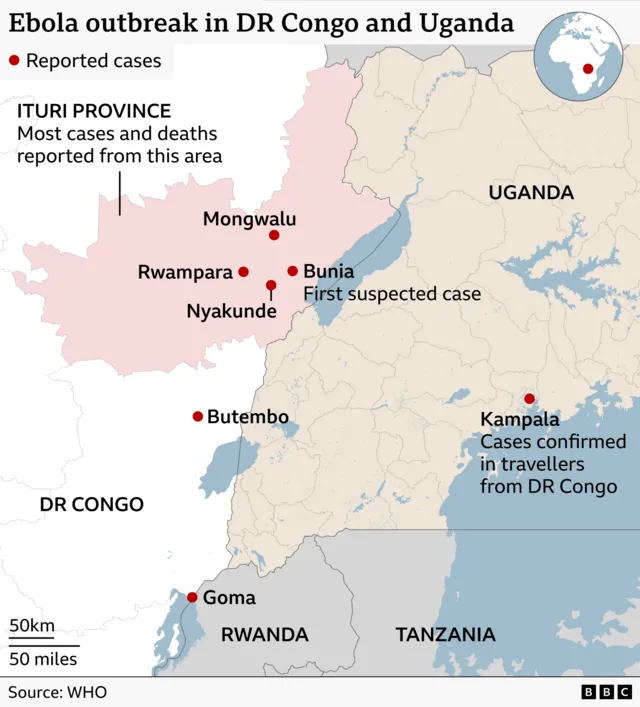
At least 131 people have died in the outbreak, while more than 513 suspected cases had been recorded in DR Congo as of Tuesday. One death has also been reported in neighbouring Uganda.
Speaking to the BBC, WHO representative Dr Anne Ancia said investigations suggest the outbreak has already spread beyond the initially affected areas.
“The more we are investigating this outbreak, the more we realise that it has already disseminated at least a little bit across border and also in other provinces,” she said.
Study suggests cases may exceed 1,000
Modelling by the London-based MRC Centre for Global Infectious Disease Analysis suggested there may have been “substantial” under-detection of cases.
Researchers said they could not rule out the possibility that the outbreak had already exceeded 1,000 infections.
The study warned the epidemic was likely “larger than currently ascertained” and that its “true magnitude remains uncertain”.
Residents describe fear and shortages
Residents in Ituri province, the centre of the outbreak, told BBC News that fear was spreading through local communities.
One resident identifying himself as Bigboy said infected people were dying “very fast”, adding: “Ebola has tortured us.”
He said residents were trying to protect themselves by washing their hands frequently, but many lacked access to protective supplies such as face masks.
Another resident, Alfred Giza, said communities were aware of the threat but feared they would not know how to respond if relatives became infected.
The Red Cross warned that Ebola outbreaks can escalate rapidly when cases are not detected early, public awareness is limited and healthcare systems are overwhelmed.
“We are seeing all those conditions,” the organisation said.
International concern grows
DR Congo President Félix Tshisekedi called for calm on Tuesday following an emergency crisis meeting.
World Health Organization Director-General Tedros Adhanom Ghebreyesus said he was “deeply concerned about the scale and speed of the epidemic”.
Health officials fear the outbreak may have been spreading for weeks before it was first detected on 24 April.
The outbreak has now spread to South Kivu province and has also reached Goma, eastern DR Congo’s largest city, with a population of around 850,000 people.
Several neighbouring countries have tightened border screenings and introduced precautionary measures. Rwanda has closed its border with DR Congo, while Uganda has advised citizens to avoid physical contact such as hugging and handshakes.
American doctor evacuated to Germany
An American citizen believed to be missionary doctor Peter Stafford is being evacuated from DR Congo after developing Ebola symptoms.

Germany’s health ministry confirmed to the BBC that a US citizen was being transferred there for treatment.
The US Centers for Disease Control and Prevention said it was working to evacuate at least six other Americans who may have been exposed.
What is Ebola?
Ebola is a severe viral disease spread through direct contact with bodily fluids such as blood or vomit from infected people or animals.
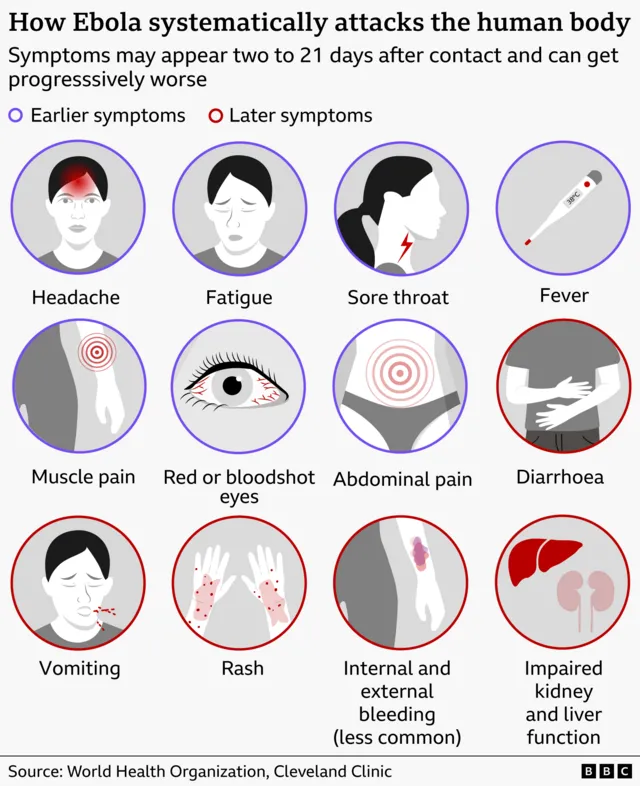
Symptoms initially resemble flu, including fever, headache and fatigue, before progressing to vomiting, diarrhoea and, in severe cases, organ failure and internal bleeding.
The current outbreak is linked to the rare Bundibugyo strain of Ebola, for which there are currently no approved vaccines.
The largest Ebola outbreak occurred in West Africa between 2014 and 2016, infecting more than 28,600 people and killing over 11,000 across several countries, including cases in the US, UK and Italy.
Source: BBC
Also read: Cyprus ranks 10th in Europe for hookah use among students
For more videos and updates, check out our YouTube channel
