

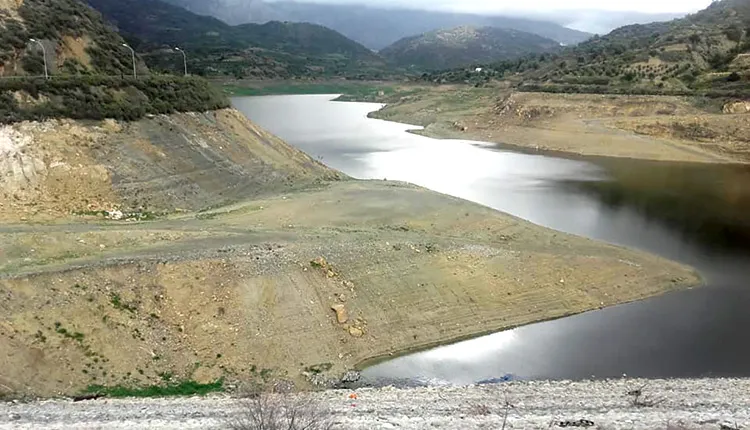
The increase in water reserves following the recent rainfall is visible but insufficient to reverse the country’s difficult hydrological outlook. This was clarified by Gianna Oikonomidou, Senior Officer at the Water Development Department, speaking on the programme Protoselido.
The discussion began with a question posed by the journalists: Although there has been a great deal of rainfall, and significantly more than last year, reservoir reserves appear much lower than they were at the same time last year. How is this explained?
Ms Oikonomidou confirmed that after the rains of recent days a clear improvement was observed, noting that reserves rose to 17 to 18 percent from the 14 percent recorded the previous Friday. However, she stressed that levels remain significantly lower than during the corresponding period last year, when reservoir capacity stood at around 26 percent.
She clarified that the improvement is not sufficient to restore the water balance, recalling that it follows three consecutive years of low inflows while demand for water supply has steadily increased. She also referred to climate variability which, as she noted, results in disproportionately low inflows relative to rainfall levels. Special mention was made of the Southern Conveyor, critical to the water supply of most of Cyprus, where capacity currently stands at just 14.9 percent.
The journalists then raised the issue of evaporation in major reservoirs and whether measures such as the installation of floating photovoltaic systems, a practice implemented in Portugal, could be adopted.
Ms Oikonomidou responded that this is a measure under consideration. She noted that a study has already been carried out with technical assistance from the European Commission on the installation of floating photovoltaic systems in reservoirs in combination with pumping and other technical solutions. She stated that it is an option worth examining in practice.
In response to a further question on whether, given current data and forecasts of limited rainfall in the coming period, planning for potential water supply cuts is being reconsidered, the Senior Officer was clear. With desalination units operating at full capacity, the objective is to avoid water supply cuts. At the same time, she warned that a reservoir level of 17.6 percent does not allow for complacency and stressed that rainfall developments up to spring will be decisive.
Responding to a question about water consumption, and specifically whether in some cases it reaches 500 litres per person per day, Ms Oikonomidou clarified that in certain areas supplied by district organisations average consumption stands at around 140 litres per person. There are however cases where consumption exceeds 500 litres, something that, as she stated, must stop.
When it was observed that the difference between 140 and 500 litres is vast, she attributed the discrepancy to water being used for irrigation rather than exclusively for domestic purposes. She stressed that water must be used prudently for household needs and that there are many ways to conserve it through simple habits, making clear that such consumption patterns are not acceptable.
The strategy, she explained, moves in two directions. On the one hand increasing supply through desalination and the use of non conventional sources and on the other reducing demand. She referred to the European Commission’s water resilience policy, underlining that a country cannot invest solely in strengthening supply sources without simultaneously taking measures to limit consumption and reduce network losses.
Particular interest was also shown in the question of swimming pools, both in hotels and private residences. When we speak of severe water scarcity what will happen in these cases?
Ms Oikonomidou clarified that potable water should not be used to fill swimming pools and that relevant conditions are included in planning and building permits issued by the competent authorities. She noted however that the Water Development Department is not the licensing authority for swimming pools. Nevertheless, she stated that it is cooperating with the relevant ministries to promote good practices and rational water use.
Finally, when asked about the possibility of cloud seeding as a measure to address drought, the Senior Officer replied that it does not fall within the Department’s remit. She clarified however that it is participating in relevant discussions and exchanges of views. As conveyed by the competent department, cloud seeding has been examined but cannot guarantee results. Even so, according to information from the Department of Meteorology, the possibility of piloting the measure will be considered.
Also Read: Greek Cypriot freed under conditions in occupied areas
