

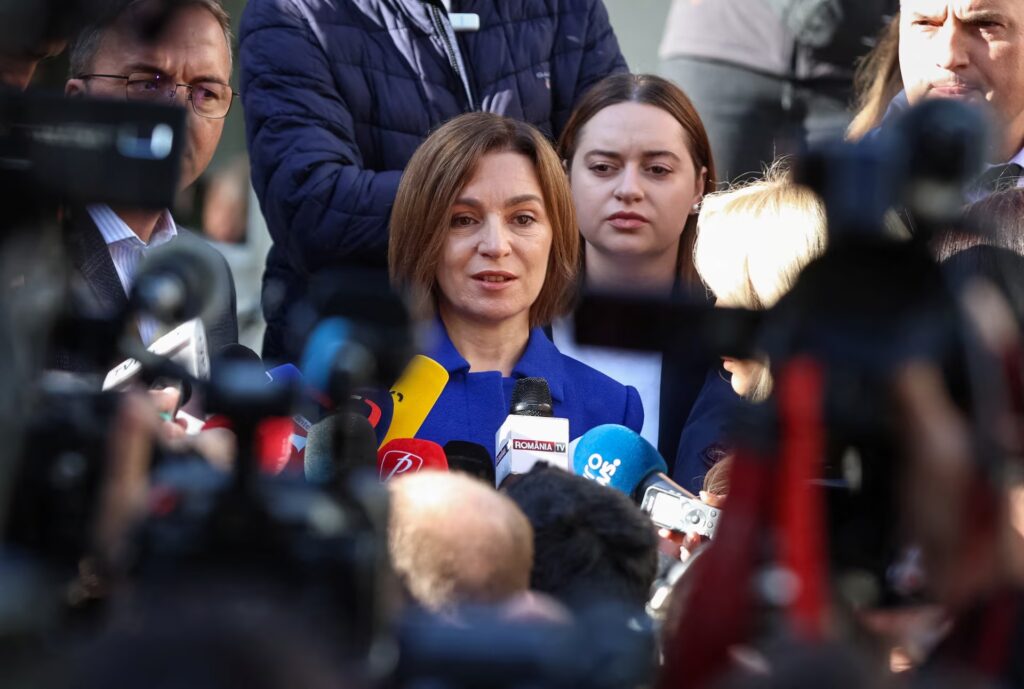
Moldova’s pro-European ruling party won a resounding victory over its Russian-leaning rival in a key parliamentary election, results on Monday showed, in a major boost for the country’s bid to join the EU and break away from Moscow’s orbit.
The surprisingly strong performance on Sunday by President Maia Sandu’s Party of Action and Solidarity (PAS) against the Patriotic Bloc was a relief for the government and its European partners, who accused Moscow of seeking to influence the vote.
With nearly all votes counted, PAS had won 50.2% versus 24.2% for the Patriotic Bloc, which had sought to steer Moldova – a small former Soviet republic that lies between Ukraine and EU member Romania – closer to Russia.
Strong support for EU Membership
“The people of Moldova… chose democracy, reform, and a European future, in the face of pressure and interference from Russia,” Antonio Costa, president of the European Council which represents the EU’s 27 member states, said on X.
The leaders of France, Germany and Poland, in a joint statement, also congratulated Moldova for “the peaceful conduct of the election, despite unprecedented interference by Russia, including with vote-buying schemes and disinformation”.
However, Moscow – which denies the accusations of meddling – accused authorities in Moldova of preventing hundreds of thousands of its citizens who live in Russia from voting by providing only two polling stations for the large diaspora.
Asked whether Moscow recognised the results, Kremlin spokesman Dmitry Peskov noted that some political forces in Moldova had spoken of violations.
“First, Moldovans themselves should probably sort this out. As far as we know, some political forces are declaring their disagreement. They’re talking about possible election violations,” he said.
In Moldova, first-time voter Ana-Maria Orsu, 18, said she had noticed that many young people like her had turned out to cast their ballot.
“I think we have a bright future ahead of us,” she said in the centre of the capital Chisinau early on Monday.
PAS leaders had called Sunday’s election the most consequential since Moldova’s independence from the Soviet Union in 1991.
Sandu’s government said Russia had attempted to sway the vote through widespread disinformation and vote-buying.
Russia, in turn, accused the pro-EU camp in Moldova of attempting to manipulate the outcome of the election.
Leonid Slutsky, head of the Committee on International Affairs in Russia’s parliament, said on Telegram there had been “violations of electoral rights and freedoms, large-scale purges of the political space, and blatant falsifications”.
“The Sandu regime is leading Moldova down the path of Ukraine.”
Ukrainian President Volodymyr Zelenskiy hailed Sunday’s election result, saying Moscow had failed to “destabilise” Moldova.
Opposition alleges voting violations
Patriotic Bloc co-leader Igor Dodon, a former Moldovan president, had called for protests against the outcome of the election.
On Monday, a crowd of about 100 people gathered in front of parliament where Dodon said his party had filed documents to the Central Electoral Commission proving voting violations.
These included denying more than 200,000 people living in Transdniestria, a pro-Russian separatist region, the ability to vote, he added.
“The election showed that PAS again lost the vote inside the country… PAS is clinging to power through the diaspora votes,” Dodon said, referring to the large number of Moldovans who live and work in the EU and elsewhere.
Moldova – with a population of 2.4 million people that has been buffeted by the war in neighbouring Ukraine, alleged Russian interference and energy shortages – has long vacillated between Russia and Europe.
The Patriotic Bloc and other opposition groups had sought to tap into voter anger over economic pain and the slow pace of reforms – grievances worsened by what officials say has been widespread disinformation.
Inflation remains stubbornly high at around 7%, while Moldovans also shoulder higher costs for imported energy.
Meeting the EU’s tough membership criteria will be very difficult for Moldova, one of Europe’s poorest countries.
Anastasia Pociumban of the German Council on Foreign Relations said PAS faced a huge challenge in “bridging the divides” in the country and better communicating the benefits of EU accession to more sceptical Moldovans.
Also read: Drama on Denmark flight for Cypriot MPs, emergency landing
For more videos and updates, check out our YouTube channel.
Source: Dan Peleschuk – Reuters
