

How close Iran has come to developing a nuclear weapon is the central question looming over Donald Trump’s decision on whether to join Israel’s military campaign.
The issue, tinged with concerns about imminent threats to America and regional stability, has created an apparent break between the president and one of his top advisers.
It also mirrors arguments made dozens of years ago by another Republican White House during another Middle East crisis.
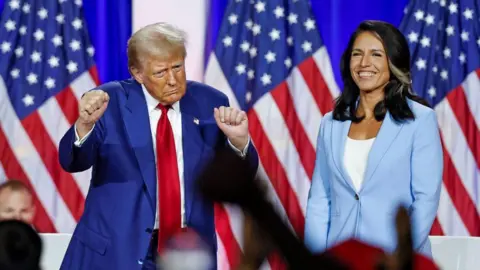
Aboard Air Force One on his surprise early return from the Canadian G7 summit, Trump was asked whether he agreed with March testimony by his director of national intelligence, Tulsi Gabbard, that Iran was not building a nuclear bomb.
“I don’t care what she said,” he told reporters, adding that he believed that Iran was “very close” to a bomb.
During her congressional testimony, Gabbard had said that US intelligence agencies determined that Iran had not resumed its suspended 2003 nuclear weapons programme, even as the nation’s stockpile of enriched uranium – a component of such weapons – was at an all-time high.
After Trump’s Tuesday comments, Gabbard pointed to the level of uranium enrichment as evidence that she and the president “are on the same page” in sharing concerns.
Gabbard was seen as a controversial pick for director of national intelligence, given her past criticism of US intelligence agencies, her willingness to meet with American adversaries like deposed Syrian President Bashar al-Assad and her outspoken anti-interventionist foreign policy views.
The former Democratic presidential candidate, who once endorsed Senator Bernie Sanders in his White House bid, broke with the Democratic Party in 2022 and endorsed Trump last year.
Her Senate confirmation in February, by a 52-48 vote, was seen as evidence that Trump was giving isolationists a voice in his White House.
Despite Gabbard’s assertions to the contrary, the president’s remarks represent a curt dismissal of his intelligence chief’s sworn testimony – and could be an indication that Iran hawks are gaining the upper hand in the White House.
While Vice-President JD Vance, another non-interventionist, has defended Gabbard, he’s also indicated his support for whatever Trump chooses to do in Iran.
“I believe the president has earned some trust on this issue,” Vance wrote on X on Tuesday. “I can assure you that he is only interested in using the American military to accomplish the American people’s goals.
The apparent Trump-Gabbard disagreement has also been swept into the increasingly acrimonious rift growing within Trump’s “America First” movement over whether the US should enter the Israel-Iran conflict.
Those who believe Iran is close to a bomb – including Defence Secretary Pete Hegseth, Iran hawks in Congress and the Israeli government – cite last week’s determination by the International Atomic Energy Agency that Iran was in violation of the Nuclear Nonproliferation Treaty for the first time in 20 years.
Advocates of American non-intervention, like conservative commentator Tucker Carlson and congresswoman Marjorie Taylor Greene, contend that evidence supporting an Iranian bomb is being overstated to justify Iranian regime change and military adventurism.
“The real divide isn’t between people who support Israel and people who support Iran or the Palestinians,” Carlson wrote on X last week. “The real divide is between those who casually encourage violence, and those who seek to prevent it.”
They also point to the 2003 US invasion of Iraq – and say a US attack on Iran, a nation three times as large with twice the population, would be a similarly disastrous foreign policy decision.
The George W Bush administration justified its 2003 invasion by warnings of dire threats to the US from Iraqi weapons of mass destruction, citing intelligence findings that ultimately proved to be unfounded.
“Facing clear evidence of peril, we cannot wait for the final proof – the smoking gun – that could come in the form of a mushroom cloud,” Bush said in an October 2002 televised speech.
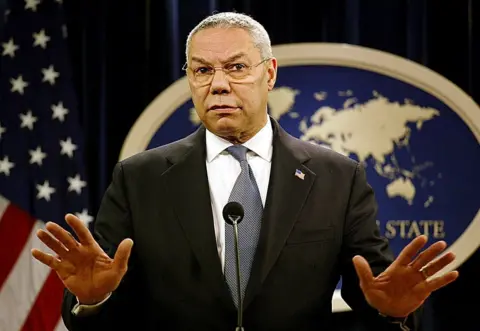
The administration dispatched Secretary of State Colin Powell to the United Nations, where he held up a small vial that he said represented just a small portion of the weaponised anthrax bacteria that Iraqi possessed.
“These are not assertions,” Powell said. “What we’re giving you are facts and conclusions based on solid intelligence.”
Doubts about the veracity of those intelligence findings, as well as the unpopular, expensive and bloody US occupation of Iraq that produced no evidence of weapons of mass destruction, led to Democratic electoral gains in subsequent elections and growing internal dissent among Republicans.
By 2016, Republican dissatisfaction with their political establishment paved the way for Trump, an Iraq War critic, to win his party’s presidential nomination – and the White House.
Nine years later, Trump is contemplating a Middle East military intervention in spite of the conclusions of American intelligence services, rather than because of them.
And while conservatives like South Carolina Senator Lindsey Graham say it is time for regime change, there appears to be little appetite at the White House for the kind of sweeping invasion and nation-building efforts of 2003 in Iraq.
Military operations can develop in unpredictable ways, however.
And while Trump is under different circumstances – and contemplating a different course of action – than his Republican predecessor, the consequences of his decisions to rely on, or dismiss, the findings of his intelligence advisers could be equally significant.
Also read: Iranian missile strike hits hospital in Israel
Featured photo source: Getty images
Source: Anthony Zurcher – BBC
