

Consumers in Cyprus are paying less for petrol and diesel than the EU average, although fuel prices vary considerably between individual filling stations and districts.
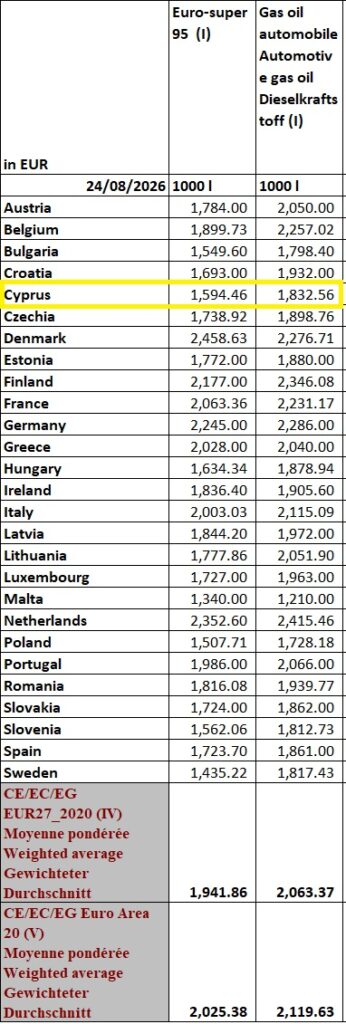
According to the European Commission’s latest Weekly Oil Bulletin, based on prices recorded on 24 August, unleaded 95 petrol in Cyprus cost an average of €1.594 per litre, placing the country sixth-lowest among the EU’s 27 member states.
Only Malta, Sweden, Poland, Bulgaria and Slovenia recorded lower average petrol prices.
Diesel averaged €1.833 per litre in Cyprus.
By comparison, the EU-wide average stood at €1.942 per litre for unleaded 95 petrol and €2.063 for diesel.
Malta has cheapest petrol in EU
The lowest petrol prices were recorded in Malta at €1.34 per litre, followed by Sweden at €1.435, Poland at €1.508, Bulgaria at €1.550 and Slovenia at €1.562.
At the other end of the table, Denmark had the EU’s most expensive petrol at €2.459 per litre, followed by the Netherlands at €2.353 and Germany at €2.245.
Diesel prices also varied substantially across the bloc. Malta recorded the lowest average at €1.21 per litre, while the Netherlands had the highest at €2.415.
The European Commission publishes its Weekly Oil Bulletin every Thursday, providing average retail prices for petroleum products across the EU’s 27 member states. The figures refer to prices recorded on the Monday of the same week.
Prices vary between filling stations
Within Cyprus, consumers can face noticeably different prices depending on where they fill up.
According to figures collected on 27 August by the Consumer Protection Service’s Retail Fuel Price Observatory, the nationwide average for unleaded 95 petrol was €1.599 per litre.
The cheapest petrol available was €1.525 per litre, while the highest price reached €1.685.
For diesel, the nationwide average was €1.846 per litre, with prices ranging from €1.749 at the cheapest stations to €1.929 at the most expensive.
The figures are updated continuously and may therefore change.
Nicosia
The district average for unleaded 95 petrol was €1.589 per litre.
The cheapest price was €1.525 at FILL N GO, 184 Larnakos Avenue, Aglantzia.
The highest prices ranged from €1.659 to €1.669 at stations including EKO in Kato Pyrgos, ESSO on Spyrou Kyprianou Avenue in Strovolos, ESSO on Agiou Nikolaou Street in Engomi, PETROLINA on G. Kranidioti Street in Latsia and ENI on Spyrou Kyprianou Avenue in Strovolos.
For diesel, the district average was €1.839 per litre.
The lowest price, €1.749, was available at FILL N GO on Larnakos Avenue in Aglantzia and FILL N GO on Stadiou Street in Pera Chorio Nisou.
The highest diesel price was €1.899 at ESSO on Spyrou Kyprianou Avenue in Strovolos, EKO in Kato Pyrgos and ENI on Spyrou Kyprianou Avenue in Strovolos.
Limassol
The average price of unleaded 95 petrol in Limassol was €1.605 per litre.
The lowest price was €1.583, available at several stations, including ESSO on Celal Bayar Street, SHELL on Franklin Roosevelt Avenue, PETROLINA on Paphos Avenue, PETROLINA on Arch. Makariou III Avenue, PETROLINA on Misiaouli & Kavazoglou Street, EKO on Franklin Roosevelt Avenue, EKO in Palodia and STAROIL stations on the Limassol-Platres road and Demokratias Street.
The highest price was €1.685 at PETROLINA on Promachon Eleftherias Street in Agios Athanasios.
Larnaca
The district average for unleaded 95 petrol was €1.595 per litre.
The cheapest price was €1.535 at SHELL on the Kalo Chorio road and PETROLINA on Ammochostou Avenue in Kalo Chorio.
The highest price was €1.639 at PETROLINA stations in Kiti, Mazotos and Dromolaxia.
Diesel averaged €1.839 per litre.
The lowest price was €1.777 at SHELL on the Kalo Chorio road and PETROLINA on Ammochostou Avenue in Kalo Chorio.
The highest price was €1.869 at stations in Livadia, Mazotos and Alethriko.
Paphos
Paphos recorded the highest district average for unleaded 95 petrol, at €1.630 per litre.
The cheapest price was €1.609 at ENI in Konia and PETROLINA stations in Geroskipou.
The highest price was €1.659, recorded at several stations across the district, including in Timi, Paphos, Stroumpi, Polis Chrysochous and Mesogi.
Diesel averaged €1.872 per litre.
The cheapest diesel was €1.841 at STAROIL on Chlorakas Avenue, while the highest price was €1.929 at SHELL on Arch. Makariou III Street in Timi.
Famagusta
The district average for unleaded 95 petrol was €1.601 per litre.
The lowest price was €1.587 at EKO on 1st April Avenue in Paralimni, while the highest was €1.619 at ESSO on Griva Digeni Avenue in Paralimni.
Diesel averaged €1.845 per litre.
The cheapest price was €1.832 at STAROIL on Karyon Avenue in Avgorou.
The highest price was €1.859, recorded at ESSO in Paralimni and EKO stations in Ayia Napa, Paralimni and Protaras.
The Consumer Protection Service’s Retail Fuel Price Observatory provides continuously updated information on individual filling station prices.
Also read: Melting glaciers may have fuelled deadly Nepal floods, experts say
For more videos and updates, check out our YouTube channel
