

New excavations in Pompeii have shed light on the final moments of two men who died during the eruption of Mount Vesuvius in 79 AD.
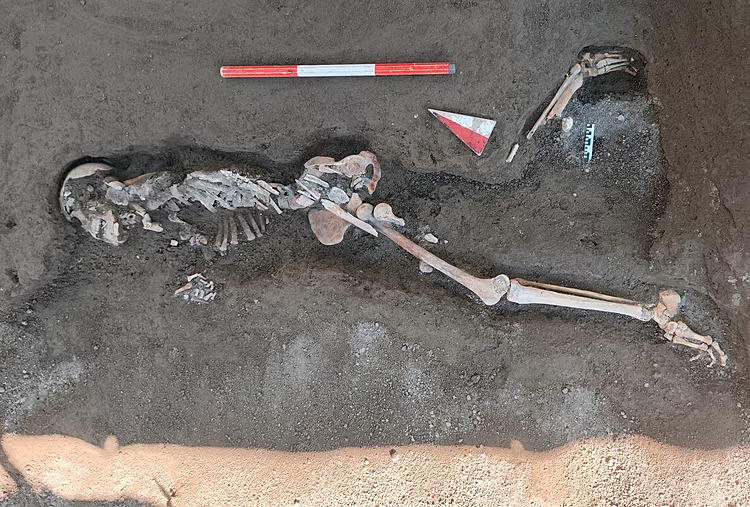
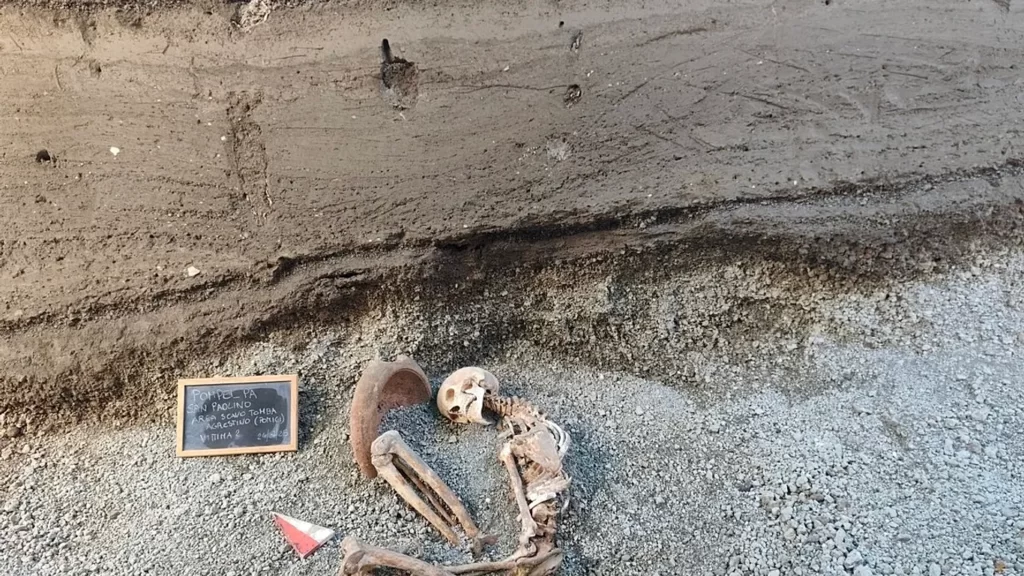
Archaeologists uncovered the remains near the Porta Stabia necropolis, offering rare insight into how victims attempted to escape one of history’s most devastating natural disasters.
The findings reveal two distinct phases of the eruption. One younger man likely died instantly after being caught in a pyroclastic flow — a fast-moving cloud of hot gas and ash.
The second, an older man, appears to have died earlier while fleeing falling volcanic debris. His final act may have been to lift a mortar above his head in an attempt to shield himself.
Nearby, archaeologists found personal items including a ceramic oil lamp, an iron ring and ten bronze coins — evidence suggesting a deliberate attempt to navigate the darkness and escape.
The discovery echoes descriptions by Pliny the Younger, who documented how people tied cushions to their heads to protect themselves from falling debris during the eruption.
For the first time, archaeological evidence appears to confirm such accounts in physical form.
AI helps reconstruct the past
Researchers at the Archaeological Park of Pompeii, in collaboration with the University of Padua, used artificial intelligence to digitally reconstruct one of the victims.
The model combines excavation data with advanced imaging techniques to create a scientifically grounded visual representation of the man’s final moments.
Italian Culture Minister Alessandro Giuli said AI can help preserve and communicate cultural heritage, while Pompeii park director Gabriel Zuchtriegel highlighted its role in managing vast archaeological data.
Experts stress that while AI offers powerful tools, it must complement — not replace — traditional archaeological methods.
Luciano Floridi noted that AI expands research possibilities but produces hypotheses rather than definitive conclusions, requiring careful scientific oversight.
Professor Jacopo Bonetto added that the technology should support interpretation and communication while remaining grounded in rigorous methodology.
A human story across centuries
The discoveries highlight the deeply human dimension of the Pompeii victims, capturing moments of fear, instinct and survival.
Nearly two millennia later, the combination of archaeology and technology continues to bring these stories back to life, offering a powerful connection between the ancient world and the present.
Also read: Lace that travelled: How Lefkaritika reached the Duomo Cathedral
For more videos and updates, check out our YouTube channel
