

One of Cyprus’s most significant theatrical outings in recent years reaches its climax this weekend, as the Cyprus Theatre Organisation takes Euripides’ rarely performed Ion to the Ancient Theatre of Epidaurus, bringing down the curtain on the 2026 Epidaurus Festival.
On Friday 28 and Saturday 29 August, the ancient Argolic theatre will belong to Ion. Directed, translated and dramaturgically adapted by Thomas Moschopoulos, the production arrives in Greece after its summer run across Cyprus, carrying with it not only one of Euripides’ most elusive plays, but a significant moment for Cypriot theatre itself.
The two performances close this year’s programme at the Ancient Theatre of Epidaurus and mark THOC’s return there with a production of its own after an absence of eight years. The organisation’s relationship with Epidaurus stretches back to 1980, when it first appeared at the festival with Euripides’ The Suppliants, directed by Nikos Charalambous. More recently, THOC has reached the Epidaurus stage through collaborations, including the 2019 Suppliants with the National Theatre of Greece and a 2025 co-production with the National Theatre of Northern Greece.
That history gives this weekend a particular weight. THOC President Pantelis Voutouris has described the organisation’s relationship with Epidaurus as a historic one that needs to be renewed, saying the return offers an opportunity for Cypriot theatre to re-enter the consciousness of Greek audiences, particularly younger spectators.
And it is doing so with an unusual choice.
Not quite a tragedy, not quite anything else
Ion is among Euripides’ less frequently staged works, and perhaps one of his most difficult to pin down. It has the architecture of tragedy, yet refuses to behave entirely like one. It moves between darkness and humour, myth and realism, religious mystery and outright scepticism, before arriving at something resembling a happy ending.
At its centre is a deceptively simple question: who are we when the story we have been told about ourselves turns out not to be true?
The young Ion has grown up serving Apollo’s temple at Delphi with no knowledge of his parents. Into this sacred landscape arrive Creusa, daughter of Erechtheus and Queen of Athens, and her husband Xuthus, desperate for an answer to their childlessness.
Apollo appears to provide one. Xuthus is told that the first young man he encounters upon leaving the sanctuary is his son. That man is Ion.
But the audience already knows that the truth is very different.
Ion is Creusa’s son, conceived after she was raped by Apollo and subsequently forced to abandon the child. What begins as a search for an heir therefore opens into something far more unsettling: a story of suppressed trauma, motherhood, power, divine manipulation and a young man attempting to construct an identity from other people’s secrets.
For Moschopoulos, those uncertainties are precisely what make the play feel contemporary. Speaking ahead of Epidaurus, he has argued that Ion resists absolutes at a moment when public life increasingly pushes people towards opposing certainties. His fascination lies in the way Euripides continually destabilises what both his characters and his audience think they know.
It is also the fourth time Moschopoulos has directed at Epidaurus, following Alcestis, Women of Trachis and Iphigenia in Tauris.
Mirrors, doubles and a Delphi that is not what it seems
That ambiguity is built directly into the production.
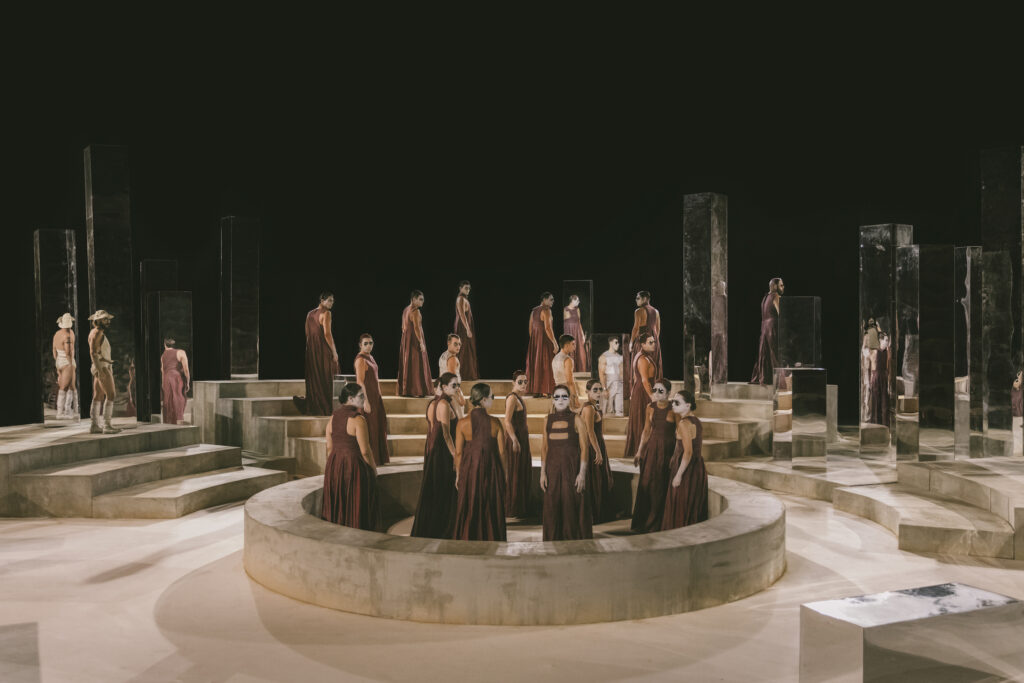
Rather than attempting a historical reconstruction of Apollo’s sanctuary, the visual world created with set and costume designer Vassilis Papatsarouchas plays with reflections, surfaces and appearances. Moschopoulos has described his Delphi as deliberately spectacular but potentially hollow, closer in spirit to an illusion than an archaeological recreation.
Mirrors and shifting reflections repeatedly ask which version of reality can be trusted. Even Hermes, normally a single character, has been divided between two performers, Andreas Koutsoftas and Vasilis Charalambous.
Moschopoulos has also transformed Euripides’ traditionally female Chorus of Creusa’s attendants into a mixed group of men and women, expanding the production’s exploration of gender, violence and the way Creusa’s story is viewed.
The result has already attracted attention following the Cyprus performances. Critics have praised the performance, highlighting its contemporary aesthetic and particularly praising Stela Fyrogeni’s Creusa, as well as the active role given to the large Chorus and Nama Dama’s music. The review described the staging as a coherent theatrical interpretation of the play’s constant movement between knowledge and ignorance, reality and illusion, drama and comedy.
Cypriot reviews also drew attention to the scale of the production, with its large ensemble, imposing costumes, changing reflections, lighting and music moving between irony and passion.
Stela Fyrogeni at the heart of the tragedy
Leading the cast as Creusa is Stela Fyrogeni, in a role that gives the production its emotional centre.
While much of Ion plays games with certainty, Creusa carries something brutally real. Her life has been shaped by the sexual violence she suffered at the hands of Apollo and by years of silence surrounding the child she believed she had lost.
Fyrogeni has described that assault as the key to understanding the character: an event that was never resolved, answered for or allowed an ending, and which continues to determine Creusa until her encounter with Ion.
Her performance has already been singled out in Greek criticism ahead of the Epidaurus dates. Athinorama praised its strength, passion and substance, while other coverage has presented the appearance as an opportunity for a wider Greek audience to encounter one of Cyprus’s leading actresses.
Opposite her, Giannis Tsoumarakis, recipient of Greece’s Dimitris Horn Award for 2025, takes the title role of Ion, while Neoklis Neokleous plays Xuthus and Valentinos Kokkinos the Old Man.
The cast
Giannis Tsoumarakis – Ion
Stela Fyrogeni – Creusa
Neoklis Neokleous – Xuthus
Valentinos Kokkinos – Old Man
Andreas Koutsoftas, Vasilis Charalambous – Hermes, Chorus
Ioannis Varvaresos – Pythia, Chorus
Margarita Zachariou – Athena, Chorus
Dimitris Antoniou – Servant, Chorus
Nikolas Grammatikopoulos, Dimitris Lagoutis – Attendants, Chorus
The Chorus also includes Vasilis Athanasopoulos, Grigoris Georgiou, Maria Drakou, Ioanna Kordatou, Theofanis Kosmas, Marian Kyprianou, Pella Makrodimitri, Theofilos Manologlou, Athina Moustaka, Christos Papadopoulos, Christina Papadopoulou, Ioanna Papamichalopoulou, Chris Spyrou, Maria Tsiakka and Vasilis Charalambous.
The creative team
Direction, translation and dramaturgical adaptation: Thomas Moschopoulos
Associate director: Marios Kakoullis
Set, costumes and visual identity: Vassilis Papatsarouchas
Original music, sound design and vocal coaching: Nama Dama
Movement and choreography: Fotis Nikolaou
Lighting design: Georgios Koukoumas
Assistant set and costume designer / special costume props: Orestis Lazouras
Production associate: Eleni Nikolaou
Music is performed live by Nama Dama on keyboards and vocals, Zinonas Oikonomidis on electric guitar, effects and bouzouki, and Nikolas Tsangaris on percussion and samples.
Cyprus at Epidaurus
There is an added resonance in a Cypriot national theatre organisation taking a story about origins, identity and belonging to one of the most symbolic stages of the Greek-speaking world.
Ion ultimately asks who gets to tell the story of where a person comes from, what happens when myth collides with an uncomfortable truth and whether identity is inherited, imposed or constructed.
More than two millennia after Euripides wrote it, those questions have lost little of their force.
And on 28 and 29 August, as THOC returns to Epidaurus in its own right and closes one of Greece’s most important theatrical festivals, they will be asked beneath the open sky of a theatre where ancient drama has been tested, challenged and reinvented for generations.
Performances: Friday 28 and Saturday 29 August 2026
Venue: Ancient Theatre of Epidaurus
Time: 21:00
Tickets: Available through More.com.
