

A decade on, economists see a clearer picture
Ten years after the United Kingdom voted to leave the European Union, the economic consequences of Brexit are becoming easier to assess.
While the immediate fears of a deep recession following the 2016 referendum did not materialise, a growing body of research suggests that the UK’s economy is smaller than it would have been had it remained in the EU.
Measuring the Brexit economic impact is not straightforward. Economists must compare today’s economy with a hypothetical scenario in which Brexit never happened, while also accounting for major global events such as the Covid-19 pandemic, the war in Ukraine and more recent energy shocks.
Despite these challenges, most studies now point in the same direction: Brexit has had a measurable negative effect on trade, investment and economic growth.
Trade with Europe has declined
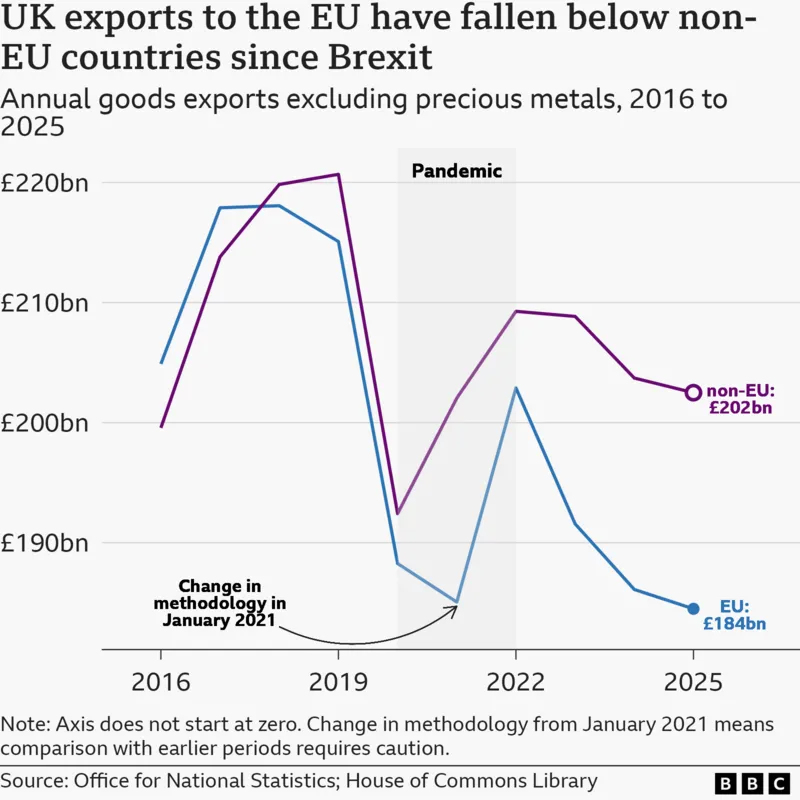
One of the clearest areas of impact has been trade with the European Union.
Although the post-Brexit agreement signed in late 2020 eliminated tariffs on most goods, British businesses still face customs declarations, regulatory paperwork and other administrative requirements that did not exist when the UK was part of the single market.
For many companies, particularly smaller exporters, these additional barriers have increased costs and complexity.
Official figures show that compared with 2019, UK exports to the EU were around 14% lower in 2025, while imports were down by about 10%.
Research also suggests that many businesses have stopped exporting certain products to European markets altogether because the costs of compliance outweigh the benefits.
The experience of smaller exporters has been particularly challenging, with thousands of firms reportedly ceasing exports to EU countries in recent years.
Small businesses have felt the pressure
One example highlighted by the BBC is Eskimo, a Bristol-based company producing energy-efficient electric radiators.
Before Brexit, around 40% of its exports were destined for EU markets. By 2025, that figure had fallen to just 5%.
The company says tariffs were not the problem. Instead, additional paperwork, delays and regulatory requirements discouraged customers and complicated sales.
Similar experiences have been reported by many smaller businesses that previously relied on frictionless trade with European customers.
Services have performed better
Not all sectors have struggled.
The UK’s services industry, which accounts for more than 80% of economic activity, has continued to grow strongly since the referendum.
Exports of services to the EU have risen significantly over the past decade, particularly in areas such as legal services, accountancy, consultancy and professional advice.
Financial services have also proved more resilient than many analysts predicted during the referendum campaign.
This has helped offset some of the weaknesses seen in goods trade and has provided an important source of economic growth.
Investment has suffered
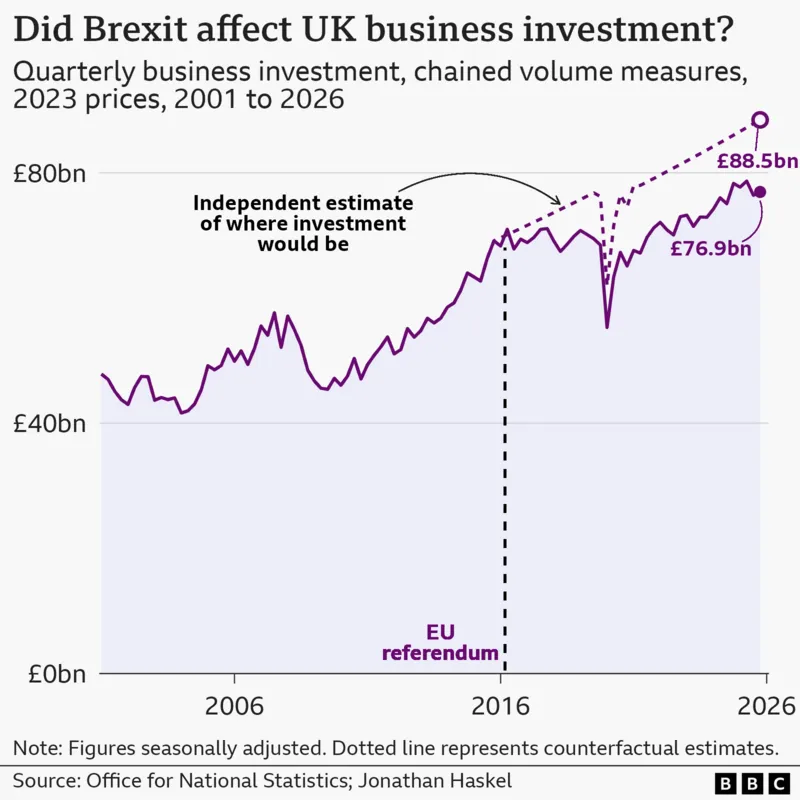
Another area where economists identify a Brexit effect is business investment.
Several major studies conclude that companies invested less in the UK following the referendum than would normally have been expected.
Many businesses delayed expansion plans during years of political uncertainty as successive governments negotiated the terms of Britain’s departure from the EU.
Researchers estimate that business investment may be around 12% to 13% lower than it would otherwise have been.
Lower investment can have long-term consequences because it often affects productivity, innovation and future economic growth.
Some economists argue that uncertainty surrounding the Brexit process itself caused almost as much damage as the new trading barriers introduced afterwards.
The pound remains weaker
The value of the pound fell sharply following the referendum result and has generally remained below pre-Brexit levels against major currencies.
A weaker currency makes imports more expensive, contributing to higher prices for consumers and businesses purchasing goods from abroad.
At the same time, it can make British exports more competitive internationally by lowering their relative cost in foreign markets.
While sterling has recovered from some of its lowest post-referendum levels, it has never returned to the highs seen before the vote.
Trade deals bring limited gains
Supporters of Brexit argued that leaving the EU would allow Britain to negotiate its own trade agreements around the world.
Since 2020, the UK has signed a number of deals, including agreements with countries such as India and participation in the Comprehensive and Progressive Agreement for Trans-Pacific Partnership (CPTPP).
However, the British government’s own assessments suggest that these agreements are likely to increase economic growth only modestly over the long term.
Economists generally agree that the gains from new trade deals are unlikely to fully compensate for reduced trade with the UK’s largest and closest market, the European Union.
How large is the economic cost?
The biggest question remains how much smaller the economy is because of Brexit.
Different studies reach different conclusions, but many estimate that the UK economy is between 3% and 8% smaller than it would otherwise have been.
Recent research from leading economists suggests the figure may be around 6%, with lower trade and reduced business investment accounting for most of the difference.
While such estimates involve assumptions and modelling, the broad consensus among economists is that Brexit has reduced economic growth compared with the path the UK appeared to be following before 2016.
The debate is far from over
Ten years after the referendum, Brexit remains a defining issue in British politics and economics.
The global environment has changed dramatically since 2016. The United States has adopted a more protectionist approach to trade, China has become increasingly assertive and the European Union has introduced new industrial policies aimed at supporting domestic manufacturing.
Against that backdrop, questions about Britain’s future relationship with Europe continue to evolve.
Some argue that the UK should seek closer economic ties with the EU to reduce barriers to trade, while others believe the flexibility gained from leaving the bloc will prove increasingly valuable in a changing world.
What is clear is that Brexit’s economic effects are still being felt. A decade after voters chose to leave the European Union, the debate over its costs, benefits and long-term consequences remains far from settled.
Source: Adapted from BBC analysis
Also read: Cypriots report modest financial improvement, but pressures persist
For more videos and updates, check out our YouTube channel
