

President Christodoulides meets Egyptian Oil Minister

Date:

President Nikos Christodoulides received Egyptian Oil Minister, Karim Badawi, at Presidential Palace on Wednesday. Badawi participates in Cyprus EU Council Presidency official launch ceremony.

Christodoulides highlighted deepening Cyprus-Egypt strategic partnership. “Among basic priorities of our Presidency: bringing EU closer to region, closer to Egypt,” Cyprus President declared.

Egypt as EU strategic partner

“Egypt constitutes EU strategic partner,” Christodoulides affirmed. Egypt functions as regional stability pillar confronting multiple challenges while opportunities emerge through Cyprus-Egypt collaboration.

President referenced extensive bilateral cooperation frameworks including trilateral Cyprus-Egypt-Israel mechanisms. Energy connectivity emerges central theme during Cyprus EU Presidency semester.

Energy agenda prioritised

“Energy constitutes basic agenda item,” Christodoulides confirmed. Thursday meeting scheduled with ENI senior executive advancing natural gas development projects. “Timing proves critical requiring coordination for swiftest possible developments,” he stressed.

Cyprus leverages EU Presidency promoting regional energy corridors integrating East Mediterranean gas resources with European markets. Strategic projects include Great Sea Interconnector electricity interlink.

Bilateral affirmations exchanged

Badawi congratulated Cyprus EU Council Presidency assumption. “Two countries strategic partners,” Egyptian Minister unequivocally stated, reaffirming deepening Cairo-Nicosia coordination across multiple domains.

Cyprus positions strategically bridging EU institutional interests with regional Mediterranean stability imperatives. EU Presidency facilitates enhanced Egypt-EU cooperation confronting shared security challenges.

Regional geopolitical context

Cyprus-Egypt partnership gains heightened significance amid regional volatility. Bilateral cooperation extends energy security toward security, counter-terrorism, migration management cooperation frameworks.

Christodoulides’ ENI meeting underscores urgency accelerating hydrocarbon exploration, development timelines. Cyprus EU Presidency facilitates EU investment frameworks supporting East Mediterranean energy diversification strategies.
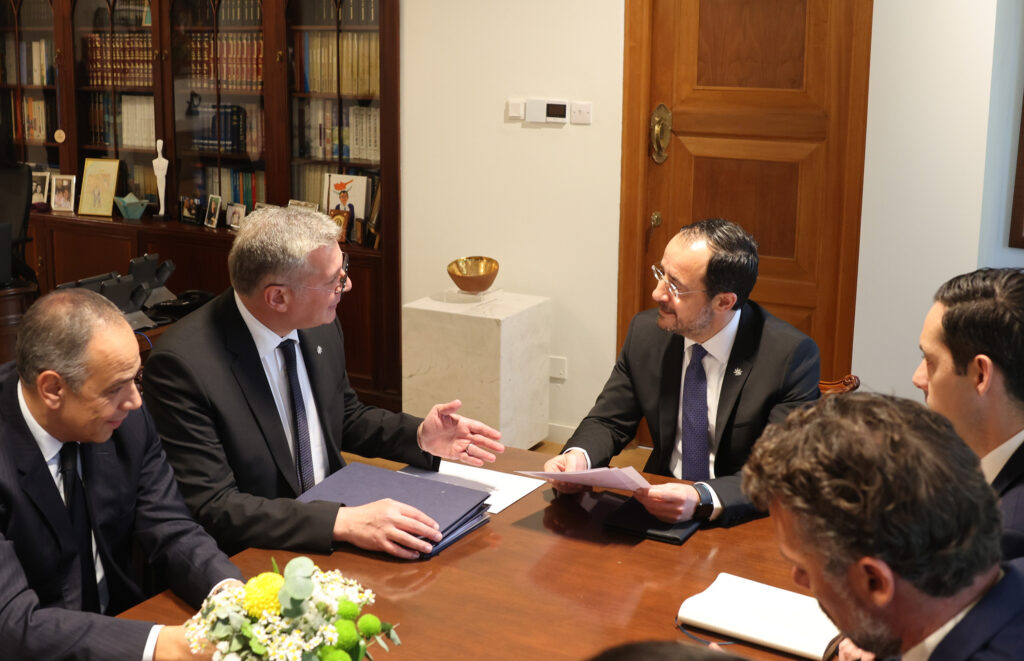
The President of the Republic, Mr. Nikos Christodoulides, receives the Minister of Oil and Mineral Resources of the Arab Republic of Egypt, Mr. Karim Badawi, at the Presidential Palace, Nicosia, Cyprus.

Source: AlphaNews


Also read: Zelensky welcomed by Christodoulides at Presidential Palace

For more videos and updates, check out our YouTube channel.

Share post:

Popular

More like this
Related

ON THIS DAY: 3.4-billion-year-old fossils revealed (1977)

On 23 October 1977, palaeontologist Elso Barghoorn announced the discovery of fossilised single-celled organisms estimated to be 3.4 billion years old, offering remarkable evidence of life on the early Earth. The announcement highlighted the possibility that microscopic life had emerged relatively early in Earth's history, long before plants, animals or other complex organisms appeared. Barghoorn was known for his pioneering work in palaeobiology, particularly his research into ancient microorganisms and the origins of life. Why ancient microfossils matter Unlike the fossilised bones and shells commonly associated with prehistoric life, ancient microfossils can be extremely difficult to identify. Their structures are tiny, and geological processes over billions of years can alter or obscure their original appearance. Researchers study these specimens to understand when life first appeared, what early organisms may have looked like and the environments in which they survived. Evidence of such ancient life is also important to astrobiology, as scientists investigate whether similar conditions might have supported microorganisms elsewhere in the solar system. The continuing search for Earth's earliest life The interpretation of some of the world's oldest proposed microfossils remains a subject of scientific debate. Structures that resemble microorganisms can sometimes form through non-biological processes, making independent chemical and geological evidence essential. Nevertheless, Barghoorn's work helped establish the study of ancient microscopic life as a major field of scientific research. Nearly half a century after his 1977 announcement, the search for Earth's earliest organisms continues to reshape our understanding of how life began.

Supreme Court upholds New Hampshire student ID limits

The Supreme Court on Thursday allowed New Hampshire officials...

Trump asked Google to rename Atlantic Ocean

Donald Trump said Google rejected his request to rename...

Magnitude 7 earthquake in Tiber kills 16

At least 16 people have died and dozens were...