

What to know about Zohran Mamdani as New York City mayor

Date:

It’s official: Zohran Mamdani is New York City mayor, meaning the biggest city in the US now has its first Muslim and first South Asian mayor.

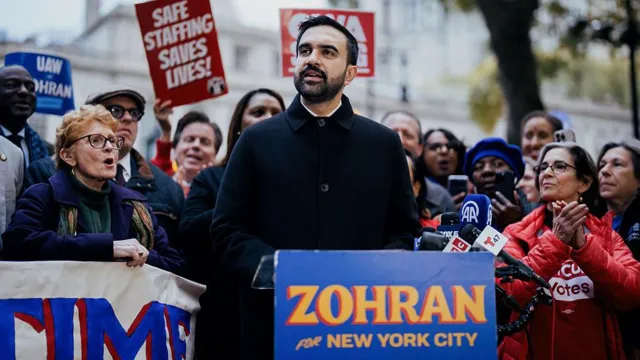
Since democratic socialist Zohran Mamdani first entered New York City’s mayoral race, the 34-year-old state assemblyman from Queens has had a meteoric rise from near-total obscurity into the national spotlight.

His bold, left-wing platform has energised progressives, shaken up his Democratic Party, and drawn harsh criticism from President Donald Trump and other Republicans.

“Today we have spoken in a clear voice: hope is alive,” Mamdani told supporters after triumphing in the contest.

Unlike his more established opponents, Mamdani’s new perspective, youth and new left-wing platform excited and ultimately won over voters eager for a fresher politician.

“Let City Hall, with our compassion, our conviction and our clarity, be the light that our city and our nation so desperately need,” Mamdani said on the week he was elected.

Birth in Uganda and Muslim faith

Born in Uganda, Mamdani moved to New York with his family aged seven. He attended the Bronx High School of Science and later earned a degree in Africana Studies from Bowdoin College, where he co-founded the campus chapter of Students for Justice in Palestine.

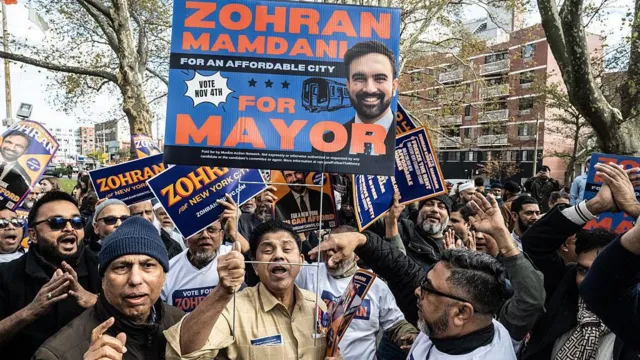
The millennial progressive has leaned into his roots in a diverse city. He has also made his Muslim faith a visible part of his campaign. He visited mosques regularly and released a campaign video in Urdu about the city’s cost-of-living crisis.

“We know that to stand in public as a Muslim is also to sacrifice the safety that we can sometimes find in the shadows,” he said at a rally.

Mamdani and his wife, 27-year-old Brooklyn-based Syrian artist Rama Duwaji, met on the dating app Hinge.

His mother, Mira Nair, is a celebrated film director and his father Professor Mahmood Mamdani teaches at Columbia. Both parents are alumni of Harvard University.

Before entering politics, he worked as a housing counsellor, helping low-income homeowners in Queens fight eviction.

Like his opponents, Mamdani’s mayoral campaign focused heavily on making the city safer and more affordable.

But he pushed more radical ways to accomplish those goals – some of which will be uncharted territory for New York City and Mamdani as the new mayor.
Connection with younger voters

Part of what made Mamdani so successful during his campaign was that younger voters perceived him to be authentic on social media, says Jane Hall, communications professor at American University.

“You don’t have to be young to be able to do it, but I think you have to be seen as being authentic and speaking to what people care about in a way that is hip and makes people want to be on the bandwagon,” Prof Hall said.

Mamdani’s critics have argued that he does not have enough experience to lead the largest US city effectively.

Trump has tried to paint him as radical, repeatedly calling him a communist, though Mamdani has frequently rejected that label. The president also has threatened to withhold federal funds from a Mamdani administration.

As New York City mayor, Mamdani followed the announcement of his victory by addressing the president directly: “Donald Trump, since I know you’re watching, I have four words for you: Turn the volume up. To get to any of us, you will have to get through all of us.”

Trump promptly posted on social media: “…AND SO IT BEGINS!”

Andres Bernal, former policy adviser to New York Representative Alexandria Ocasio-Cortez, says Democrats can learn from Mamdani’s ability to connect with people.

“Today’s Republicans shape public discourse and they try to shape political consciousness in this country,” Bernal argued. “While Democrats kind of just assume that people have fixed beliefs and they look at polls and say, okay, how do we match what we say to what we think people believe?”

Rent freeze plan

The high cost of housing is one of residents’ most common gripes about living in the city that never sleeps.

Average rent for a one-bedroom apartment in Manhattan in November 2025 is $4,778 (£3,666), a nearly 20% increase from three years prior, according to apartment listings site RentHop. And in Brooklyn, average rent for a 1-bedroom is $3,625, about a 5% increase, according to RentHop.

One of the most talked-about points in Mamdani’s housing plan is freezing rent for four years on the city’s one million rent-stabilised apartments.

“This is a city where one in four of its people are living in poverty, a city where 500,000 kids go to sleep hungry every night,” Mamdani told the BBC over the summer. “And ultimately, it’s a city that is in danger of losing that which makes it so special.”

But researchers at Maverick Real Estate Partners argue that the four-year rent freeze would be “catastrophic” for many building owners, permanently reducing their net operating income.
Pledges on groceries, childcare and buses

Mamdani ran on a campaign of making the most expensive US city affordable for its residents beyond simply housing.

One of his more novel ideas is creating a network of city-owned grocery stores across New York’s five boroughs, expanding on the six city-owned stores. Shopping in such shops would be cheaper for customers.

But critics have argued that Mamdani’s proposal ignores complex logistical realities of the food supply chain.

He also wants to make public buses free – the current fare for most riders is $2.90 – and he plans to make them faster. While Mamdani has estimated that his plan would cost the city $630m a year, the chair of the MTA told the Gothamist website that it would be closer to $1bn.

Also on Mamdani’s agenda is lowering the cost of childcare, citing the experiences of friends who have told him they are leaving the city due to the high costs.

To help pay for his plans, Mamdani wants to raise the corporate tax rate to 11.5%, matching the top end of New Jersey’s range. The corporate tax rate in New York City currently goes up to 7.25%.

He also wants to add a flat 2% tax for New Yorkers who make more than $1m a year. The campaign said these hikes would raise $9bn, but how they would be raised remains a question. Kathy Hochul, the governor of wider New York state, has also said she won’t support the new mayor’s plan to increase taxes on the wealthy.

Mamdani wants to raise the city’s minimum wage – currently $16.50 per hour – up to $30 per hour by 2030.

But critics have argued that it would put many lower-skilled workers out of work and force them out of the city.

Quality of life is another major concern for New Yorkers: only 34% of them ranked the city’s as excellent or good in 2025, down from 51% in 2017, according to a survey from the Citizens Budget Commission.

A flagship element of Mamdani’s platform is creating a department of community safety, which would expand city mental health services, including building a system for mental health workers to respond to related 911 calls, instead of police.

Mamdani’s Republican opponent Curtis Sliwa criticised the plan, saying it’s unrealistic and unsafe for social workers to respond to potentially violent situations.

Views on Israel-Gaza war

Mamdani’s strong support of Palestinians and staunch criticism of Israel goes further than most of the Democratic establishment.

As an assemblyman, he introduced a bill to end the tax-exempt status of New York charities with ties to Israeli settlements that violate international human rights law.

He has said he believes Israel is committing genocide in Gaza, is an apartheid state, and that the Israeli Prime Minister Benjamin Netanyahu should be arrested. Israel vehemently rejects accusations of genocide and apartheid.

Mamdani has been pressed numerous times by press in interviews to state whether he supports Israel’s right to exist as a Jewish state. In a response, he said: “I’m not comfortable supporting any state that has a hierarchy of citizenship on the basis of religion or anything else, I think that in the way that we have in this country, equality should be enshrined in every country in the world.” Israel says all religions have equal rights under the law.

Mamdani has also said that there is no room for antisemitism in New York City, adding that if he were elected, he would increase funding to combat hate crimes.

The rise of Mamdani to New York City mayor marks a new political chapter for the city- one that blends activism, identity and ambitious reform.

Source: BBC


Also read: Polls open- five things to watch in US elections
For more videos and updates, check out our YouTube channel

Share post:

Popular

More like this
Related

Cyprus organised crime unit targets entire networks

Cyprus's new Directorate for Combating Organised Crime (DAOE), dubbed the country's FBI, will focus on dismantling entire criminal networks rather than simply investigating individual cases. Speaking on SIGMA's Mesimeri kai Kati programme, DAOE Director and Drug Law Enforcement Unit (YKAN) Commander Christos Andreou explained that the new Cyprus organised crime unit would adopt a more targeted approach to investigations, combining intelligence gathering, financial scrutiny and international cooperation. Although the directorate officially begins operating under its new organisational structure on Monday, its operational activities have been under way since the beginning of 2026. According to Andreou, four major organised crime cases have already been completed during this period. These include two cases in May that resulted in the arrest of three people, a conspiracy to commit murder involving plans to kill two individuals who were due to arrive in Cyprus, and a major operation in which more than 420 kilograms of ketamine were seized. Andreou described the past several months as an important period of operational preparation, during which shortcomings and problems were identified to ensure the directorate could function effectively from its official launch. Four pillars of intelligence-led policing The directorate will operate according to the principles of intelligence-led policing, with its activities organised around four main pillars. The first is the Intelligence and Special Operations Subdirectorate, responsible for gathering and handling intelligence. The second is YKAN, the Drug Law Enforcement Unit. The third is the Organised Crime Subdirectorate, which will include investigators responsible for organised crime cases beyond drug-related offences. The fourth is the Strategic Analysis, International and European Relations Subdirectorate. Under this structure, intelligence will be collected, assessed and analysed before targeted investigations proceed once sufficient evidence has been obtained. Andreou said the fundamental difference would be how information is used and how investigations develop beyond the initial offence. Investigations will not stop at individual cases Andreou emphasised that investigations would no longer be limited to the specific offence that initially brought a criminal organisation to the attention of police. Previously, criminal and financial investigations tended to concentrate on the individual case under examination. The new approach aims to continue investigating until the entire criminal network behind an offence has been identified and dismantled. "We will not stop there. We will proceed to dismantle and break up entire criminal networks that emerge from a single case," he said. This will involve more specialised and targeted investigations, with strict safeguards to protect intelligence and minimise the risk of leaks. Andreou cited the first two cases investigated under the new structure as examples. Investigations began in January 2026, with arrests following in May, without any information being leaked. "When there are leaks, whether major or minor, they certainly affect investigative work. That is when we lose certain evidence and witness testimony," he explained. Strict selection criteria and confidentiality Staffing will play a central role in maintaining the confidentiality of investigations. The directorate will operate from its own building, while officers are selected according to specific criteria, including experience, discretion and personal character. Andreou stressed that the team had managed to operate without information leaks in the cases it handled between January and the time of the interview. However, he declined to disclose the exact number of officers assigned to the directorate. He explained that staffing levels could increase and the four-pillar structure could be expanded, depending on operational requirements. International cooperation against criminal networks Andreou highlighted the international nature of organised crime, explaining that criminal networks operating in Cyprus are not necessarily confined to the island or composed exclusively of Cypriot nationals. One part of a criminal organisation may operate in Cyprus while another is based elsewhere in Europe or in a third country. He used drug trafficking as an example, explaining that one group may arrange shipments from abroad while another network handles distribution and sales within Cyprus. For this reason, the Cyprus organised crime unit will cooperate with law enforcement agencies in other countries through Interpol and Europol, as well as with relevant services within Cyprus. Such cooperation is intended to help investigators identify and dismantle criminal organisations operating across national borders. Financial investigations to weaken criminal organisations Financial investigations will be another central element of the directorate's work. Andreou explained that financial resources are among the main factors allowing criminal organisations to expand their activities. "We want to dismantle them because financial power strengthens criminal networks," he said. According to Andreou, access to substantial funds allows criminal organisations to acquire more advanced technology, recruit additional members and expand the range of their illegal activities. The directorate therefore intends to investigate not only the crimes themselves but also the financial structures supporting them. The objective, he said, is to dismantle criminal networks "from beginning to end, at their roots". Police seek additional surveillance powers Asked about technological developments in organised crime, particularly the use of encrypted communication applications, Andreou said police needed access to additional investigative tools. He specifically referred to legislation concerning the interception of telephone communications, which remains pending. The YKAN commander described such powers as particularly important,...

Couple tied up in Limassol armed home robbery

Five masked intruders armed with knives and a handgun...

Christa Pike angry and confused after failed execution

Christa Pike was “angry and confused” in the hours after regaining consciousness following Tennessee’s failed execution attempt, first asking, “Where am I?” her lawyer said Wednesday. Pike, believed to be the first person to survive after receiving lethal injection drugs during an execution, stunningly woke up as plans were being made to remove her from life support, just six days after she was strapped to a gurney in the death chamber, said attorney Randy Spivey. “But on Tuesday, to the shock of everyone ... Christa woke up and began talking,” Spivey said. Pike, who was sentenced to death for the 1995 beating and stabbing death of classmate Colleen Slemmer, is aware of what happened to her, at least up to a point, Spivey said. Many questions remain, though, about her prognosis for recovery and whether Tennessee will make another attempt to execute Pike, now age 50. Her lawyers said Wednesday that she has suffered enough and want the governor to commute her sentence. A judge in Nashville told the state on Wednesday to save evidence from the execution attempt as Pike’s attorneys try to find out more. The failed execution on Sept. 30 has renewed scrutiny of how states carry out the death penalty, in particular the use of lethal injection. Texas on Wednesday carried out the first execution in the U.S. since Tennessee attempted to put Pike to death. Pike faces a long recovery, lawyer says Pike’s legal team said she still can’t move her arms or swallow and has some cognitive confusion. She also has pneumonia and a blood clot in her arm, Spivey said. Her hands were extremely swollen when they saw her Tuesday in the hospital, shackled to a bed, he added. Her prognosis remains unclear and she has a long road to recovery, he said. “She is angry and confused about everything right now,” Randy Spivey said during a news conference following a court hearing about preserving evidence. Spivey, who was not with Pike when she woke up, was told her first words were, “Where am I?” and “Who are you?” Pike’s attorneys want evidence preserved The Death Penalty Information Center says Pike is the first person to survive after receiving lethal injection drugs during an execution. At the hearing Wednesday, a judge told the state that the Tennessee Department of Correction needs to save evidence including “anything that was in the actual room.” Chancery Court Judge I’Ashea Myles said she plans to issue a sweeping order that will direct the state to maintain recordings, witness accounts, emails, drugs, syringes, IV lines and other medical items. The Tennessee Attorney General’s Office had argued a court order was unnecessary. John W. Ayers, assistant attorney general, said some evidence from the death chamber already had been collected and logged. He declined to comment after the hearing. Pike’s attorneys accused the state of carrying out the attempted execution in secrecy, saying more transparency is needed. They also repeated their calls for clemency for Pike. Republican Gov. Bill Lee has not yet indicated how he’ll respond. Outside the courthouse, Michelle Nowell yelled “Justice for Colleen” as Pike’s attorneys talked with supporters. “The victim is Colleen. The victim is not Christa Pike,” said Nowell, who was among a group outside the prison last week where the failed execution took place. What happened in the execution chamber remains unclear The governor postponed the state’s only other execution for...

Protests spread across Europe

Student protests are spreading across several European countries, with...