

The World Health Organization (WHO) has declared the DR Congo Ebola outbreak a public health emergency of international concern amid fears the virus is spreading faster than initially believed.
Health officials say the outbreak is especially concerning because it involves the rare Bundibugyo strain of Ebola, for which there is currently no approved vaccine.
Hundreds of suspected cases reported
According to officials, around 600 suspected cases have been recorded in the Democratic Republic of Congo, with at least 139 deaths linked to the virus.
The outbreak is concentrated mainly in Ituri province in eastern DR Congo, though confirmed cases have also emerged in North Kivu and the city of Goma.
A further Ebola-related death was reported in neighbouring Uganda after an infected traveller arrived from DR Congo.
Conflict complicates response efforts
The outbreak is unfolding in conflict-affected areas where armed groups operate and hundreds of thousands of people have been displaced.
Medical teams face major logistical difficulties due to insecurity, poor road infrastructure and population movements across porous borders.
Aid organisations and health officials also warn that misinformation and distrust remain obstacles, with some communities reportedly attributing Ebola to witchcraft or mystical causes.
Symptoms and transmission
Ebola is a severe viral disease transmitted through contact with infected bodily fluids such as blood or vomit.
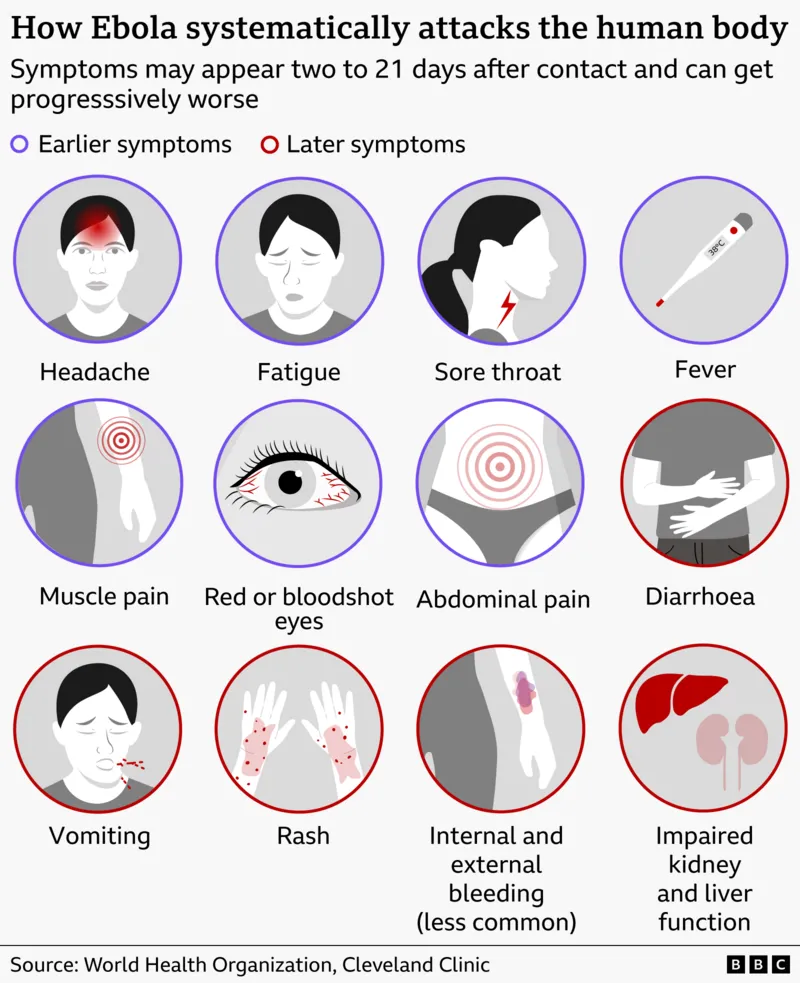
Symptoms usually appear between two and 21 days after infection and initially resemble flu or malaria, including fever, headache and fatigue. As the disease progresses, patients may develop vomiting, diarrhoea, organ failure and, in some cases, internal and external bleeding.
No approved vaccine for current strain
Unlike previous Ebola outbreaks, no approved vaccine currently exists for the Bundibugyo strain involved in the current crisis, although experimental vaccines are under development.
Health experts are also concerned about underreporting, with modelling suggesting the true number of active infections may exceed 1,000 cases.
Regional measures intensified
Several neighbouring countries, including Rwanda and Uganda, have strengthened border controls and public health measures to limit transmission risks.
Uganda has advised the public to avoid physical contact such as handshakes and hugs, while Rwanda has temporarily closed its border with DR Congo.
The WHO has allocated nearly $4 million to support containment efforts, treatment centres and emergency response operations.
Information from BBC
Also read: DR Congo cancels World Cup training camp over Ebola
For more videos and updates, check out our YouTube channel
