

Turkey has mapped 172 Turkish military cemeteries and memorials across 48 countries as part of an extensive programme by the Turkish Ministry of Defence to document the presence of military personnel and state officials who died away from their homeland.
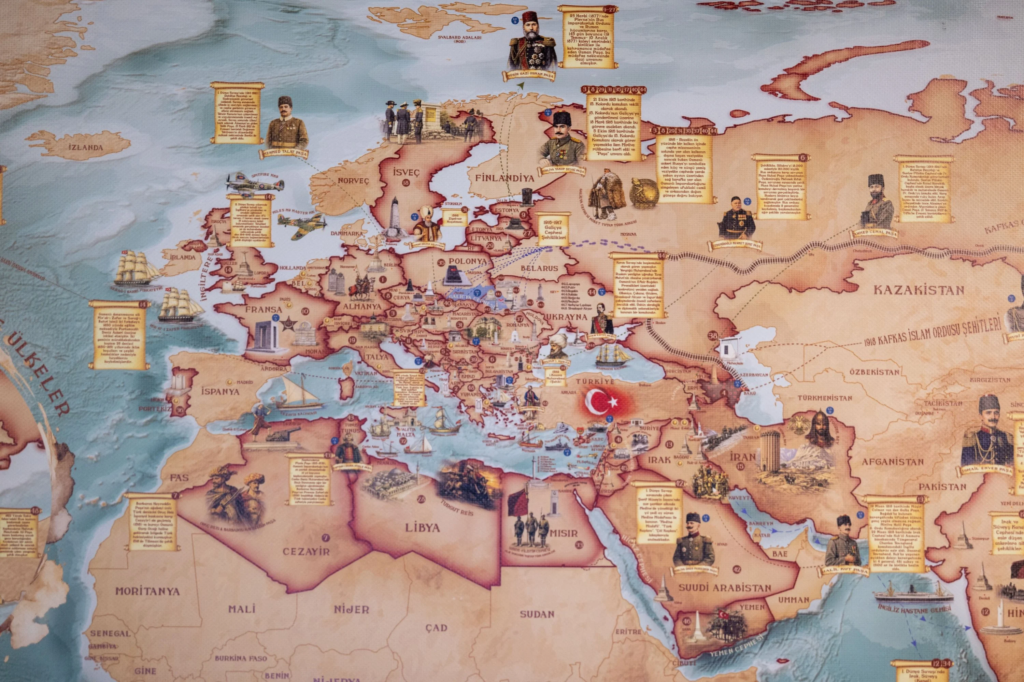
The “Map of Turkish Military Cemeteries and Memorials Abroad” was compiled by the General Directorate of Mapping of the Turkish Ministry of Defence following approximately one year of research. The map covers locations across several continents and has been published online.
According to Lieutenant Colonel Fatih Kale, who coordinated the project, information was collected in cooperation with the Turkish Ministry of Foreign Affairs and the Turkish Cooperation and Coordination Agency (TİKA), before being cross-checked with academic and military institutions.
Kale said the number of recorded locations could increase, as historical sources indicate the existence of additional graves in villages and former battlefields that have yet to be documented.
Cemeteries in Cyprus, Greece and Israel
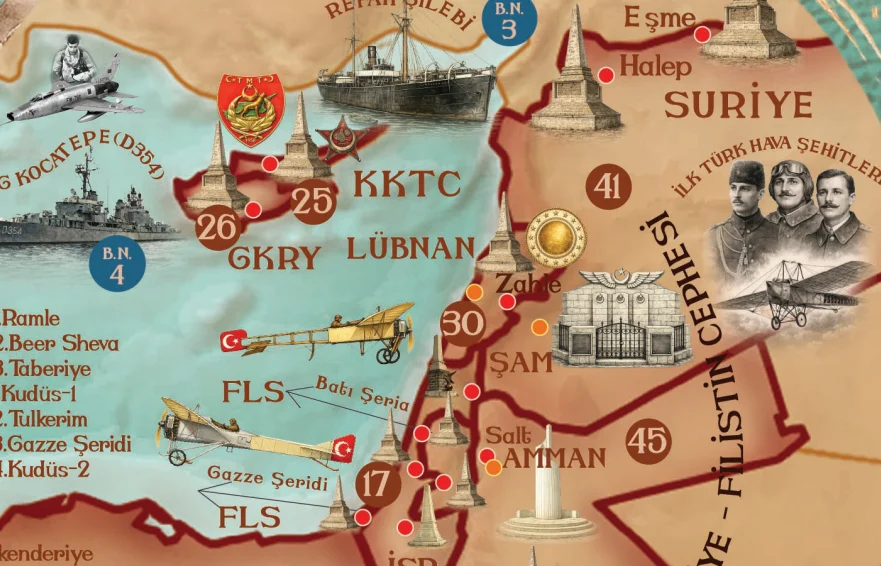
The mapping is particularly extensive in the occupied areas of Cyprus, where the Turkish Defence Ministry’s map lists more than 20 military cemeteries and memorials. Matching the Turkish place names with their Greek or historical names, these include Sinta (İnönü), Bogazi (Boğaz), Ortaköy in Nicosia, Vouno (Taşkent), Kioneli (Gönyeli), Agios Georgios in Kyrenia (Karaoğlanoğlu), Ampelikou (Bağlıköy), Vasileia (Karşıyaka), Tziaos (Serdarlı), the Astromeritis/Taşpınar area – where caution is required regarding the precise geographical correspondence – Lapithos (Lapta), and other locations.
The Turkish map places most of these within the period of intercommunal violence and the Turkish invasion, stating that they concern military personnel, police officers, Turkish Cypriot fighters and civilians killed between 1963 and 1974.
A separate case is the so-called “Çanakkale Şehitliği” in Famagusta, which concerns Ottoman prisoners of war transferred to Cyprus by the British during the First World War. According to the Turkish records, there are 35 identified graves at the site, while the total number of deaths associated with the cemetery stands at 217.
The map also includes images of the ships Refah and TCG Kocatepe in honour of crew members who died at sea and therefore do not have individual graves.
The TCG Kocatepe was sunk in July 1974 during the Turkish invasion of Cyprus after it was mistakenly attacked by Turkish military aircraft.
Greece: The map records five main cases. In Corfu, it identifies a cemetery for Turkish prisoners who died in Greece during the Greco-Turkish War of 1897, the Balkan Wars, the First World War and the Asia Minor Campaign, with three mass graves.
In Piraeus, a cemetery established in 1859 is recorded as containing 26 individual graves, while, according to the map, the number of people buried in mass graves remains unknown.
On Chios, the “Sakız Kara Ali Şehitliği” is linked to the Ottoman suppression of the Greek Revolution on the island in 1822, with the map stating that 2,776 Turks were buried there.
In Rhodes, a cemetery containing a total of 241 graves is recorded, while on Lemnos, at the Muslim cemetery of Moudros, the map refers to 57 Turkish soldiers who died as prisoners of war between 1917 and 1919.
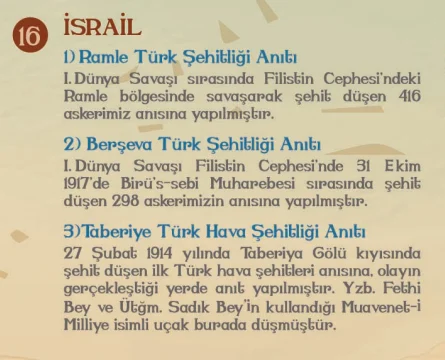
Israel: Three entries concern the territory of present-day Israel and are connected with the Ottoman presence in Palestine.
In Ramla, according to the map, there is a memorial dedicated to 416 Ottoman soldiers killed on the Palestine front during the First World War, while in Beersheba there is a memorial to 298 soldiers killed in the battle of October 31, 1917.
In Tiberias, the map also records a memorial to two Turkish aviators who died on February 27, 1914, when their aircraft crashed near the Sea of Galilee.
From Yemen and India to Siberia
Particular emphasis was placed on historically representing the different periods. Researchers sought to accurately depict the military uniforms, weapons, equipment, ships and aircraft associated with each era.
The map includes, among other things, depictions of Turkish and Ottoman soldiers who served in regions such as Yemen and India, as well as Ottoman ships and military aircraft.
The Trans-Siberian Railway is also depicted in memory of Ottoman soldiers who were held in areas along its route during the First World War.
At Brookwood Cemetery in Britain, where Turkish military personnel are buried, aircraft associated with the deceased were even depicted with their historical tail numbers, according to Kale.
An “evolving project”
The programme is not limited to military personnel. It also includes diplomats, members of the security forces and government officials who died while serving on Turkish missions abroad, including cases in which their remains were subsequently repatriated and buried in Turkey.
Turkish authorities say the map is an evolving project that can be updated as historical research identifies additional military cemeteries, memorials or previously unknown burial sites.
Also read: Apollonion: Patient’s surgery successful- “OKYPY statements inaccurate”
