

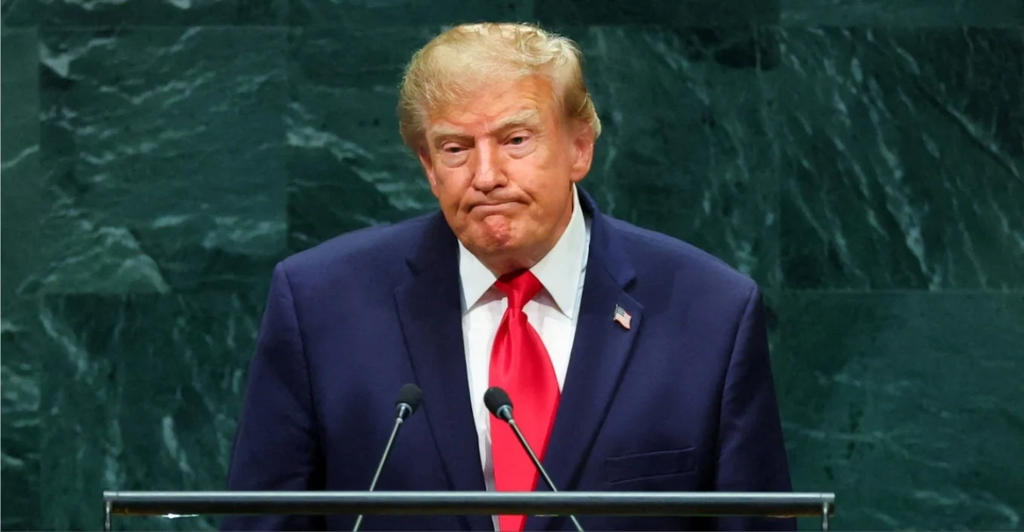
Donald Trump on Friday rejected an Iranian proposal aimed at reopening the Strait of Hormuz within seven days, according to the Wall Street Journal, which also reported that the US president expects strikes on Iran to resume after the midterm elections in early November.
Late on Friday night, shortly before 4 a.m. Cyprus time, the 80-year-old Republican once again shared a map on Truth Social in which the Strait of Hormuz had been renamed the “Trump Strait.”
Citing sources within his administration, the Wall Street Journal reported that Trump remains sceptical over whether Tehran would comply with his demands.
Earlier on Friday, Iran submitted a proposal to the United States offering to reopen the strategically vital waterway within seven days, saying that “the choice now rests” with Washington.
“The seven-day deadline will begin as soon as the United States accepts this plan,” Iranian Foreign Minister Abbas Araghchi said at the United Nations headquarters in New York.
The reopening of the strait has become a central issue in the conflict between Iran and the United States, which erupted following the attack launched by the US and Israel against the Islamic Republic on February 28.
Before the outbreak of the war, around one-fifth of the world’s hydrocarbon supplies passed freely through the Strait of Hormuz.
“The measures the United States must take are not new,” Araghchi said, explaining that they had “already all been included in the memorandum of understanding” signed by the presidents of the two countries in June.
“If the United States agrees to proceed in this way, everything will return to the situation that existed before,” Iranian President Masoud Pezeshkian told CBS News on Friday, insisting that “the process will begin on the day they accept it.”
Trump and Pezeshkian signed the so-called Islamabad memorandum of understanding in June, which was intended to pave the way towards ending the war in the Middle East, reopening the Strait of Hormuz and laying the groundwork for negotiations over Iran’s sensitive nuclear programme.
However, the two sides interpreted the document differently and the agreement ultimately collapsed.
Frozen assets
Among the conditions Iran set in June was an end to hostilities and the immediate and complete cessation of military operations on all fronts, including Lebanon, where the Israeli military has been engaged in conflict with the Shiite Hezbollah movement.
Tehran also demanded the release of Iranian funds frozen abroad and the lifting of economic sanctions, as the Iranian economy struggles with soaring prices that triggered widespread protests in January before they were violently suppressed.
Iran has been subject to US sanctions for decades, severely affecting its economy and particularly its international trade. Iranian assets abroad have also been frozen since the 1979 Islamic Revolution.
In the absence of official figures, Iranian media estimated in the spring that the frozen assets were worth between $100bn and $123bn.
In an exclusive interview with AFP on Tuesday, Revolutionary Guards spokesperson Hossein Mohebi said Iran’s conditions now also include an end to hostilities in Yemen.
“It is up to America whether it wants this war to end or not,” Pezeshkian told Fox News earlier this week on the sidelines of the UN General Assembly.
Trump revealed on Tuesday that talks had taken place between Iranian and US officials on the sidelines of the annual UN gathering.
Until now, the US president had largely sidelined negotiations aimed at reopening the Strait of Hormuz and bringing down oil prices.
With the midterm elections of his second term approaching, the stakes are particularly high for Trump’s Republican Party, which risks losing its majority in both chambers of Congress.
The US president has also faced declining popularity amid the rising cost of living in the United States, particularly higher fuel prices, which have been partly attributed to the war against Iran and the closure of the Strait of Hormuz.
Also read: President: Turkish side “in a weakened position” after refusing meeting
