

Fireworks ban sparks innovation
Times Square drew massive crowds since 1904 for New Year’s Eve near the new New York Times Tower. Pyrotechnics lit the building like fire but dropped hot ash on revelers, prompting a 1907 fireworks ban. The Times countered with an illuminated ball drop: a 5-foot diameter, 700-pound (317 kg) iron-and-wood sphere with 216 25-watt bulbs.
Electric sign maker Jacob Starr designed and oversaw the pulley descent from the tower roof at midnight on December 31, 1907, signaling 1908’s birth. The New York Times announced: “The exact moment of the New Year’s arrival will be signalized by the dropping of an electrically illuminated ball.”
Ball evolution through decades
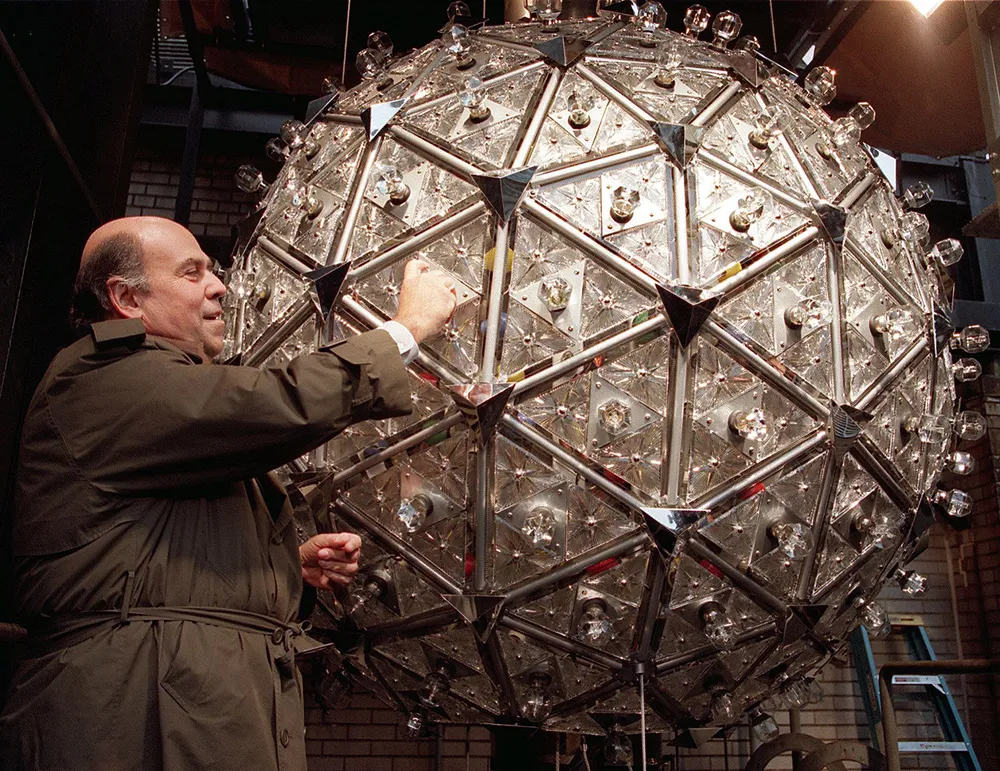
Designs advanced: aluminum replaced iron/wood; the 1999 Y2K ball had hundreds of crystal panels over 1,000 pounds (450 kg). The current “Big Times Square New Year’s Eve Ball”, since 2009, weighs nearly 12,000 pounds (5,443 kg), a 12-foot geodesic sphere with 2,688 Waterford Crystal triangles (over 5,000 for 2025). LED lights enable color-changing displays.
Tradition halted only from 1942 to 1943 for WWII blackouts; otherwise, annual since inception.
Maritime time ball origins
The ritual draws from 19th-century “time balls,” practical signals for precise timekeeping before affordable personal clocks and watches. Pioneered in 1833 at the Royal Greenwich Observatory in London, a 3-foot copper ball was dropped daily at exactly 1:00 PM from a mast, visible to ships on the River Thames below. Captains synchronized their marine chronometers – essential navigation tools accurate to seconds – against it, enabling longitude calculations vital for safe sea voyages.
By the 1850s, about 150 time balls operated worldwide at ports, observatories, and lighthouses, from Sydney to Cape Town, standardizing local time for sailors, merchants, and sundial-dependent citizens. Electrified versions appeared later, but mass-produced clocks obsoleted most by the early 20th century.
Surviving originals include Greenwich’s restored 1833 mechanism (now drops at Greenwich Mean Time); the U.S. Naval Observatory in Washington, D.C., which signals noon daily since 1845; and Detroit’s restored 1916 ball. Times Square transforms this nautical utility into a dazzling global countdown spectacle viewed by over a billion annually.
Source: Britannica
Also read: Icons who passed away in 2025
For more videos and updates, check out our YouTube channel.
