

Today, 9 July, marks the 204th anniversary of the horror of the hanging of Archbishop Kyprianos and the beheading of the three Metropolitan bishops, Chrysanthos of Paphos, Meletios of Kition and Lavrentios of Kyrenia, events that marked the beginning of the July massacres and the immense price paid by Cyprus as a result of the “Sultan’s wrath” over the uprising of the Greeks in the Danubian Principalities and the Peloponnese.
It is telling that, three generations after the dramatic events of the summer of 1821, that is, in the opening decades of the twentieth century, contemporary sources and Cypriot literature referred to the massacres as “the time of the onslaught” or “the time of Küçük Mehmed”. By contrast, our own generations, and contemporary “public memory”, associate 9 July with the epic poem by Vasilis Michaelides or, at best, among those who read, with Georgios I. Kypiades’ classic book, Memoirs of the Tragic Scenes in the Island of Cyprus in 1821 (Alexandria, 1888), which, despite its evident weaknesses, remains the principal source for the events.
Below is reproduced, from the Limassol newspaper Salpinx, published by the Chourmouzios family, one of the earliest “pre-publications” of an excerpt from Michaelides’ epic poem on the 9th of July, before its first edition in 1911. It comes from the issue of 16 July 1909 and was published on the occasion of the unveiling ceremony of the bust of Archbishop Kyprianos at the Archbishopric, on Thursday, 9 July 1909, by Archbishop Kyrillos II.
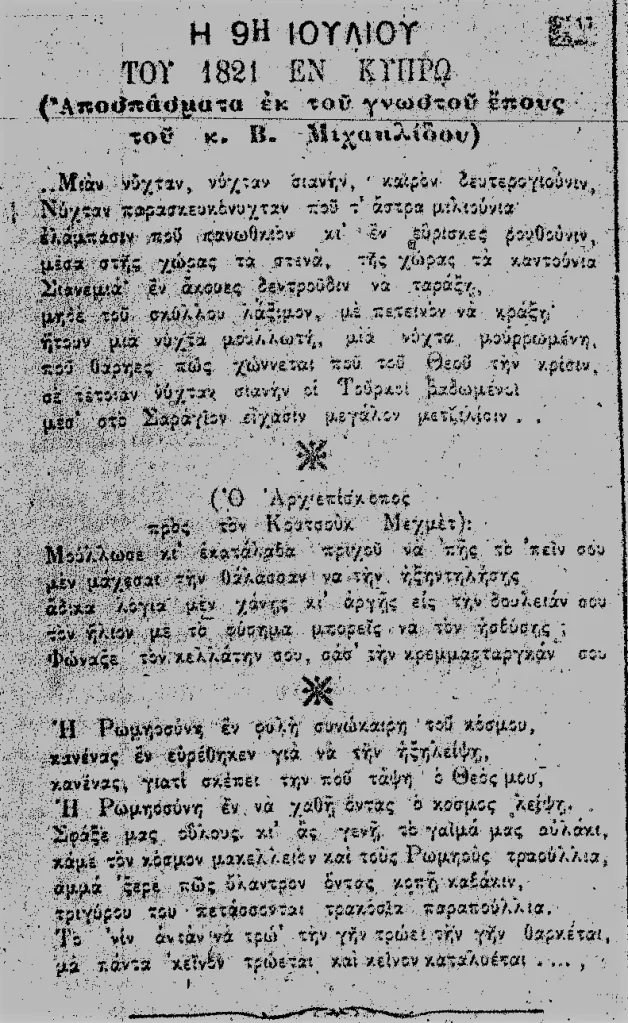
Needless to say, among the verses selected by the newspaper’s editors was the line:
“Romiosyni is a race as old as the world.” (=Η Ρωμηοσύνη εν φυλή, συνώκαιρη του κόσμου)
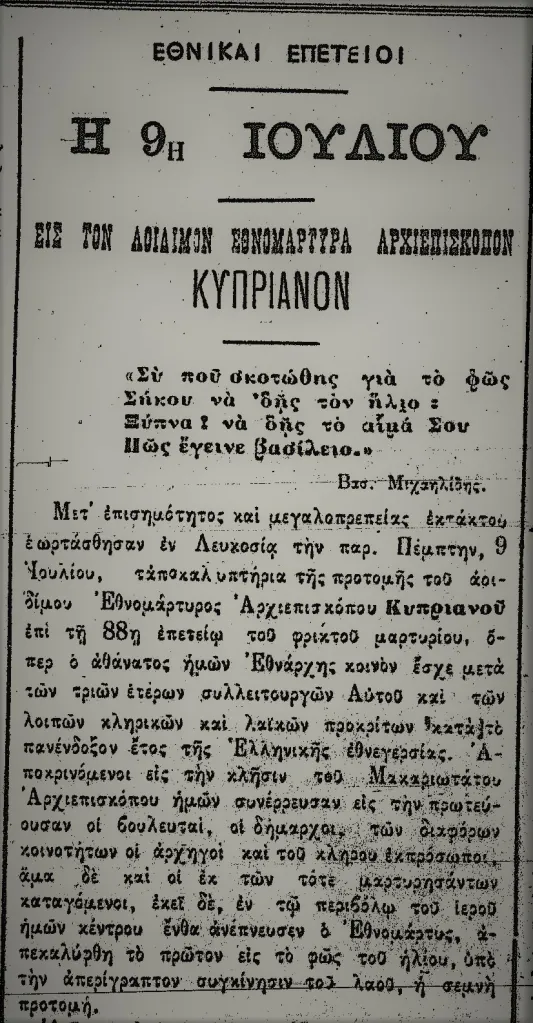
In the same issue, on the front page, Christodoulos S. Chourmouzios, a friend of Vasilis Michaelides and publisher of Salpinx, who attended the unveiling ceremony representing the Mayor of Limassol, Christodoulos Sozos, began his account of the unveiling of Kyprianos’ bust as follows:
If we attempt to summarise the events and their consequences within the narrow confines of this article, we must begin, first and foremost, with the ferocity of the repression. Although Ioannis Filimon’s account of 486 people proscribed by Küçük Mehmed has been shown by modern research to be exaggerated, the final number of victims may in fact have been even higher. As Turkish sources also confirm, the Sultan sent 4,000 soldiers to Cyprus in May 1821, an enormous number both by the standards of the island and in comparison with the forces involved in the Greek Revolution.
As mentioned earlier, the first target of the massacres of 9 July was the Church of Cyprus, with the hanging of Archbishop Kyprianos, the beheading of the three Metropolitan bishops, Chrysanthos of Paphos, Meletios of Kition and Lavrentios of Kyrenia — and the martyrdom of other members of the clergy, including the abbots of the monasteries of Kykkos, Acheiropoietos and Chrysostomos, Dositheos of Omodos, Lavrentios of Faneromeni, and others.
At the same time, dozens of members of prominent families and leading persons from Nicosia, Larnaca, Limassol and Paphos, from the towns of Lapithos, Karavas and Kythrea, and from other villages across Cyprus were led to the scaffold in Seraglio Square.
There followed an unchecked orgy of pillage, murder and the abduction of women and children directed against the Greek population, forcing many to flee Cyprus, some to join the Revolution and, in the case of the wealthier among them, to seek refuge in Europe. Others were forced to convert to Islam. Of these, some later returned to their ancestral faith; others died as Crypto-Christians (“Linobambaki”); and still others are numbered among the ancestors of today’s Turkish Cypriots.
At the local level, the massacres of 9 July were intended to terrorise the Greeks of Cyprus. And indeed, the shadow of the massacres hung heavily over the decades that followed. Perhaps the most telling example is the death of Archbishop Kyrillos I in 1854, who, according to tradition, died from fear that he might meet the same fate as Kyprianos during the Crimean War.
Likewise, the intellectual bloom that had begun under Archbishops Chrysanthos, in the field of publishing, and Kyprianos, in education, was violently interrupted. Yet the spirit of resistance did not disappear, as demonstrated both by the participation of hundreds of Greek Cypriot villagers in the Revolution of 1821 and by the letter addressed to Kapodistrias in August 1828 by Archbishop Panaretos and eleven other prominent Cypriots.
At the same time, within the collective national subconscious, Cyprus remained present both in the revolutionary plans of the enlightened pioneers of the Filiki Eteria and within the envisaged boundaries of the new state then taking shape, as described by Ioannis Kapodistrias in October 1827:
“Since 1821, these boundaries have been defined by the blood shed in the massacres of Kydonies, Cyprus, Chios, Crete, Psara and Missolonghi, and in the many struggles on land and at sea through which this valiant nation has won glory.”
Also read: ON THIS DAY: War of Greek Independence (1821)
Source: papapolyviou.com
