

Twenty-three previously unknown ship engravings have been identified at ancient Kition beneath modern-day Larnaca, using high-resolution 3D laser scanning.
The Ancient Kition ship engravings were carved into the southern façade of Temple 1 at Kition-Kathari. The new findings more than double the 19 ship depictions documented in the 1980s by archaeologists Lucien Basch and Michal Artzy.
The research was carried out by Graham C. Braun, Caroline Barnes and Tzveta V. Manolova and published in the International Journal of Nautical Archaeology.
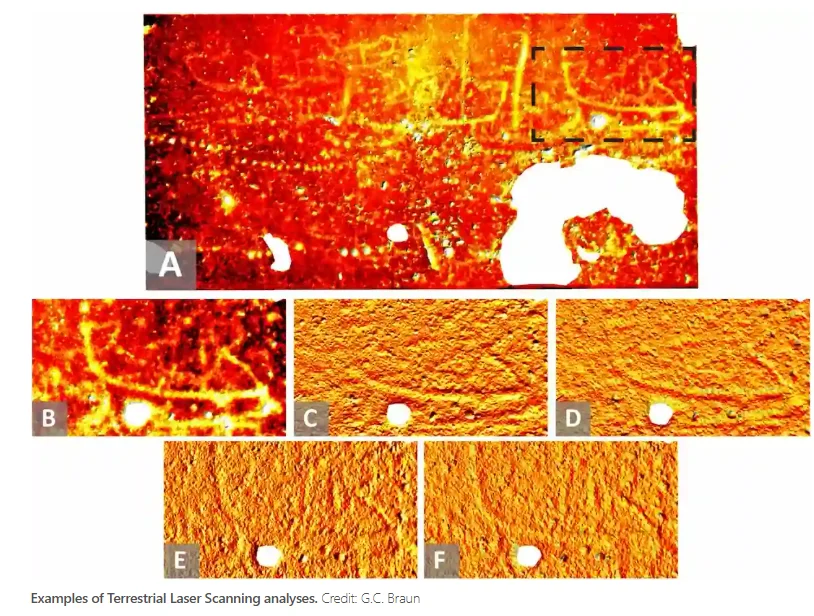
Using a terrestrial laser scanner, researchers examined the depth and angles of marks on the stone, allowing them to distinguish deliberate human engravings from weathering and other damage.
Of the 23 newly identified possible ship engravings, nine are considered high-confidence examples, six medium-confidence and eight low-confidence.
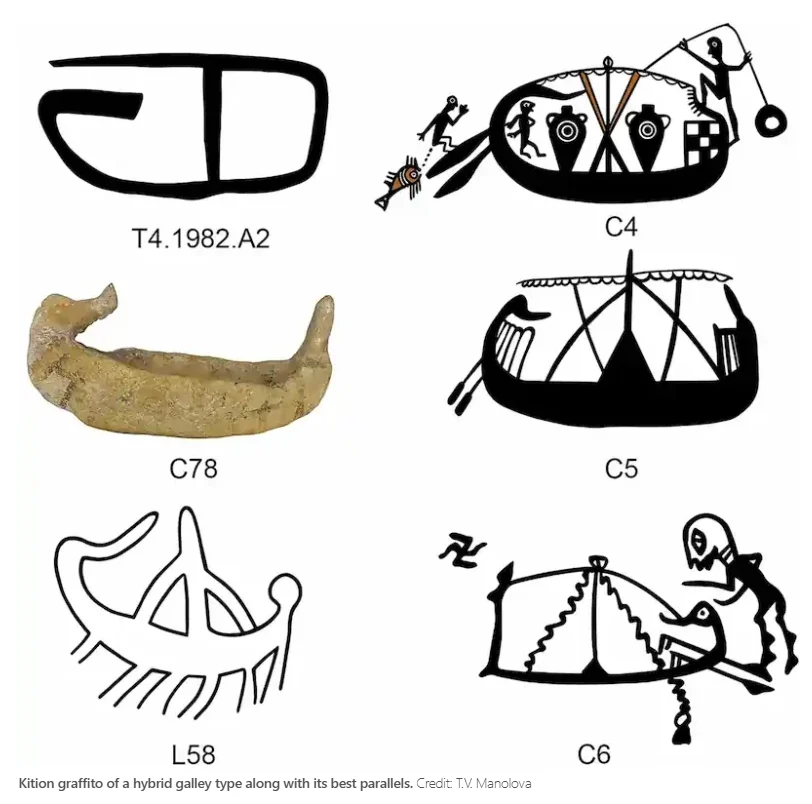
The digital survey also revealed previously unnoticed details in earlier engravings. One known ship, for example, appears to have a lookout platform on its mast, allowing comparisons with ship representations found on Cypriot and Levantine seals.
New evidence changes the dating
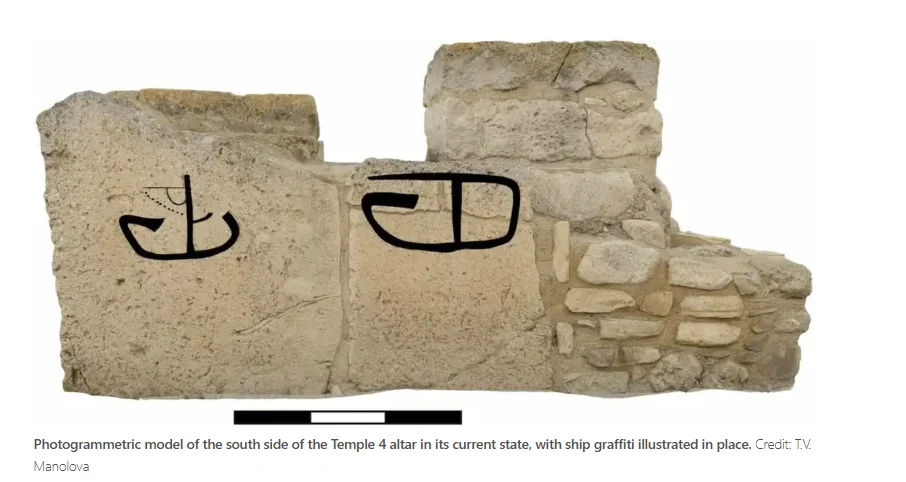
One of the most significant findings concerns two ships carved into stone T1.8, which forms part of a later repair to the southern façade of Temple 1.
The stone is made of yellow sandstone, a material introduced at Kition after the end of the Late Bronze Age. This means the two ships could not have been carved during the temple’s original construction phase.
The discovery prompted researchers to reconsider the chronology of the engravings.
The study suggests that the ships were not all carved at the same time. Instead, they may have been added gradually over several centuries, from the Late Bronze Age through the Early Iron Age.
This challenges the earlier interpretation that the ship depictions formed a single composition or procession created during one particular period.
Six types of ships identified
Researchers classified the engravings into six categories based on the shape of their hulls.
Several depictions resemble Cypriot and Levantine ship types, while parallels can also be found in material from Egkomi, Lapithos, Akko, the Carmel coast and Tell Tweini.
According to the study, Cypriot and Levantine ship types are the most widely represented among the engravings.
At least 11 rows of deep dots were also recorded alongside the ships. Their meaning remains uncertain, although researchers suggest they could represent aspects of the sea, such as waves or reflections of light on the water.
Why were the ships carved?
The concentration of ship depictions and distinctive rows of dots on the monumental surface suggests that the area may have been deliberately associated with maritime imagery.
Researchers consider two main interpretations.
One possibility is that the engravings were votive images created by sailors before or after a voyage, either seeking protection or expressing gratitude for a safe return.
Another possibility is that they were created by people who observed ships in Kition’s harbour and reproduced the vessels they saw on the stone.
The researchers do not reach a definitive conclusion between the two interpretations.
Evidence of Kition’s maritime identity
The Ancient Kition ship engravings provide broader insight into the city’s long-standing relationship with the sea.
The continuation of ship engraving during the Cypro-Geometric period suggests that maritime activity remained an important part of the community’s identity during the transition from the Bronze Age to the Iron Age.
The researchers also connect the practice with a form of collective memory associated with the temples and the city’s maritime activities.
With the new discoveries, a total of 43 ship engravings have now been recorded at Kition: 41 at Temple 1 and two on the altar of Temple 4.
The findings point to a coastal community that continued for centuries to record its connection with the sea and navigation on the same monumental surfaces.
Also read: A taste of Cyprus at the wedding of Richard the Lionheart
For more videos and updates, check out our YouTube channel
