

About this Summary
This summary was created with the help of artificial intelligence (AI) to help readers quickly understand the key points of the article.
It has been reviewed by our editorial team before publication. For complete information and full details, please read the full article.
- Gaza’s unemployment rate has risen above 80%, and humanitarian groups see freelancing as a key digital lifeline for income.
- Gaza Sky Geeks, founded by Google and Mercy Corps in 2012, had two hubs destroyed during the war.
- Tarik Zaeem and Mahran Bayed, both displaced, now freelance from co-working spaces despite damaged infrastructure and severe payment difficulties.
- Walaa recently secured a full-time job with a Dubai-based firm and hopes to help her sister receive medical evacuation from Gaza.
“I was just in a trough, drowning in uncertainty,” says Walaa Volidis, a Palestinian software engineer. “But deep inside, I made a decision: it will not be the end, no matter how hard it gets. I’ll keep fighting for my dreams.”
Wearing a headset and glued to her laptop, Walaa discusses AI on a video call with her mentor in California’s Silicon Valley. The 24-year-old wants to keep her skills up to date.
But that is the least of her daily challenges as she lives in a tent in central Gaza supporting her displaced parents and four younger siblings.
“When the war started, I lost everything: my job, my university, even some of my family members. My sisters were injured,” Walaa tells me from a co-working space in Deir al-Balah. She says her mental health was “totally destroyed”, but she prioritised finding work.
Walaa is one of thousands of young Gazans now pursuing roles in the digital economy. “It’s a kind of momentum,” she says. “I have my main goal every single day to go to work, to finish my tasks. If you stop or cry about your situation, you will not do anything.”

Amid the rubble of Gaza, the majority of the two million population is reliant on humanitarian aid to survive, and there are few ways for people to earn a decent salary. The UN says the unemployment rate has passed 80%, compared to 22% before the war. Humanitarian groups see online work – particularly freelancing for clients abroad – as offering some of the best opportunities.
“We talk about it now as a sort of digital lifeline, this idea that if you have a laptop, if you have a working internet connection, you can work and have an income,” says Nicole Hark, from the US humanitarian organisation, Mercy Corps. “It’s really critical to help people go back to work. They don’t want to be dependent on aid.”
Before the latest devastating war, triggered by the deadly Hamas-led attacks on Israel in October 2023, Gaza had a burgeoning tech sector. Israel and Egypt kept the Hamas-run territory under blockade, citing security reasons. Coding, designing and programming remotely were a way for young graduates to overcome tight border restrictions.
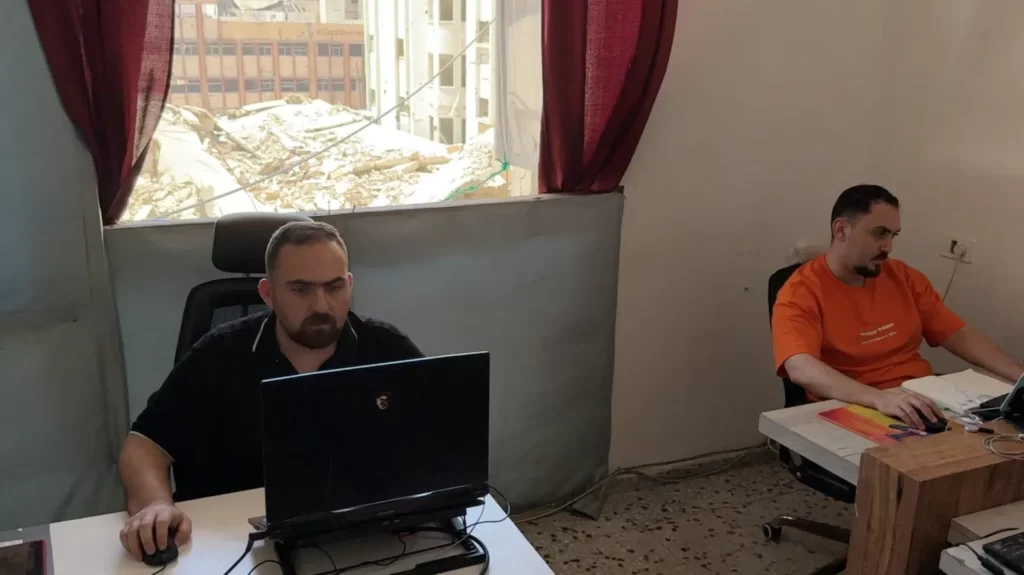
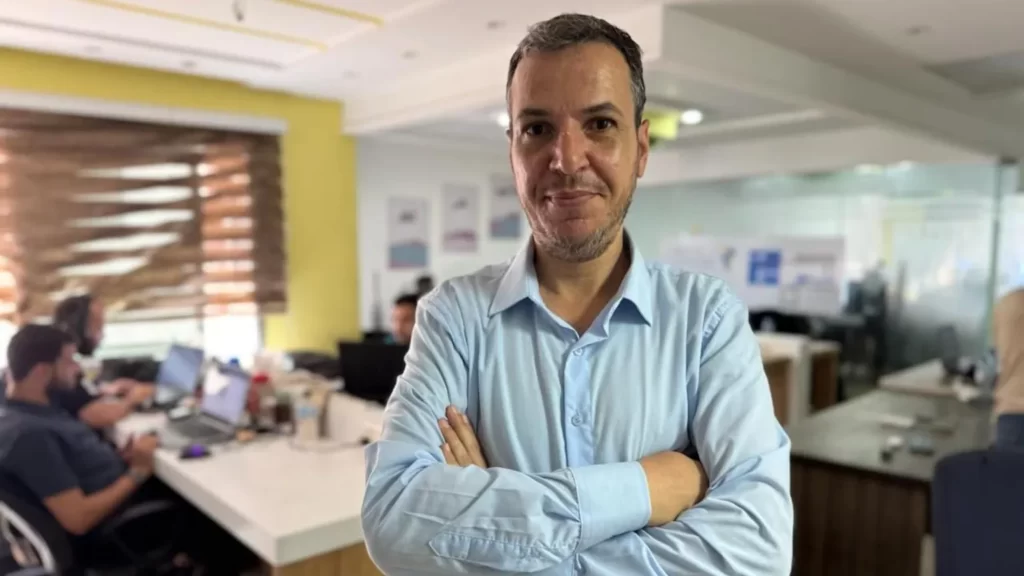
Gaza Sky Geeks was founded in 2012 by Google and Mercy Corps. The initial idea was to promote tech start-ups, but its three bustling hubs also ran coding courses and gave advice on accessing international markets. Two were destroyed during the war.
Mercy Corps now supports some of the new co-working spaces which have popped up across Gaza using generators and solar panels to offer better internet connections and a more stable power supply. Gaza’s power system has suffered near-total collapse, and approximately 75% of its telecommunications networks have been damaged or destroyed.
“I am starting from scratch, from zero, to start a new career,” says Tarik Zaeem, speaking to me from a co-working space in Gaza City. Before the war, the 44-year-old was the chief technology officer for a local firm. Now, he is a freelance programmer.
“When I work on my laptop, I forget everything. I forget what’s happened,” Tarik says. He has recently developed a mobile app to make bookings for a barber’s shop and a valet parking app for a Saudi client.
Most of Tarik’s income goes to support his wife and three children, who are now living in neighbouring Egypt – as he used his savings to buy their exit early in the war.
But getting paid remains a challenge. Few bank branches have reopened in Gaza, and there are severe shortages of cash. Palestinians face many international banking restrictions, and those in Gaza cannot register with most digital payment platforms.
Some manage to route their money through relatives abroad. But others rely on brokers in Gaza who charge high fees to convert electronic transfers into cash. Tarik says these have often left him with only half his original payment. “It’s not enough for a good living,” he adds. “[Just] the basics.”
Despite last year’s US-brokered ceasefire, and the recent deal between President Donald Trump’s Board of Peace and Hamas to advance his peace plan, Israeli bombardments in Gaza have continued on a near-daily basis. Israel says it is targeting Palestinian armed groups.
At least 1,250 people have been killed, including 265 children, since October’s truce, according to Gaza’s Hamas-run health ministry, whose figures are seen as reliable by the UN.
Tarik describes an air strike outside his co-working space in Gaza City in June. On that occasion, a Palestinian student sitting her exams online was killed in the street. Israel said it was targeting a Hamas operative and that it tried to prevent harm to civilians.
Given the risks, another Gazan tech worker tells me that he feels obliged to reassure prospective clients about his team’s ability to deliver on projects creating mobile apps, websites and advertisements.
“Once we get a job for IT that needs like three to four months, we are trying to say to this customer: ‘Please know that everything will be online, if we get killed, you will have your work,'” says Mahran Bayed.
Mahran lives in a tent with his wife and three young children close to his destroyed home near the ruins of al-Shifa hospital in Gaza City. The medical complex was repeatedly targeted during the war by Israel, which accused Hamas of using it as a command and control centre – something the armed group denied.
“I lost all my equipment, I lost my house, I lost my office,” Mahran remembers. “I was thinking that this was the end of the world here in Gaza.”
Now Mahran finds an escape and purpose freelancing to create mobile apps, websites and advertisements. “From Gaza, I can collaborate with teams in completely different [parts] of the world and contribute with people I’ve never met,” he says. “That’s one of the things I enjoy most about technology.”
An extra problem for Mahran is that his laptop screen was damaged during Israel’s attacks. This forces him to carry around an external display.
While Gazan workshops do their best to repair computers, using spare parts from other damaged devices, there is a limit to what they can do.
The Israeli defence authority Cogat, which controls Gaza’s border crossings, classifies computers and computer parts as “dual-use” items – able to be used for civilian or military purposes – and bans imports.
Back in Deir al-Balah, Walaa has been helped by the Palestinian-Dutch social impact startup, TAP, to connect to mentors, career coaches and possible employers. She recently landed a full-time job with a Dubai-based firm.
She now aims to improve everyday life for her siblings and find a way for her sister, who is nearly 13, to get a medical evacuation from Gaza. Trauma injuries left her with lymphoedema, a chronic condition that causes severe swelling in her leg.
“My first hope is to help my family to get a good life, to help my sister to get out of Gaza to find treatment,” Walaa tells me. “Also, I’m working for myself to get a scholarship to travel.”
While Gaza’s wider recovery remains at a standstill, its tech workers give a glimpse of a brighter, possible future.
Source: BBC
Also read: CCTV shows Afghan boxer moving suitcase containing body of British woman
For more videos and updates, check out our YouTube channel
