

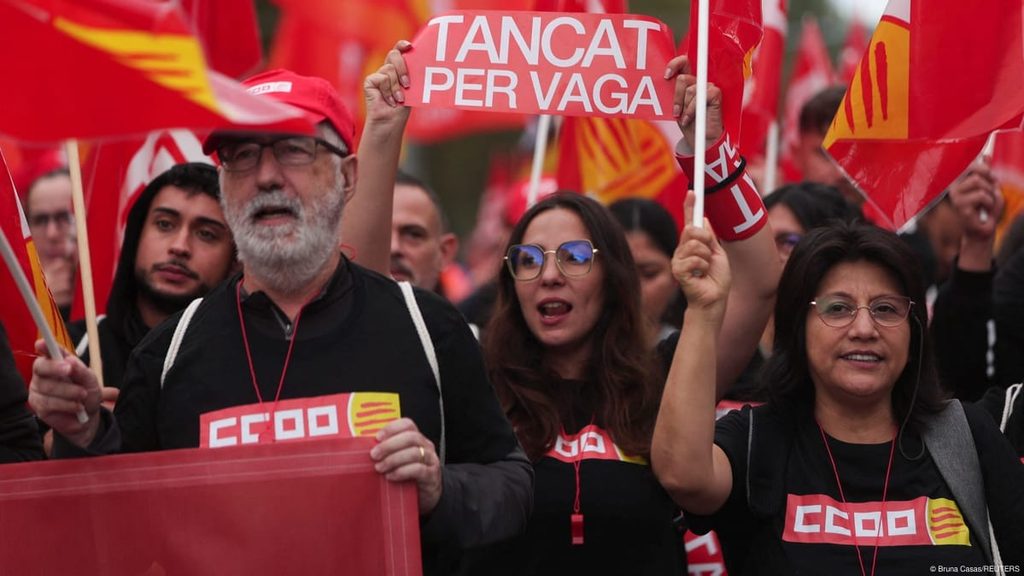
Spain is experiencing its first general strike in 14 years on Wednesday, with transport disruptions, industrial stoppages and blockades reported across the country.
Called by major trade union confederations UGT and CCOO, the nationwide action has affected roads leading into Madrid, Barcelona’s Sants railway station, ports and industrial facilities. Public transport services have also been reduced, while electricity consumption has fallen during the early hours of the strike.
The unions say the mobilisation reflects widespread frustration, with the housing crisis emerging as a central issue alongside workers’ demands.
Blockades and clashes reported in Madrid
Picket lines blocked access roads to Madrid from the early hours, while disruptions were also reported at municipal bus depots in Fuencarral and Mercamadrid.
The unions accused police of using force against picket lines and obstructing workers’ right to strike.
At Mercamadrid, CCOO said National Police officers attacked an information picket “completely unjustifiably”. The union reported that 13 people required medical attention after suffering bruising from batons, eye irritation and exposure to tear gas.
According to CCOO, officers also prevented workers from informing the public and confined a group of people to a specific area.

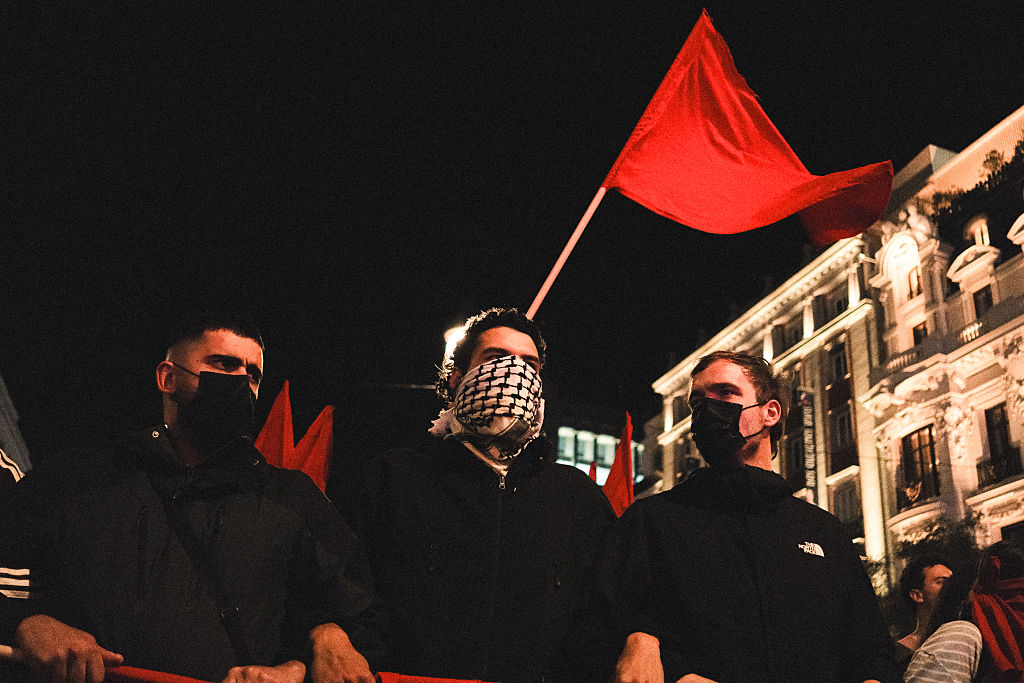

Electricity consumption falls by almost 10%
Electricity consumption, used as an approximate indicator of the strike’s impact on economic activity, fell by around 9.7% during the first hours, according to CCOO, citing data from Red Eléctrica.
The decline reflects reduced activity in factories, offices and shops compared with forecasts for a normal Wednesday.
The minimum service levels were set at between 50% and 75% for rail services and between 18% and 85% for flights, depending on the destination.
Rail and bus services affected
In Catalonia, blockades on major roads leading into Barcelona prevented some Renfe train drivers from reaching stations on time.
Of the 44 trains scheduled to operate between 6.30am and 8am to meet the minimum 25% service requirement during peak hours, 13 initially failed to depart. Five of those were expected to leave later.
Road blockades and the obstruction of a TMB bus depot also affected bus routes. Metro services, however, maintained the required minimum levels.
During peak hours, a minimum service level of 25% applied to Rodalies commuter trains, the metro, buses, FGC trains and trams.

Algeciras port largely paralysed
The Port of Algeciras, Spain’s largest port by cargo volume, was largely brought to a standstill.
Both terminals remained inactive from early morning, with more than 85% of approximately 2,000 dockworkers taking part in the strike, according to CCOO.
Only the northern entrance remained open initially. The southern entrance reopened following intervention by the National Police after picket lines blocked access.
Minimum service levels were set at 40% to safeguard connections with Ceuta.
Meanwhile, trade unions cancelled planned demonstrations in Algeciras and La Línea because of heavy rain and forecast winds of up to 120 kilometres per hour in the Strait of Gibraltar.
Unions report high participation across industries
UGT and CCOO described participation during night and early morning shifts as widespread, reporting significant disruptions in several strategic sectors.
According to the unions, participation reached:
- 90% in the automotive industry, with production completely halted at factories including Volkswagen in Navarra and Seat in Barcelona.
- 90% at the ports of Algeciras and Valencia.
- 85% in the meat industry.
- 82% in waste collection.
- 75% in the energy sector.
- 38% in social and healthcare services, where minimum service levels were maintained.
- 35% in the postal sector during the early hours.
A ministerial decision also required 20% of petrol stations in each region and autonomous community to remain open to ensure fuel supplies. The measure also covered the supply chain, warehouses, regasification facilities, international interconnections and refineries.
Housing crisis at the centre of the mobilisation
Before the strike began, CCOO General Secretary Unai Sordo and UGT General Secretary Pepe Álvarez called for mass participation in a rally at Madrid’s Plaza del Sol.
Valeria Racu, a spokesperson for the Tenants’ Union, linked the mobilisation to Spain’s housing crisis in an interview with public broadcaster TVE.
“The time for politicians is over. We cannot wait any longer. Our patience has run out,” she said.
“What is the value of a pay rise if housing costs increase even more?” she asked, arguing that housing has become the main source of inequality.
Racu also said permanent rental contracts would help ensure homes are used for residential purposes rather than speculation. She cited Maricarmen Abascal’s campaign against Urbagestión as an inspiration, saying: “Fight for what belongs to you.”
The strike is Spain’s first general strike since 2012.
Also read: Europe takes to the streets, but where are the Cypriots?
For more videos and updates, check out our YouTube channel
