

Heavy police presence ahead of planned demonstrations
Heavy security has been deployed across South Africa amid fears that planned anti-migrant protests could turn violent, as President Cyril Ramaphosa urged demonstrators to protest peacefully.
The protests coincide with an unofficial deadline set by campaigners demanding that undocumented migrants leave South Africa.
Police have increased their presence in major cities, including Johannesburg and Durban, while many businesses closed ahead of the demonstrations.
Migrants leave amid rising tensions
Many undocumented migrants have already left South Africa to avoid violence and intimidation. According to police, around 25,000 people have been repatriated so far, most of them from neighbouring African countries.
One undocumented Malawian told the BBC he was “happy to be going back” but “heartbroken” to leave behind his four young children.
In Johannesburg, where one of the main protests is taking place, shops near the planned gathering point remained closed, while police maintained a visible presence across the city.
Authorities also reported several arrests on Tuesday, including five people accused of looting a foreign-owned shop in Soweto and another five arrested after allegedly breaking into a tuck shop in Hammarsdale, KwaZulu-Natal.
Ramaphosa calls for peaceful demonstrations
President Ramaphosa has repeatedly urged protesters to remain peaceful while acknowledging concerns over immigration policy.
In his weekly newsletter, he reminded South Africans that many foreign nationals live in the country legally.
“Some foreign nationals who live in South Africa are here lawfully,” he wrote. “They work, study, raise families, invest in our economy, and contribute positively to our society.”
He added that the right to protest “does not allow people to threaten or intimidate others, or to engage in acts of vandalism or violence.”
Official figures show there are more than three million documented foreign nationals living in South Africa.
Thousands await repatriation
Ahead of the protests, thousands of migrants have been staying in temporary transit camps while awaiting repatriation.
In Durban, where some of the largest demonstrations are expected, authorities have begun dismantling camps housing mainly Malawian nationals as buses transport people back home.
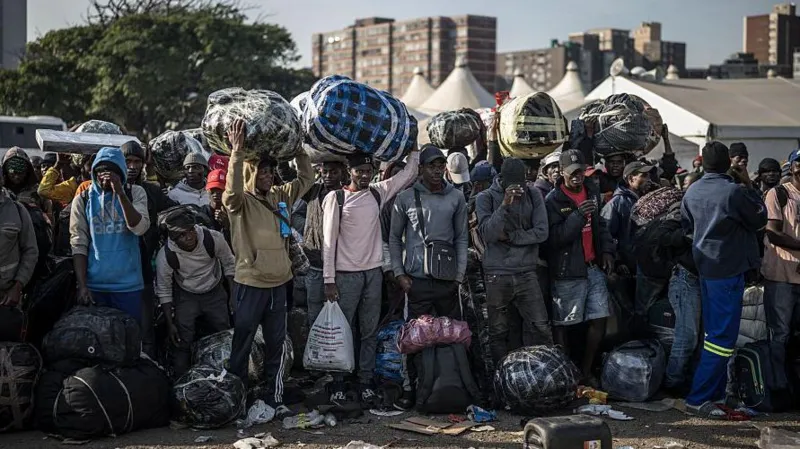
One migrant, Nelson Mbewe, said he had travelled to South Africa to find work and support his family but accepted he would have to return home after being told he lacked the necessary documentation.
Another Malawian migrant, Hassan Phiri, appealed for unity, telling the BBC that “Africa must remain Africa” and calling on Africans to “love each other and stick together.”
Long-standing tensions over immigration
Authorities have authorised anti-migrant marches in Johannesburg, Durban and other cities but warned organisers that violence will not be tolerated.
Police also said traditional weapons, including shields, sticks and whips often carried during Zulu marches, will not be permitted.
The government says more than 12,000 undocumented migrants have been deported or repatriated since protests began earlier this year, while a further 3,500 have volunteered to return to their home countries.
Countries including Malawi, Mozambique, Ghana, Nigeria and Zimbabwe have organised flights and buses for returning nationals.
Xenophobia has been a recurring issue in South Africa for many years. According to the African Centre for Migration and Society’s Xenowatch tracker, two people have been killed in xenophobic violence so far this year.
In 2008, more than 60 people died during widespread anti-immigrant riots.
Source: BBC
Also read: EU delegation heads to Ankara for talks on Cyprus issue and migration
For more videos and updates, check out our YouTube channel
