

Supporters face barriers ahead of tournament
Football supporters from a number of countries competing in the World Cup say travel bans, visa restrictions and high rejection rates are preventing them from attending matches in the United States.
BBC World Service analysis of travel data found that fans from more than a quarter of the nations taking part in the tournament face significant challenges in securing entry to the US, raising concerns about accessibility at what is expected to be the largest World Cup in history.
For many supporters, the obstacles have transformed what should be a celebration of football into a source of frustration and disappointment.
Iraqi fan’s dream trip comes undone
Among them is Iraqi football fan Abdulla Adnan, who purchased tickets for Iraq’s matches against Norway and France after his country’s qualification for the World Cup in March.
For Adnan, attending the tournament represented a once-in-a-generation opportunity. Iraq has qualified for the World Cup only twice, with its previous appearance coming in 1986.
However, obtaining a visa proved impossible.
Although Iraq is not included in President Donald Trump’s travel ban list, routine US consular services in Iraq were suspended following the outbreak of the US-Israel conflict with Iran, citing regional security concerns.
As a result, Iraqi applicants requiring in-person visa interviews were left without access to visa services inside the country.
Adnan travelled to neighbouring Jordan in an attempt to obtain a visa through the US embassy in Amman. Upon arrival, he was informed that the embassy could not process his application because he was not a Jordanian citizen.
After spending approximately $1,800 on match tickets and travel arrangements, he eventually abandoned his efforts to attend the tournament.
“To go to a match, a stadium, a crowd, cheering, and see my team – that is worth the world to me,” Adnan told the BBC.
Travel bans and restrictions spark criticism
Several countries competing in the tournament have been affected by US travel restrictions.
Haiti, Iran, Senegal and Ivory Coast are among the participating nations whose citizens face restrictions on obtaining the visitor visas recommended for football supporters.
Supporters’ groups argue that the World Cup visa restrictions disproportionately affect nations outside Europe and North America.
Julien Kouadio Adonis, from Ivory Coast’s National Committee for the Support of the Elephants, described the measures as discriminatory.
“It’s a form of segregation that doesn’t dare speak its name, but the proof is there,” he said.
“No European country has faced this kind of restriction. Why Africa?”
His organisation, which normally organises supporter travel to World Cups, decided not to pursue attendance in the United States due to the visa requirements.
Adonis also questioned whether a country unwilling to welcome supporters from participating nations should be allowed to host the tournament.
“Football is a spectacle and a spectacle needs people watching,” he said.
Costly and uncertain visa process
While citizens of 42 generally wealthier countries can travel under the US Visa Waiver Program through an online application system, supporters from many other nations must complete a far more demanding process.
The visitor visa recommended for football fans costs $185 and requires an in-person interview. Applicants must also demonstrate their intention to leave the United States after their visit and prove they can cover all travel expenses.
In May, US authorities announced they would remove proposed deposit requirements of up to $15,000 for supporters from several World Cup qualifying countries, including Algeria, Cape Verde, Ivory Coast, Senegal and Tunisia, provided they held valid match tickets.
Nevertheless, many fans remain sceptical about their chances of approval.
Senegalese supporter Aliou Ngom, who attended the last two World Cups in Qatar and Russia, said one of the tournament’s greatest attractions is seeing cultures from around the world come together.
However, following previous visa issues involving Senegal’s women’s basketball team, he felt there was little point applying.
High rejection rates add to concerns
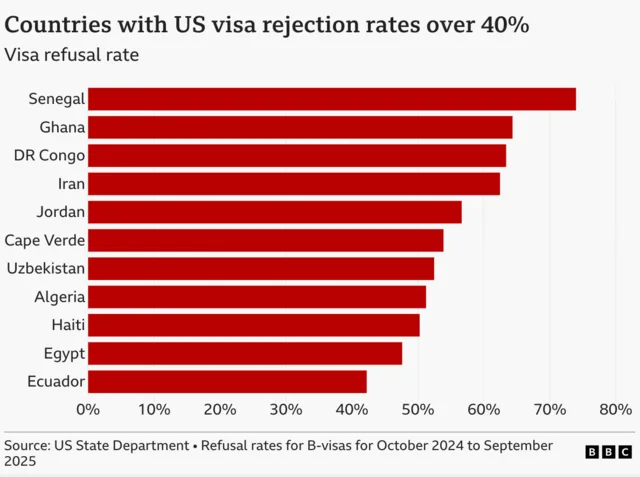
BBC analysis of US State Department data found that citizens from 11 of the 48 qualified countries faced visa rejection rates above 40%.
The countries include Ecuador, Egypt, Haiti, Algeria, Uzbekistan, Cape Verde, Jordan, Iran, Democratic Republic of the Congo, Ghana and Senegal.
The average rejection rate for tourist and business visa applications worldwide stood at 34%.
The figures relate to all visa applications rather than football supporters specifically, but they highlight the uncertainty many fans face before committing significant sums of money to travel and accommodation.
Immigration lawyer Celine Atallah said FIFA’s dedicated FIFA Pass programme can help ticket holders secure priority visa interview appointments.
However, she noted that it does not improve the chances of approval.
“The visa system is the invisible gatekeeper of the World Cup,” Atallah told the BBC.
“FIFA can sell a ticket, but the US government decides who gets a visa, and CBP decides who actually enters.”
Even a visa is no guarantee
Supporters also point out that receiving a visa does not automatically guarantee entry to the United States, as border officials retain the authority to refuse admission upon arrival.
Jordanian supporters’ association leader Abu Kass said his own visa application was rejected despite submitting more than 40 supporting documents.
According to US data, Jordan recorded a visa refusal rate of 57% during the year ending September 2025.
“This World Cup is not ours,” Kass said.
“It’s not for Arabs this World Cup, it’s for them. If the head of the fan association was refused, who will be accepted?”
US defends its policies
Responding to concerns about World Cup visa restrictions, a State Department spokesperson told the BBC that the United States was prepared to welcome visitors from around the world for the tournament.
The spokesperson noted that many supporters already qualify for visa-free travel or possess existing visas.
US authorities also stressed that each visa application is assessed individually following extensive security checks.
The Department of Homeland Security has highlighted concerns over visa overstays, reporting more than 538,000 overstay incidents between October 2023 and September 2024.
A global tournament with unequal access
While previous World Cup hosts introduced special visa arrangements for supporters, access was never guaranteed.
The 2026 tournament is being jointly hosted by the United States, Canada and Mexico. However, 78 of the 104 matches, including the final, will take place in the United States.
Canada and Mexico operate separate immigration systems, but both present challenges for supporters from some participating countries. Canada, for example, lacks biometric facilities in certain qualifying nations, while Mexico does not maintain diplomatic missions in several participating countries.
For many supporters, the concern remains that a tournament intended to unite football fans from across the world is becoming inaccessible to those from some of the very nations taking part.
Source: BBC
Also read: Israel hits Iran with new strikes despite Trump admonition
For more videos and updates, check out our YouTube channel
