

A new ethics complaint against Canadian New Democratic Party MP Heather McPherson has placed renewed attention on one of Canada’s most contested Russia-sanctions cases: the designation of billionaire energy investor Igor Makarov.
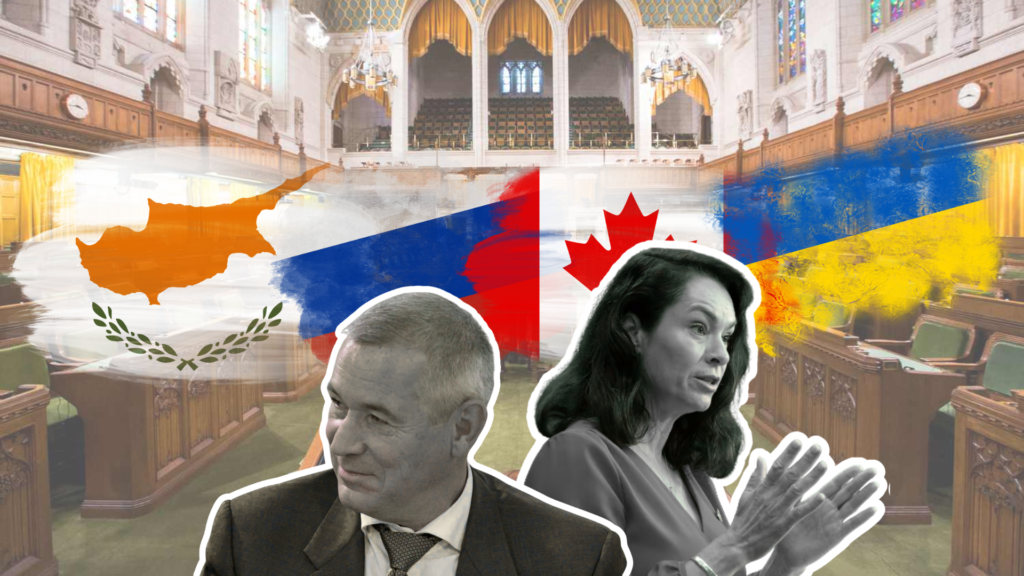
The complaint, filed by lawyers acting for Makarov and described in material reviewed for this report, centres on comments McPherson made in Canada’s House of Commons in April 2022, weeks after Russia’s full-scale invasion of Ukraine. In that intervention, McPherson said Makarov had been “sanctioned in the United States since 2018” and alleged that money he moved from Canada was used to support Russia’s war. The parliamentary record confirms that McPherson made the statement on 28 April 2022, saying Makarov had been able to move $121 million out of Canada and that the money “was used to prop up Russia’s war.”
Makarov’s lawyers argue that the claim about US sanctions was false and easily checkable. Public sanctions records and subsequent reporting show a more complicated picture: Makarov was sanctioned by Canada, the UK, Australia and New Zealand after the invasion of Ukraine, but he was not sanctioned by the United States or the European Union. ABC News reported in 2025 that he had never been subject to US or EU sanctions, while the UK and Australia had removed him from their lists following the renunciation of his Russian citizenship.
The issue is not simply whether one MP misstated a sanctions fact in Parliament. The complaint lands at a time when Makarov is challenging Canada’s sanctions regime on several fronts, including through international arbitration. Canada’s own trade department confirms that Makarov filed a request for arbitration with the World Bank-affiliated International Centre for Settlement of Investment Disputes in January 2026 under the Canada–Moldova Foreign Investment Promotion and Protection Agreement. He is seeking no less than CA$350 million, alleging that Canada’s sanctions and related conduct deprived him of the value of his shareholding in Spartan Delta.
Makarov, a former Russian citizen and energy-sector businessman, had substantial Canadian investments connected to Alberta’s oil and gas industry. His case has become a test of how far Canada can go in maintaining sanctions against individuals it says are linked to Russia’s political and economic networks, even when other Western jurisdictions have taken a different approach.
Canada listed Makarov under its Russia sanctions regulations in April 2022. Government material later published in the Canada Gazette stated that he was listed on the basis that he was a Russian national and that he was “an associate of a person involved in the Russian regime.” After Makarov’s Russian citizenship was terminated in 2023, Canada amended its regulations so former Russian nationals could also remain subject to designation.
That change is now central to Makarov’s argument that Canada adjusted the rules to keep him on the list. A legal summary by Harper Grey noted that Canada’s sanctions regime initially applied to Russian citizens, and was later expanded to include former Russian citizens. The same summary says Makarov applied to be removed from the sanctions list in August 2023, but the Minister of Foreign Affairs denied the request in October that year.
Canadian courts have so far backed Ottawa’s position. In 2024, the Federal Court upheld the minister’s decision to keep Makarov on the sanctions list, finding that the government had broad discretion in assessing national security and foreign policy material. A later report on the arbitration claim said the Federal Court of Appeal also found that Foreign Affairs Minister Mélanie Joly had provided “ample and detailed” support for maintaining the listing, citing Makarov’s past involvement in Russian gas sectors, his connections to Russian business figures and state-linked companies, and his dealings with Vladimir Putin in a sports-official capacity.
Makarov denies that he supports the Kremlin or Russia’s invasion of Ukraine. Global News reported in 2024 that he had sent a confidential statement to Canada’s foreign affairs department condemning Vladimir Putin and the war, as part of his effort to be removed from the sanctions list. His legal team has also said he supported Ukrainian refugees and had sought to give up Russian citizenship after the invasion.
The international picture has shifted in his favour in several jurisdictions. The UK removed Makarov from its Russia sanctions list in March 2024, meaning he was no longer subject there to an asset freeze, travel ban, transport sanctions or trust-services sanctions. Australia removed him from its consolidated sanctions list in May 2025, while New Zealand followed in September 2025.
Canada, however, has held its ground. That divergence is part of what gives the ethics complaint political weight. Makarov’s lawyers allege that McPherson’s comments helped entrench a public narrative that he had already been sanctioned by the US and that Canadian funds were tied to Russia’s war effort. The complaint asks Canada’s Conflict of Interest and Ethics Commissioner to examine whether her remarks were compatible with MPs’ obligations to act honestly and avoid conduct that could create real or apparent conflicts of interest.
There is also a wider parliamentary context. McPherson and other opposition MPs were pressing the Liberal government in 2022 over whether Canada was moving quickly enough against Russian-linked assets. In June 2022, McPherson again referred in Parliament to Makarov moving about $120 million out of Canada before being added to the sanctions list, arguing that the money should have gone to Ukraine.
The complaint may face procedural hurdles. Parliamentary privilege gives MPs broad protection for statements made in the House of Commons, and ethics inquiries into political speech are uncommon. Still, the filing adds a new dimension to a dispute already being fought in Canadian courts, sanctions review processes and an international investment tribunal.
For Canada, the case poses a difficult question: how to preserve a tough sanctions policy against Russia while ensuring that listings are legally robust, factually accurate and consistent with those of close allies. For Makarov, the argument is that Canada has become an outlier. For Ottawa, the position remains that sanctions are a legitimate foreign policy tool in response to Russia’s war.
What began as a post-invasion effort to freeze Russian-linked wealth has now become a broader test of evidence, accountability and political rhetoric in sanctions enforcement.
