


Cyprus IP Box Regime: Real Tax Advantage for Innovation-Driven Businesses
By Sergios Charalambous Partner and Head of the
Corporate and Tax Department at Philippou Law Firm
As international businesses become more selective about where they develop, hold and commercialise intellectual property, tax incentives are no longer assessed by headline rate alone. They are judged by whether they are credible, sustainable and aligned with modern international standards. That is why the Cyprus IP Box Regime continues to attract serious attention. It offers a highly competitive tax result, but it does so within a framework that is structured, OECD-aligned and designed to reward genuine innovation rather than passive asset ownership.
For innovation-led groups, that distinction matters. A tax regime is only truly valuable if it can withstand scrutiny from tax authorities, counterparties, auditors and investors. Cyprus remains attractive not simply because of the effective rate that may be achieved, but because that result sits within a stable EU jurisdiction with a recognised legal system, a business-friendly environment and a modern post-BEPS tax framework.
What the Cyprus IP Box Regime Is
The Cyprus IP Box Regime is a special tax framework that applies to qualifying profits derived from qualifying intellectual property. In broad terms, it allows an 80% deemed deduction on qualifying profits, with only the remaining 20% subject to Cyprus corporate income tax. Since the corporate tax rate in Cyprus is 15% from 1 January 2026, the effective tax rate on qualifying IP profits can be reduced to as low as 3%, subject always to the proper application of the nexus-based formula. It is therefore not a standalone 3% tax rate, but a targeted incentive that applies only where the statutory conditions are met.
That distinction is critical. The regime is not available simply because a company owns an intangible asset or earns income loosely connected with intellectual property. The actual tax outcome depends on whether the asset is a qualifying asset, whether the income is qualifying income, and whether the taxpayer can support the claim under the modified nexus approach by reference to qualifying research and development expenditure. In other words, the Cyprus IP Box Regime is highly attractive, but also highly technical, and it rewards proper structuring rather than superficial positioning.
Why the Regime Carries Credibility
One of the strongest features of the Cyprus IP Box Regime is its international legitimacy. The current framework is aligned with the OECD BEPS Action 5 modified nexus approach and has applied since 1 July 2016. The previous Cyprus IP regime was closed to new entrants on 30 June 2016 and phased out under transitional rules. The current rules therefore belong to the post-BEPS landscape, where tax benefits are expected to follow real development activity and real value creation.
This matters in practice. In today’s environment, businesses are not merely looking for a favourable tax outcome; they are looking for an outcome that is sustainable and defensible. Cyprus offers that combination. The jurisdiction remains competitive, but the competitiveness is now grounded in substance, evidential support and recognised international tax principles. That makes the regime materially more valuable than one that appears attractive on paper but is vulnerable under scrutiny.
Which Assets Can Qualify
A common misconception is that all forms of intellectual property fall within the Cyprus IP Box Regime. They do not. Under the current rules, qualifying IP may be legally or economically owned. The qualifying categories are patents, copyrighted software, utility models, IP assets that grant protection to plants and genetic material, orphan drug designations, and extensions of patent protection. None of those six categories carry a revenue-based size restriction. A further catch-all category covers certain other intangible assets that are non-obvious, useful and novel, but this final category alone is subject to two additional conditions: the asset must be certified by an appropriate authority in Cyprus or abroad, and the taxpayer must not derive annual gross revenues from all its intangible assets in excess of €7.5 million, while the worldwide turnover of the group must not exceed €50 million, each measured on a five-year average basis.
By contrast, marketing-related intellectual property such as trademarks, brands, business names and similar marketing intangibles does not qualify. That exclusion is fundamental. The Cyprus IP Box Regime is designed for innovation-based assets, not for brand exploitation as such. This is precisely why the regime is particularly relevant for software businesses, SaaS providers, technology groups, engineering-led businesses, and life sciences structures whose value is driven primarily by technical or scientific innovation.
Which Income Can Benefit
The regime is broader than a simple royalty incentive. Qualifying profits may include royalty income, licence income, compensation or insurance proceeds connected with qualifying intellectual property, trading income from the sale of qualifying IP, and income embedded in the sale of products, services or processes that are directly related to qualifying IP assets. At the same time, capital gains are treated differently. The rules distinguish between trading income from the sale of qualifying IP, which may fall within the regime, and capital gains on IP, which are excluded from the IP Box computation – and for good reason: gains arising from the disposal of qualifying intellectual property that are characterised as capital in nature are not subject to income tax in Cypruscapital gains arising from the disposal of qualifying intellectual property of a capital nature are entirely exempt from income tax in Cyprus, a position that has applied since 1 January 2020. In practice, this means that a Cyprus entity that develops qualifying IP and subsequently disposes of it at a gain will generally not be subject to Cyprus income tax on that gain, independently of the IP Box. That combination – a 3% effective rate on exploitation income and zero tax on a capital exit – is materially difficult to replicate in most other European jurisdictions and represents one of the most commercially significant features of the Cyprus framework for founders, investors and groups planning for a future exit.
That distinction is especially important in modern business models. Many innovation-led businesses do not monetise IP purely through traditional royalties. A software company, for example, may generate value through subscriptions, platform access, embedded software functionality or integrated digital services. In such cases, the legal labels alone are not enough. The taxpayer must be able to support, on the facts, whether and to what extent part of the profit is properly attributable to the qualifying intellectual property.
The Nexus Approach as the Central Test
The real gatekeeper of the regime is the nexus approach. The Cyprus IP Box does not reward passive ownership of intellectual property in isolation. It rewards profits to the extent they are linked to qualifying research and development expenditure. The stronger the taxpayer’s own qualifying expenditure, the stronger the nexus position and the greater the proportion of profits that may benefit from the 80% deemed deduction. Conversely, acquisition costs and related-party outsourcing dilute the result.
This is why the regime should never be treated as an end-of-year tax adjustment. It needs to be built into the structure from the outset. Ownership analysis, development functions, intercompany arrangements where relevant, accounting segregation and evidential support all play a central role. A taxpayer that cannot demonstrate how the qualifying asset was developed, what expenditure was incurred, how the income was generated and why the relevant profits should be treated as qualifying profits will inevitably face a weaker position. In such cases, the taxpayer should also be able to support the methodology by which the relevant portion of profit is identified and attributed to the qualifying intellectual property.
Cyprus in a European Context
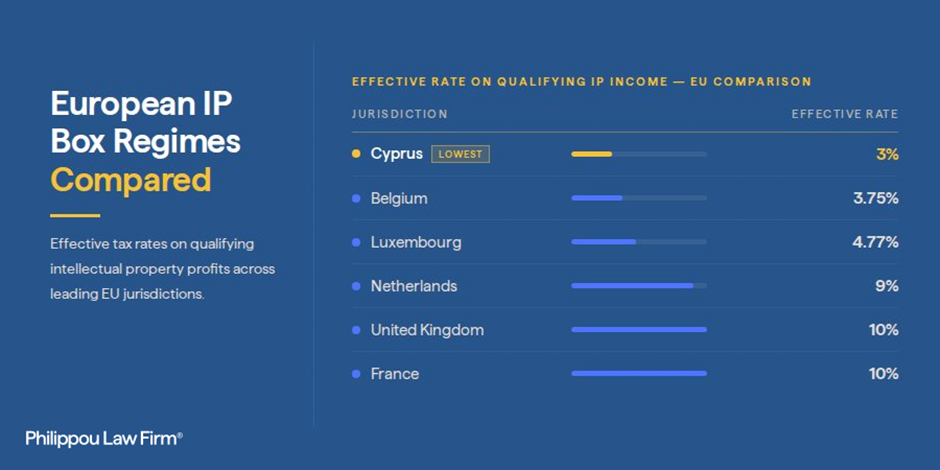
When comparing innovation regimes across Europe, headline rates tell only part of the story. The scope of qualifying assets, the treatment of net versus gross income, nexus requirements and access conditions differ materially between jurisdictions. Even so, Cyprus remains highly competitive in comparative terms. Based on current published summaries, Cyprus can reduce the effective tax rate on qualifying IP profits to as low as 3%, subject to the proper application of the nexus approach, compared with approximately 3.75% in Belgium, around 4.774% in Luxembourg City, 9% in the Netherlands, and 10% in both the United Kingdom and France under their respective regimes. These comparisons are not perfectly like-for-like, but they remain useful in showing that Cyprus sits firmly within the top tier of European jurisdictions for properly structured innovation-led models.
The practical conclusion is straightforward. Cyprus remains highly competitive by European standards, particularly for businesses built around qualifying software, technology and other innovation-driven assets. That said, the correct jurisdiction can never be selected by headline tax rate alone. The right answer will always depend on the nature of the asset, the development model, the expected income streams and the practical nexus position of the group in question.
The Wider Innovation Tax Framework
The Cyprus IP Box Regime also sits within a broader framework that remains supportive of innovation-led businesses. Cyprus has extended the additional 20% elective super deduction for qualifying R&D expenditure until 2030, bringing the total deduction to 120% of actual eligible expenditure. At the same time, the two regimes operate as distinct tools at different stages of the asset lifecycle: the R&D super deduction reduces the cost base during the development phase, while the IP Box applies to exploitation income once the asset is commercialised. Under the nexus approach, the same expenditure cannot support both simultaneously, and where a taxpayer claims IP Box treatment in respect of an asset, the qualifying expenditure attributed to that asset forms part of the nexus fraction rather than generating an additional super deduction on the same outlay. That interaction is important and reinforces the need for careful planning rather than mechanical stacking of incentives.
In addition, the capital cost of qualifying intangible assets may generally be deducted over the useful economic life of the asset, subject to the statutory limit. This wider framework strengthens Cyprus’s position as a jurisdiction that does not merely advertise innovation, but actively supports it through a coherent tax system.
Conclusion
The Cyprus IP Box Regime is best understood not as a simplistic low-tax mechanism, but as a sophisticated and internationally credible tax tool for businesses that genuinely create, develop and exploit qualifying intellectual property. Its value lies not only in the effective tax outcome, but in the fact that it is grounded in OECD principles, supported by a stable legal and regulatory environment, and capable of serving real commercial structures rather than purely theoretical tax planning.
For founders, scale-ups, multinational groups and investors assessing where qualifying intellectual property should sit within a European structure, Cyprus remains a serious option. Its continuing appeal lies in the combination of competitiveness, credibility and technical sophistication. In the current international environment, that combination is precisely what makes the regime relevant.
About the Author:
Sergios Charalambous is a Partner and Head of the Corporate and Tax Department at Philippou Law Firm. He advises international businesses, founders and investors on corporate structuring, tax planning and IP holding arrangements in Cyprus. He is a member of both the Cyprus Bar Association and the Athens Bar Association.
About Philippou Law Firm:
Philippou Law Firm is a Cyprus-based law firm specialising in corporate law, tax structuring and international business. The firm advises founders, multinational groups and high-net-worth individuals on legal and tax matters in Cyprus and internationally. Visit www.philippoulaw.com
Also read: House prices, the largest Real Estate study conducted in Cyprus
For more videos and updates, check out our YouTube channel
