

A milestone in animal cloning
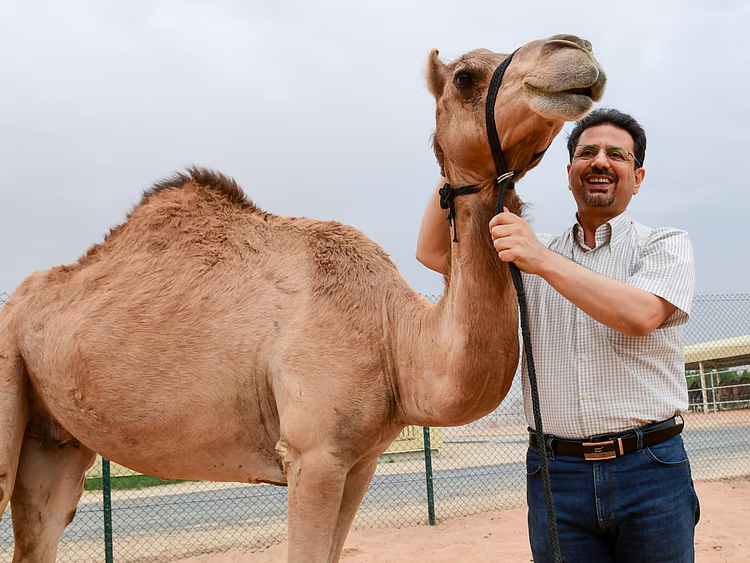
On this day in 2009, the world’s first cloned camel was born in Dubai, marking a major breakthrough in animal genetics and reproductive science.
The female calf, named Injaz- meaning “achievement” in Arabic- was successfully cloned by scientists at Dubai’s Camel Reproduction Centre.
Building on Dolly’s legacy
The birth of the cloned camel came more than a decade after the creation of Dolly the sheep, the world’s first mammal cloned from an adult cell.
Like Dolly, Injaz was produced using somatic cell nuclear transfer- a technique where the nucleus of a body cell is inserted into an egg cell whose own nucleus has been removed.
The success demonstrated that cloning could be extended beyond traditional laboratory animals to species of cultural and economic importance.
Why clone a camel?
Camels play a significant role in Gulf countries, particularly in racing and breeding. Scientists aimed to use cloning to preserve valuable genetic traits and support breeding programmes.
The project focused on replicating elite animals, potentially allowing prized characteristics to be maintained across generations. Since the new offspring is genetically identical to their predecessor, desirable traits can be carried forward and- in the case of breeding programmes- maintained in the gene pool.
A step forward for genetics
The birth of Injaz highlighted the rapid progress of cloning technology and its expanding applications.
While cloning remains a complex and debated field, the successful cloning of a camel showed how techniques first developed in controlled research environments could be adapted for wider use.
Unlike many early cloning attempts, Injaz didn’t just survive, she went on to live a normal life, quietly proving that one of science’s most controversial techniques could work beyond the lab.
It also reinforced the lasting impact of earlier breakthroughs in genetic science, paving the way for further developments in animal reproduction and conservation.
Also read: ON THIS DAY: The discovery of the Venus de Milo
For more videos and updates, check out our YouTube channel
