

Ancient messages still emerging
Viking rune stones continue to surface across Sweden, nearly 1,000 years after they were carved, offering rare insights into love, grief, faith and even climate fears of the past.
In recent years, Swedish rune expert Magnus Källström was called to examine a stone discovered by a farmer south of Stockholm. The slab, initially intended for use as a doorstep, was turned over to reveal rows of ancient runes. When read aloud, the inscription delivered a message unheard for centuries: “Gärder erected this stone in memory of Sigdjärv his father, Ögärd’s husband.”
Such finds are not unusual in Sweden and other Scandinavian countries. Rune stones continue to emerge during construction work, farming and road building. Some date back as far as 2,000 years, including a stone discovered in Norway in 2023. Over centuries, many were reused as building material, embedded in church steps or house foundations.
Today, thousands remain scattered across fields, roadside verges and town centres, visible reminders of a writing system whose name derives from the Old Norse word rún, meaning “secret”.
The social media of the Viking Age
Runic writing first appeared in northern Europe around 2,000 years ago. Inspired by contact with Latin and other southern European scripts, traders and travellers adapted the concept of writing to capture northern languages such as Old Norse. Early versions used 24 characters, later simplified to 16.
Runes were carved into wood, bone, tools and textiles. One 11th-Century textile tool found near Gothenburg bears the message: “Do you think of me, I think of you, do you love me, I love you.” But stone inscriptions have endured most visibly.
Rune stones became especially popular during the Viking Age, between 800 and 1050 AD. Often erected in public places such as roads, fords and assembly sites, they served as memorials and status symbols. Scholars have described them as the “social media” of their time.
Commissioning a stone was costly and likely reserved for families of means. Many inscriptions reflect the gradual spread of Christianity in Scandinavia, incorporating crosses and prayers for the dead alongside traditional decorative patterns.
Grief, pride and everyday humour
Most rune stones were raised in what is now southern Sweden and Norway, though examples have been found in Denmark, Iceland, the UK and even as far as Turkey and Greenland. In total, around 7,000 runic inscriptions are known worldwide.
Their texts often follow a formula, commemorating the deceased while sometimes highlighting achievements:
“Tóla placed this stone in memory of Geirr, her son, a very good valiant man. He died on a Viking raid on the western route.”
Others reveal dramatic events or inheritance claims, referencing odal – ancestral land rights. One inscription from northern Stockholm recounts betrayal and affirms family ownership of an estate.
Some stones convey intimate grief. Near the town of Sala, one reads: “The good husbandman Holmgautr had [the stone] raised in memory of Óðindísa, his wife. There will come to Hǫsumýrar no better housewife.” The message closes with praise for her as a sister.
Not all were solemn. Runes were also used playfully on bones carved for practice, featuring riddles and puns. When rotated, some reveal messages such as “decipher this” or “tasty beer” – evidence that Vikings enjoyed linguistic games.
One notable figure, Jarlabanke, commissioned several stones praising himself while still alive, declaring sole ownership of his land and asking God to help his spirit.
The mystery of the Rök stone
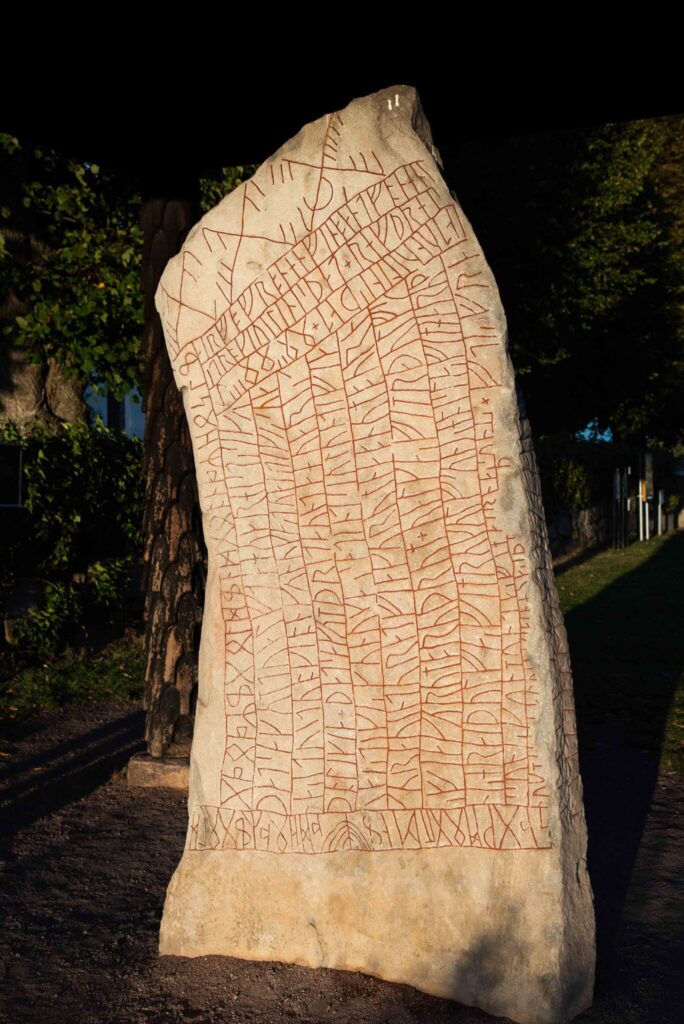
Among the most debated inscriptions stands the Rök stone in southern Sweden, erected in the 9th Century. Protected under a roof near a village church, it carries the world’s longest known runic text.
The inscription begins with a father commemorating his dead son before unfolding into a series of riddles. For decades, scholars linked the text to heroic tales and the Gothic king Theoderic. More recently, researchers from Uppsala University and the University of Gothenburg have proposed a different interpretation.
In 2020, scholars suggested the stone reflects anxiety about extreme climate events centuries earlier, possibly triggered by volcanic eruptions that led to cold weather and famine. According to this theory, the riddles encode references to darkness, loss of sunlight and fear of another catastrophe.
The reinterpretation made international headlines, though debate continues. Some scholars caution against viewing the text solely through the lens of contemporary concerns about global warming. Others argue that climate anxiety was a genuine and recurring theme in pre-industrial societies dependent on harvests and weather patterns.
Another interpretation suggests the stone functioned similarly to religious funeral sermons today, using mythological references – including Odin and Ragnarök – to comfort the grieving father by placing his son within a cosmic narrative.
A living and contested legacy
By the 12th Century, runic writing gradually gave way to Latin letters as Christianity became firmly established in Sweden. Yet the stones remain embedded in the landscape, too large and heavy to be easily relocated.
Modern fascination with runes continues. They appear in public art, popular culture and online quizzes linking symbols to personality traits. However, runes also carry a darker modern association: their appropriation by Nazi ideology in the 20th Century as symbols of racial mythology.
Despite this complex legacy, the stones themselves remain grounded in personal human stories – of parents mourning children, spouses praising one another, warriors commemorated and communities marking land and lineage.
The once-hidden message read from the farmer’s stone – honouring Gärder, Sigdjärv and Ögärd – now stands visible once more. After centuries buried in a field, its voice from the Viking Age has returned to the public landscape.
Source: BBC
Also read: Tsiknopempti: Flavour, fire, and fellowship across Cyprus
For more videos and updates, check out our YouTube channel
