

Police have banned Hungary’s annual Budapest Pride march later this month, prompting a defiant response from liberal Mayor Gergely Karacsony.
“Budapest city hall will organise the Budapest Pride march as a local event on 28 June, Period,” vowed the mayor.
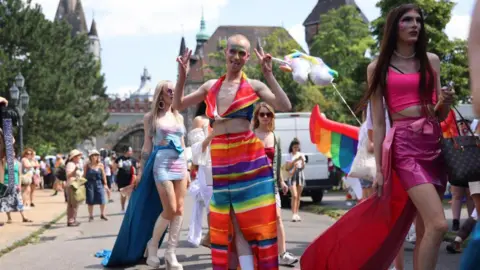
It’s the latest twist in a cat-and-mouse confrontation which pits nationalist Prime Minister Viktor Orban’s Fidesz government, backed by the city police, against Hungary’s LGBTQ community and its supporters, with some legal backing from the courts.
The annual Pride march has been in doubt since Orban announced in February that it would not take place this year, and a law was then passed restricting gatherings if they broke child protection laws on public promotion of homosexuality.
Karacsony said police had no right to ban a “Day of Freedom”, organised by the city council as an umbrella event for Pride, as it does not come under the rules on freedom of assembly.
Tens of thousands of people from Hungary and abroad are expected to take part in the 28 June event.
“They might as well try to ban a procession of unicorns,” the mayor wrote on Facebook.
Under the new law on gatherings, passed in March, all those identified by the police as participants using facial recognition software could be fined between £14 and £420.
“The protection of children trumps all other laws. And in that spirit we changed the laws, we make politics, and we will act in future,” Fidesz communications chief Tamas Menczer told news portal 444.
“Pride has nothing to do with freedom of expression or freedom of assembly… Pride is a festival, the festival of a certain sexual community, which is not suitable to be seen by children.”
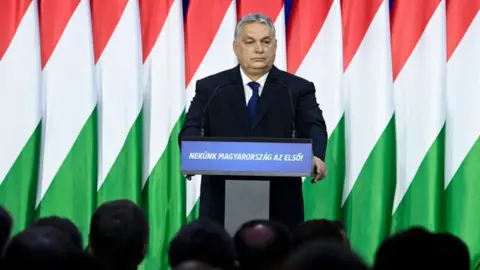
Viktor Orban announced in his annual state of the nation speech last February that Pride organisers “need not bother this year”. That was followed the next month by a law restricting the right to freedom of assembly, if it fell foul of the 2021 Child Protection Law.
To get around it the Rainbow Mission foundation, which organises Pride in Hungary, and other human rights groups, announced a series of events on 28 June in solidarity with Pride.
But they kept authorities guessing about which event would mark Pride itself. Police attempts to ban those events were thwarted by Hungary’s Supreme Court, the Curia, in two rulings so far.
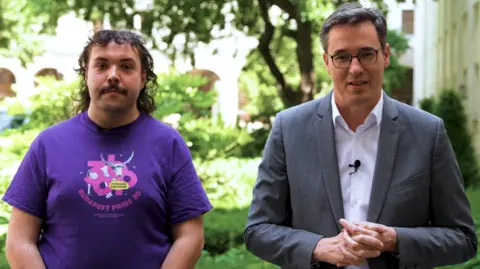
The Budapest mayor then appeared on 16 June with the spokesperson of Budapest Pride, Mate Hegedus, in a joint Facebook video, announcing their Day of Freedom, with events from early morning to late in the evening.
The central event was to be a procession through the city and the event “is not Pride”, the mayor wrote to the police.
“There will be no trucks, no dancers, no sexuality in any form.” The purpose, he maintained, was simply “to make the nation’s capital free”.
That is what the police are now trying to prevent, on the grounds that underage bystanders may witness the procession, no matter the age of those actually taking part, how they are dressed, or what banners they carry.
That would breach the child protection law, Budapest police chief Tamas Terdik argued, in a 16-page document issued by police, justifying the ban.
Terry Reintke, German MEP took to the European Parliament to voice her opposition to the ban.
You can't ban love. You can't ban freedom. You can't silence a rainbow. 🌈
— Terry Reintke (@TerryReintke) June 19, 2025
Despite the ban ordered by Viktor Orbán, the Budapest Pride will go ahead.
To queer communities in Hungary & across Europe: We see you, we support you, we won't stay silent. ✊
🏳️🌈 🏳️⚧ See you at Pride pic.twitter.com/je0Z2pdtLY
So what will actually happen on 28 June?
Human rights group the Hungarian Helsinki Committee (HHC), has advised anyone going on the day to refuse to pay any on-the-spot fines.
They suggest anyone who does receive a notification by post to ask for an in-person right of appeal with the police, or in court if that fails.
The more people take part, the less likely the police will try to attempt this, the HHC argues, as it could create a massive backlog for both the police and the courts.
⚡️🏳️🌈After Viktor Orbán’s government passed an anti-LGBT law to ban the Pride march, Budapest mayor Gergely Karácsony announced the city will officially organize Budapest Pride as a municipal event—meaning the ban won’t apply, and police can’t disperse the crowd or issue fines. pic.twitter.com/CPxpNysQmN
— Szabolcs Panyi (@panyiszabolcs) June 16, 2025
Also read: Hungary to veto new EU sanctions on Russia
Featured photo source: Anna Szilagyi/ AP
Source: Nick Thorpe – BBC
