

A new Euronews analysis looks at when Europeans retire and how many years they can expect to spend in retirement, highlighting significant differences across countries.
According to OECD data, the average retirement age in the EU in 2024 was 64.7 years for men and 64 years for women.
To compare retirement years in Europe, Euronews Business used life expectancy at retirement age in each country, based on 2024 Eurostat and OECD data.
The figures represent the expected period during which people may receive a pension, provided they also meet other requirements, such as minimum contribution or employment periods.
Men spend an average of 18.4 years in retirement
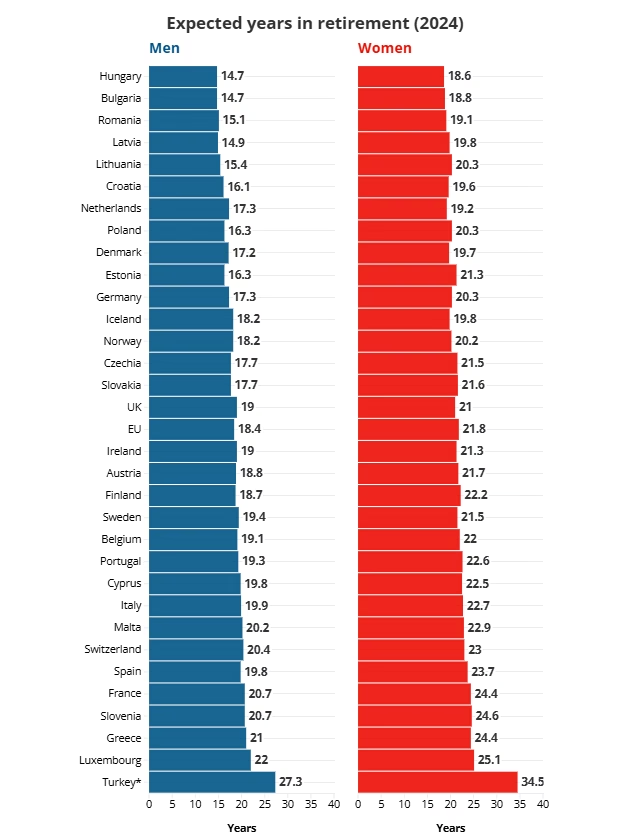
Men in the EU are expected to live for an average of 18.4 years after reaching retirement age, compared with 21.8 years for women.
For men, the expected period ranges from 14.7 years in Bulgaria and Hungary to 27.3 years in Turkey.
Within the EU, Luxembourg has the longest expected retirement period for men, at 22 years.
Men in Greece are expected to spend around 21 years in retirement, followed by France and Slovenia at 20.7 years, Switzerland at 20.4 years and Malta at 20.2 years.
The figure is also above the EU average in Cyprus, at 19.8 years, as well as Sweden (19.4), Portugal (19.3), Belgium (19.1), Ireland (19), the UK (19), Austria (18.8) and Finland (18.7).
The differences are mainly linked to variations in retirement ages and life expectancy.
Germany falls below the EU average
Among Europe’s largest economies, Germany stands out for having a shorter expected retirement period for men.
German men are expected to spend 17.3 years in retirement, 1.1 years below the EU average.
By comparison, the figure is 21 years in Greece, 20.7 in France and 20.7 in Slovenia, while Italy and Spain also stand above the EU average.
Outside Bulgaria and Hungary, men are expected to spend the fewest years in retirement in Latvia, Romania and Lithuania, where the figure is below 16 years.
For women, the EU average is 21.8 years.
The figure ranges from 18.6 years in Hungary to 34.5 years in Turkey, while it exceeds 25 years in Luxembourg.
Women in Slovenia, Greece, France, Spain, Switzerland, Malta, Italy, Portugal, Cyprus and Finland are expected to spend more than 22 years in retirement.
Germany, at 20.3 years, and the UK, at 21 years, are both below the EU average.
Women spend longer in retirement
On average, women in the EU are expected to spend 3.4 more years in retirement than men.
The gap ranges from 1.6 years in Iceland to 7.2 years in Turkey.
It reaches four years or more in Estonia, Lithuania, Latvia, Bulgaria, Romania and Poland.
Euronews notes that labour-force participation rates are comparatively lower in some of these countries.
There is also a significant gender gap in pension income. Across OECD countries, women receive pensions that are on average 23% lower than those of men. In the UK, the gap reaches 37%.
Turkey is a major exception
Turkey stands out among the 32 European countries included in the analysis.
In 2024, the retirement age was 52 for men and 49 for women, compared with a range of 62 to 67 for men and 60 to 67 for women across the other countries examined.
The EU average retirement age was 64.7 for men and 64 for women.
Life expectancy was 83.1 years for men and 85.8 years for women.
Although Turkey has the highest expected number of retirement years, the picture changes when the actual age at which people leave the labour market is considered.
Actual retirement from work can come earlier or later
The average age at which people actually leave the labour market can differ from the official retirement age.
In the EU, men have an average retirement age of 64.7 but leave the labour market at an average age of 63.8. For women, the corresponding figures are 64 and 62.9.
Turkey shows the largest difference.
While men can retire at 52, their average labour-market exit age is 60.8. For women, the figures are 49 and 60.5 respectively.
Based on the actual labour-market exit age, the expected period outside the workforce would therefore be around 18.2 years for men and 22.6 years for women in Türkiye.
The comparison shows why official retirement ages alone do not provide a complete picture of how long people spend outside the labour market.
Pensions remain the main source of income for older Europeans, but pension levels vary considerably across Europe, both in nominal terms and in purchasing-power terms.
Also read: €820m pension reform bill to reach Parliament by end of September
For more videos and updates, check out our YouTube channel
