

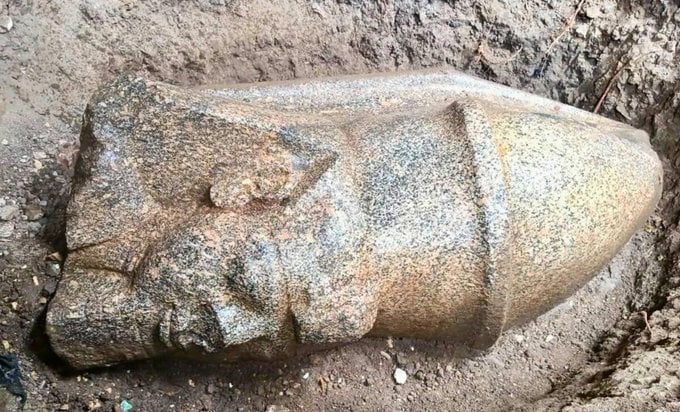
A giant Ramses II statue has emerged from an unexpected archaeological discovery in Egypt, after a farmer found ancient stone fragments in a cucumber field in the Nile Delta. The find led archaeologists to the remains of two monumental royal statues, including a head identified as belonging to one of ancient Egypt’s most powerful pharaohs.
Khaled Khalil was working on his farmland in Behbeit el-Hagar, a village in the Gharbia Governorate, when he noticed a stone bearing ancient carved symbols. Recognising its possible significance, he alerted the archaeological authorities, prompting a rescue excavation by an Egyptian team from the Supreme Council of Antiquities.
According to Egypt’s Ministry of Tourism and Antiquities, the excavation uncovered significant remains of ancient Egyptian sculpture that could help researchers better understand the area’s history.
A 1.6-metre head and an 8.5-metre statue
The most significant discovery is a colossal head measuring approximately 1.6 metres in height. It depicts Ramses II wearing the double crown of Upper and Lower Egypt.
Archaeologists also found part of the statue’s back pillar, which bears the pharaoh’s Horus name, one of his official royal names.
Hisham El-Leithy, secretary-general of the Supreme Council of Antiquities, said the proportions of the surviving fragment suggest that the complete Ramses II statue may have stood approximately 8.5 metres tall, including its base.
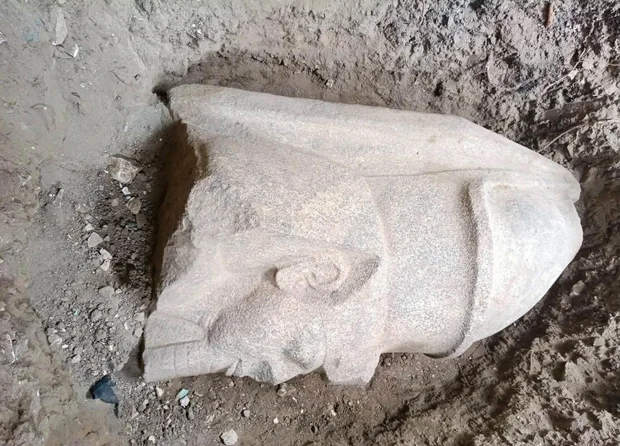
A second large statue was also discovered during the excavation. Its surviving fragment measures approximately 2.4 metres in length. Although its feet and base are missing, the face remains in very good condition, with the distinctive nemes headdress associated with Egyptian pharaohs clearly visible.
The facial features resemble those of the first head, leading experts to suggest that the second statue may also depict Ramses II. However, its identity has not yet been confirmed.
The excavation also uncovered a pink granite block measuring approximately 1.3 metres long. It bears hieroglyphic inscriptions containing royal titles, including “King of Upper and Lower Egypt” and “Son of Ra”.
Ramses the Great ruled for more than 60 years
Ramses II, also known as Ramses the Great, ruled Egypt from 1279 to 1213 BC during the 19th Dynasty. His reign lasted more than six decades and was marked by major construction projects and monumental buildings that remain symbols of ancient Egyptian civilisation.
Among the best-known monuments associated with the pharaoh are the temples of Abu Simbel, where enormous statues of Ramses II still dominate the entrance.
Behbeit el-Hagar is already known to archaeologists for the remains of a major temple dedicated to the goddess Isis. Research at the site is continuing as experts investigate how the newly discovered fragments relate to one another and to the wider archaeological complex.
Farmer rewarded for reporting the discovery
The discovery attracted the attention of Egyptian officials. Tourism and Antiquities Minister Sherif Fathy visited Khalil to thank him for notifying the authorities about the ancient remains.
The farmer and his wife were offered a trip to Mecca to perform Umrah, the Muslim pilgrimage that can take place throughout the year.
During the visit, Khalil also asked the Gharbia governor for help covering the remaining cost of purchasing an ambulance for his village. Residents had already raised part of the money needed.
The discovery in land used to grow cucumbers highlights how much of Egypt’s ancient history may still lie beneath its soil.
Also read: World’s oldest known shipwreck found off Turkey
For more videos and updates, check out our YouTube channel.
