

On 26 February 1802, in the city of Besançon, a child was born who would grow to embody the restless spirit of 19th-century France. Victor Hugo would become not merely a novelist or poet, but a moral force, a writer whose words stirred revolutions of the heart and whose imagination gave voice to the poor, the exiled and the condemned.
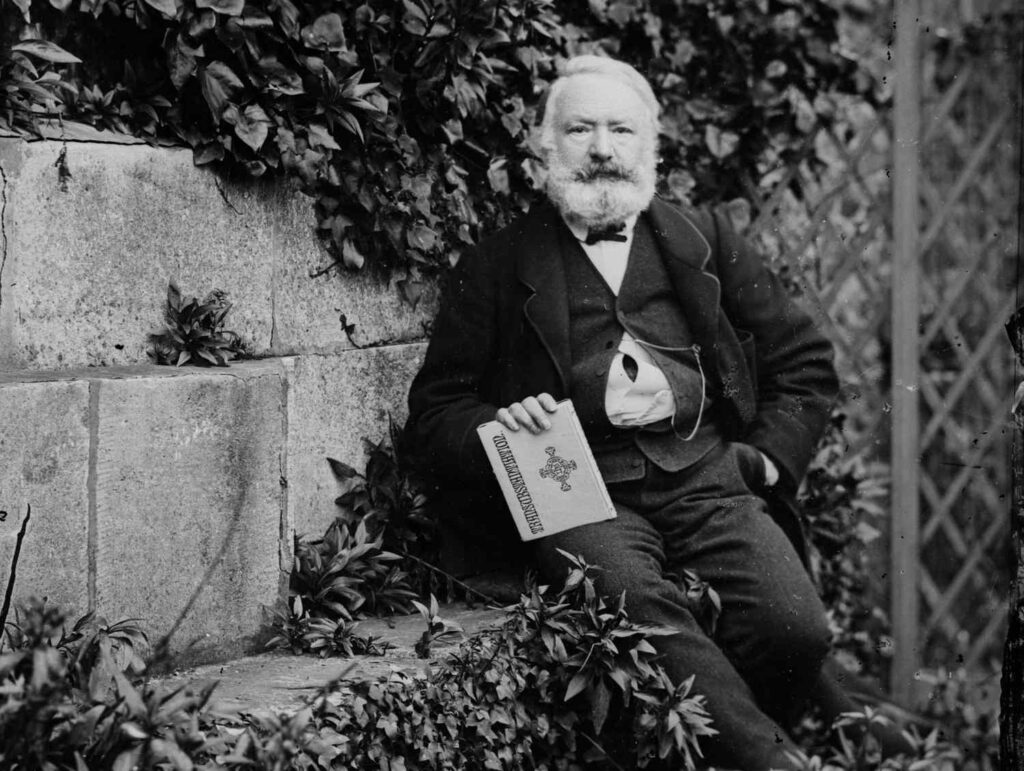
Hugo lived through one of the most turbulent eras in European history. His lifetime spanned the rise and fall of Napoleon, the Bourbon Restoration, the July Monarchy, the Revolution of 1848 and the authoritarian rule of Napoleon III. France shifted repeatedly between monarchy and republic; Hugo’s pen shifted with it, evolving from royalist sympathies in his youth to an impassioned defender of republican ideals, social justice and human dignity. Exiled for nearly two decades to the Channel Islands for opposing Napoleon III, he continued to write with undimmed fire, turning personal banishment into artistic liberation.
It was during this period that he produced what many regard as his crowning achievement: Les Misérables. Published in 1862, the novel was an immediate sensation. Readers queued for copies; critics alternated between reverence and outrage. Some dismissed its vast scope and emotional intensity as excessive. Others recognised in Jean Valjean’s suffering and redemption a universal cry for compassion. Hugo himself described the book as a work for humanity: “So long as ignorance and misery remain on earth, books like this cannot be useless.”
Earlier, he had already secured literary immortality with The Hunchback of Notre-Dame (Notre-Dame de Paris), a sweeping Gothic tale that rescued a neglected cathedral from decay by rekindling public fascination with medieval architecture. Through Quasimodo and Esmeralda, Hugo demonstrated his rare ability to fuse romance, tragedy and social commentary into one unforgettable tapestry.
Hugo was also a master poet and dramatist. Collections such as Les Contemplations and plays like Hernani helped define French Romanticism, challenging classical conventions and electrifying audiences. The infamous “Battle of Hernani” in 1830, when traditionalists and romantics clashed in the theatre, signalled not only a cultural shift but Hugo’s ascent as the standard-bearer of a new artistic age.
During his lifetime, he was both a celebrated and controversial figure. He was elected to the Académie Française at just 41. Crowds gathered beneath his windows. Yet he was also denounced, censored and forced into exile for his political convictions. When he returned to France in 1870 after the fall of the Second Empire, he was welcomed as a hero. Upon his death in 1885, more than two million people are said to have lined the streets of Paris to pay their respects as his body lay in state beneath the Arc de Triomphe before burial in the Panthéon, a testament to the extraordinary bond between writer and nation.
Posthumously, his stature has only grown. Les Misérables has never fallen out of print and continues to be rediscovered by each generation. Its afterlife has been particularly luminous on the stage. The musical adaptation by Claude-Michel Schönberg and Alain Boublil, which premiered in Paris in 1980 before conquering London’s West End and Broadway, transformed Hugo’s sweeping narrative into one of the most beloved musicals of all time. Anthems such as “I Dreamed a Dream” and “Do You Hear the People Sing?” have carried Hugo’s themes of suffering and hope to global audiences, proving that his moral vision transcends centuries and languages.
The story has proved equally powerful on screen. From early silent adaptations in the 20th century to the sweeping 1998 film starring Liam Neeson as Jean Valjean, filmmakers have repeatedly returned to Hugo’s epic. Most notably, the 2012 cinematic adaptation of the stage musical, directed by Tom Hooper and featuring Hugh Jackman, Anne Hathaway and Russell Crowe, brought a raw, close-up intensity to the beloved score. Hathaway’s rendition of “I Dreamed a Dream” earned her an Academy Award and introduced a new generation to Hugo’s unflinching portrait of despair and redemption. Each adaptation, in its own way, reaffirms the enduring cinematic pull of Hugo’s vision, intimate human suffering set against the vast machinery of history.
Hugo was a man of immense appetites, for literature, for politics, for love. He wrote prolifically, kept detailed journals, and maintained a lifelong commitment to humanitarian causes, speaking out against the death penalty and poverty. He believed in progress, in the possibility of a more just society, and in the sacred power of the written word.
To read Hugo today is to encounter a writer unafraid of grandeur, of emotion worn openly, of injustice denounced loudly, of beauty described lavishly. As we mark the birth of a literary titan, we are reminded that great art does more than entertain. It consoles. It provokes. It demands that we look at the least fortunate among us and see not statistics, but souls.
Also read: 10 of the greatest murder mysteries ever
