

On January 28, 1986, the United States faced a heartbreaking space disaster when the Space Shuttle Challenger exploded just 73 seconds after liftoff from Kennedy Space Center in Florida. All seven crew members aboard died, sending shockwaves across the nation and the world.
A mission of hope cut short
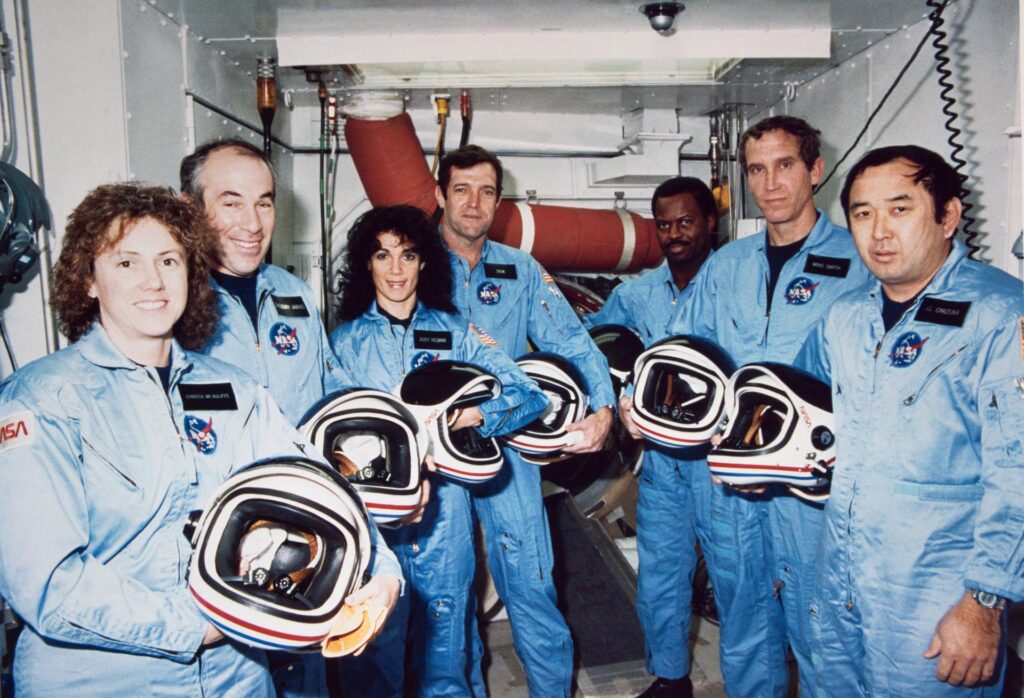
The ill-fated flight, STS‑51L, marked the shuttle’s tenth mission and the 25th flight of NASA’s Space Shuttle Program. It carried seven crew members, including Christa McAuliffe, a high school teacher chosen to participate in NASA’s Teacher in Space Project.
At 11:38 a.m. EST, Challenger lifted off amid global excitement. But at Max Q, the moment of maximum aerodynamic pressure, the shuttle broke apart in a devastating explosion.
What caused the explosion?
Investigators found that a failed O‑ring seal in the shuttle’s right solid rocket booster triggered the disaster. The extreme cold on launch day made the rubber seal brittle, allowing hot gases to escape and ignite the external fuel tank. The resulting chain reaction destroyed the shuttle within seconds.
The crew and the human toll
The explosion claimed the lives of:
- Francis R. “Dick” Scobee – Commander
- Michael J. Smith – Pilot
- Ellison S. Onizuka – Mission Specialist
- Judith A. Resnik – Mission Specialist
- Ronald E. McNair – Mission Specialist
- Gregory B. Jarvis – Payload Specialist
- Christa McAuliffe – Teacher and Payload Specialist
These astronauts were skilled pilots, engineers, scientists, and in McAuliffe’s case, a civilian educator whose mission inspired millions.
A nation mourns
Millions watched the tragedy live on television. President Ronald Reagan appointed the Rogers Commission, including Neil Armstrong, Chuck Yeager, and physicist Richard Feynman, to investigate. Feynman famously demonstrated the O‑ring failure during the inquiry.
Aftermath and lasting legacy
NASA grounded the shuttle program for 33 months, redesigned critical components, and improved safety procedures. Shuttle flights resumed in 1988, but the Challenger explosion remains a poignant reminder of the risks of human spaceflight. Memorials, documentaries, and educational programs continue to honour the crew and inspire future explorers.
Also read: ON THIS DAY: Liberation of Auschwitz-Birkenau by the Red Army (1945)
For more videos and updates, check out our YouTube channel
