

On 10 July 1964, fashion history remembers Mary Quant’s role in transforming the way a generation dressed, as the miniskirt emerged as one of the defining symbols of 1960s Britain. More than a new hemline, it came to represent youth, movement, rebellion and a changing idea of women’s freedom.
The date is listed as the moment in 1964 when Mary Quant “revolutionised fashion” with the miniskirt in England. Yet the history behind that revolution is more complex than a single day or a single designer. The Victoria and Albert Museum notes that the rise of above-the-knee skirts was gradual and that the extremely short miniskirt familiar from later images of the Swinging Sixties did not fully arrive until around 1966.
What is beyond doubt is that Quant became the designer most closely associated with taking the short skirt out of the exclusive world of fashion experimentation and placing it at the heart of a mass youth culture.
A new kind of London
By the early 1960s, Britain was changing. A younger generation had more cultural visibility and increasingly rejected the conventions of its parents. Rock ’n’ roll, new dance crazes, the rise of the Mods and the growing importance of teenagers as consumers all helped create an appetite for clothes that were less formal, less restrictive and more expressive.
Quant was ideally placed to capture that mood. Her boutique Bazaar, opened on London’s King’s Road in 1955, became part of a new retail culture in which shopping itself felt youthful and theatrical. The V&A describes an atmosphere of loud music, drinks, witty window displays and late opening hours, a striking contrast with conventional department stores and the formality of haute couture.
Her clothes reflected the same philosophy. Rather than asking young women to imitate the polished, structured silhouettes associated with their mothers’ generation, Quant produced simple shifts, pinafores, tunics and separates designed for an active life. The London Museum notes that her short skirts allowed wearers greater freedom to move, dance and run than much traditional womenswear.
That practicality was central to the revolution. The mini was provocative, certainly, but its appeal was not simply about exposing more leg. It belonged to a complete rejection of the stiff, heavily constructed ideal of femininity that had dominated much of the 1950s.
Did Mary Quant actually invent the miniskirt?
The familiar claim that Quant “invented” the miniskirt needs qualification.
Fashion historians have long debated the garment’s origins. The French couturier André Courrèges is another major figure in the story, and the V&A records that his short-skirted couture collection attracted international attention in 1964. Other designers were also experimenting with rising hemlines, while young women on the streets of London were shortening skirts independently of the fashion establishment.
The V&A therefore treats the idea of a single inventor as something of a myth. Hemlines had been moving upwards for years, influenced by youth culture, dancing, changing social conventions and street style. Quant’s particular achievement was to understand that shift, amplify it and make it commercially powerful.
Even 1964 was a transitional year rather than the sudden appearance of the thigh-high mini. One surviving Quant lace dress from that year, produced for her more affordable Ginger Group label, originally had a hemline around the knee. Its owner later shortened it — a small but revealing example of how women themselves participated in pushing hemlines higher. The V&A says surviving garments and photographs suggest that skirts only became dramatically short by 1966.
So 1964 is best understood as a turning point: the moment when the new silhouette gathered momentum and the fashion revolution became increasingly difficult to ignore.
From boutique experiment to mass phenomenon
Quant’s commercial instinct was crucial. In 1963, she expanded into the wider UK market with Ginger Group, a cheaper line that helped make fashionable clothes more accessible to younger consumers. Her designs were easy to reproduce, often based on straightforward shapes and practical fabrics, and by 1965 demand was growing in Britain, Europe and the United States. The term “miniskirt” also began appearing in newspaper reports around that time.
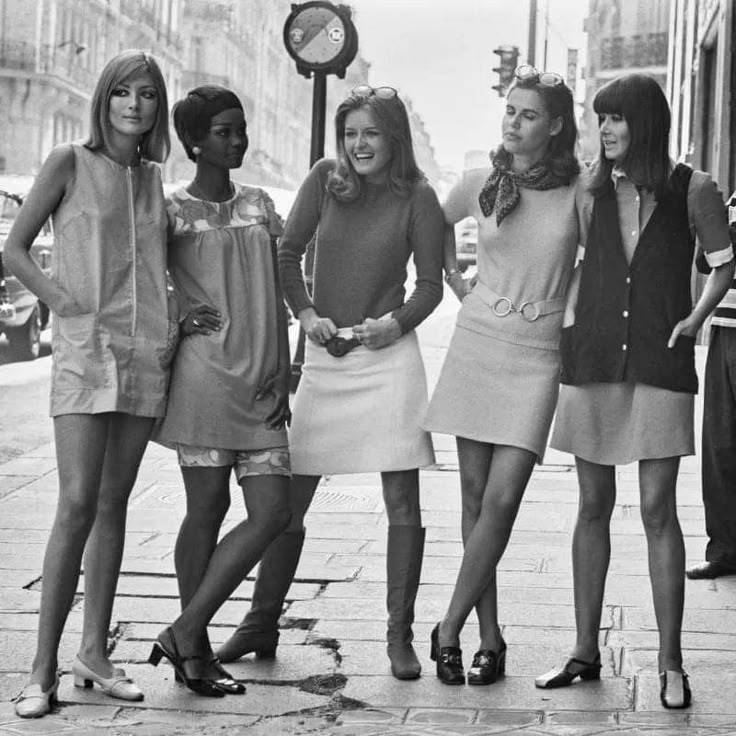
The garment soon became part of a complete visual language. Short skirts were worn with brightly coloured tights, flat shoes, simple sweaters and geometric haircuts. Quant’s use of jersey was particularly important: the fabric was practical, colourful, relatively easy to mass-produce and suited the clean, energetic shapes of her dresses.
Tights also helped make the mini workable. Traditional stockings, suspenders and exposed upper thighs were poorly suited to rapidly rising hemlines. Quant promoted coloured hosiery as part of the look, helping to create outfits in which women could move more freely. By the 1970s, tights had overtaken stockings in popularity.
The result was a style that looked modern because it behaved differently. It was made for walking quickly, dancing, travelling and inhabiting the city.
Shock, criticism and generational conflict
The miniskirt’s reception was far from universally enthusiastic.
For many older observers, the sudden exposure of the legs seemed indecent or socially threatening. The V&A records that the mini provoked shock and outrage among the older generation, even as it became increasingly normal among younger people.
That controversy was part of its power. Clothing had become a visible battleground between generations. A short skirt could signify a refusal to accept inherited rules about respectability, age and female appearance.
Yet the politics of the mini were never simple. It was celebrated as a symbol of liberation, confidence and bodily autonomy, but critics later questioned whether it also encouraged the sexualisation of women. The V&A notes both sides of this legacy: the mini became an international symbol of women’s liberation, while some campaigners associated it with an over-sexualised stereotype.
That tension remains part of the garment’s history. Was the miniskirt empowering because women chose to wear it, or restrictive because it created another expectation about how women should look? The answer has changed across generations and social contexts.
1966: the mini becomes unmistakable
By 1966, the transformation was complete. The V&A describes this as the point when the “miniskirt proper” arrived, with hemlines several inches above the knee. Models such as Twiggy, along with performers including Cilla Black, helped spread the look internationally.
That same year, Quant received an OBE for her contribution to fashion. In a moment rich with symbolism, she appeared at Buckingham Palace in one of her own distinctive jersey minidresses, taking a style associated with youthful irreverence into one of Britain’s most traditional settings.
By the end of the decade, the mini had become inseparable from the international image of Swinging London.
From mini to micro, and back again
Fashion, however, rarely moves in a straight line.
As the 1960s progressed, hemlines climbed still higher, eventually producing the micro-mini. Yet from around 1968, longer midi and maxi styles also entered fashion, meaning the mini did not simply replace every other skirt length. Instead, women increasingly encountered a wider range of silhouettes and choices.
The mini has repeatedly returned since then, reinterpreted through punk, 1980s power dressing, 1990s minimalism and later revivals. Today, micro-minis continue to appear both on catwalks and in street fashion, evidence of the extraordinary endurance of an idea once regarded as shocking.
Quant’s influence also stretched far beyond skirt length. She helped popularise jersey dresses, coloured tights, skinny-rib sweaters, PVC rainwear and an approach to branding that extended into cosmetics and accessories. By the end of the 1960s, she had become Britain’s highest-profile designer, with an unusually broad reach into everyday wardrobes.
A hemline that changed more than fashion
The enduring significance of the miniskirt lies in the fact that it was never merely a smaller version of an existing garment.
It emerged from a broader transformation in who could shape fashion. Young consumers mattered more. Street style challenged couture. Ready-to-wear clothing gained cultural force. Women increasingly demanded clothes suited to movement and modern urban life. London, rather than simply following Paris, became an international centre of fashion innovation.
Mary Quant did not create all of those changes by herself, and history does not support a simple story in which one designer invented the miniskirt on one precise day. But she recognised the moment more clearly than most, gave it form, made it accessible and turned a rising hemline into a global cultural symbol.
Also read: Fashion Fighting Stigma: Mental health disorders reimagined
