

Major digitisation project completed
The digitisation of Greek diplomatic archives marks a new era in documenting modern Greek history, with millions of pages expected to shed light on previously unknown aspects of the Cyprus issue.
The project, funded through the Recovery Fund and launched in early 2024, includes material primarily from the Ministry of Foreign Affairs’ central archive and key diplomatic missions abroad.
At the same time, tens of thousands of files are being classified for the first time, including records from the 1967–1974 military dictatorship and the crucial period between 1955 and 1960.
New access for researchers and public
From May 1, both researchers and the wider public will be able to access the Greek diplomatic archives digitally, following established procedures.
Particular attention is focused on documents from the dictatorship era, including the rule of George Papadopoulos and the later months under Demetrios Ioannides.
These records are expected to help reconstruct Greece’s foreign policy during that period and, once declassified, provide valuable material for historical research.
Shedding light on the Cyprus issue
The Cyprus issue is central to the significance of the Greek diplomatic archives, given its close link to the foreign policy decisions of the dictatorship.
Historians hope that newly accessible documents will reveal both the miscalculations of the junta and the diplomatic thinking of officials at the time.
The period leading up to July 15, 1974 – when a coup was carried out against Archbishop Makarios – and the subsequent Turkish invasion remains a key focus of interest.
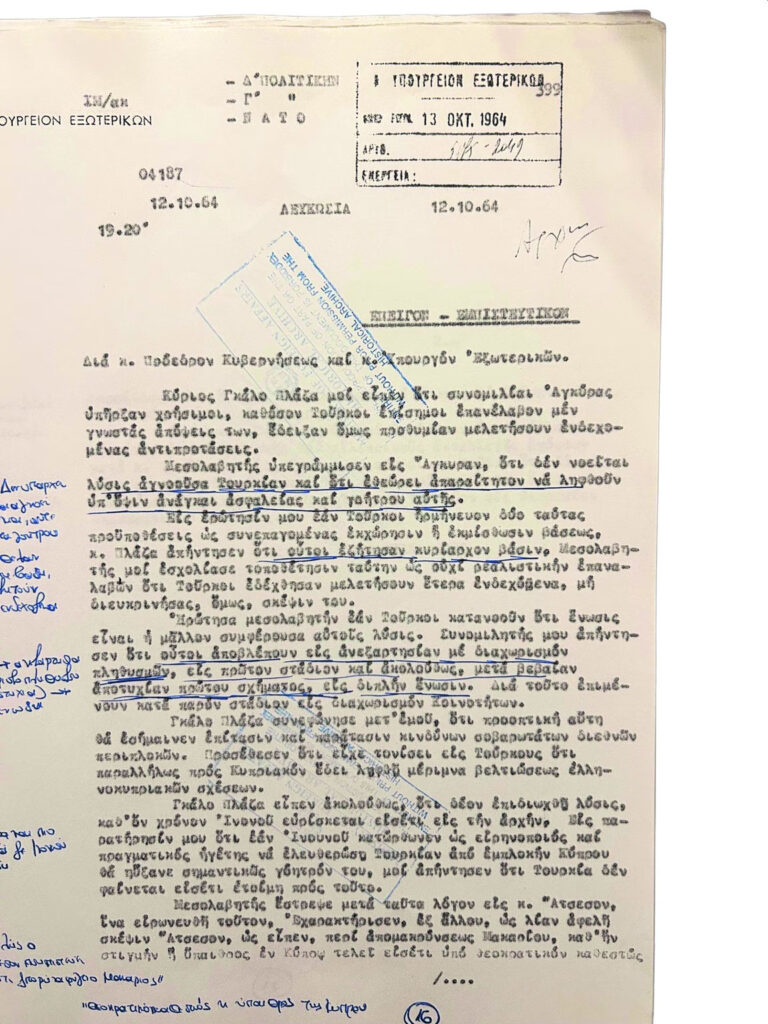
Alexandrakis outlines the key points he gathered from his contacts with the then UN mediator on the Cyprus issue, Galo Plaza. According to Plaza, Turkey would not accept a settlement unless “its needs” in the field of security, as well as its “prestige”, were taken into account. The mediator tells Alexandrakis that the primary objective of the Turks is the separation of populations, followed by “double enosis” (partition combined with the parallel union of the Greek Cypriot part with Greece).
Focus on earlier historical period
Beyond the dictatorship years, a significant volume of documents from 1955 to 1960 is also being processed, marking an important step for historical research.
This period includes key milestones such as the start of the EOKA armed struggle in 1955, the involvement of Turkey in the Cyprus issue, and the Zurich–London Agreements that led to Cyprus’ independence in 1960.
These developments are considered foundational in understanding the evolution of the Cyprus problem.
Breaking long-standing taboos
The initiative follows earlier efforts to release historical material, including the publication of intelligence reports by Greece’s National Intelligence Service in 2024.
Although those reports did not contain major revelations, they were seen as a significant step in addressing long-standing reluctance to confront sensitive historical events.
The digitisation of Greek diplomatic archives is expected to further break these taboos, offering a more complete and transparent picture of critical periods in Greek and Cypriot history.
Source: To Vima
Also read: Kissinger tapes expose U.S. management of Cyprus in July 1974
For more videos and updates, check out our YouTube channel
