

About this Summary
This summary was created with the help of artificial intelligence (AI) to help readers quickly understand the key points of the article.
It has been reviewed by our editorial team before publication. For complete information and full details, please read the full article.
- Residential property prices rose 21.3% from 2023 to 2025, outpacing median earnings growth of 15.7% and increasing pressure on households.
- Paphos is the most vulnerable district to foreign demand, while Limassol and Larnaca also depend significantly on external buyers.
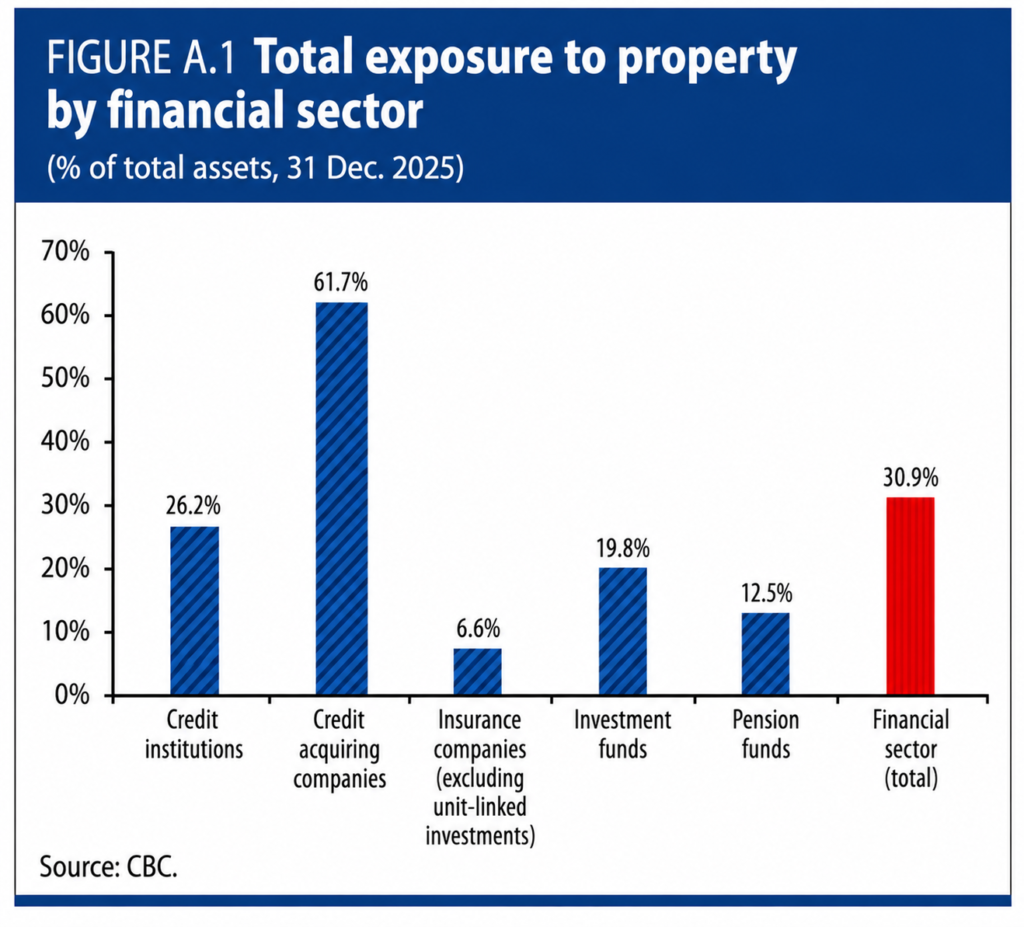
- The property market is closely linked to finance, with 30.9% of the financial sector’s assets directly or indirectly exposed to property developments.
- The CBC warns that sharp corrections in property or global markets could damage collateral values, asset prices and financial stability in Cyprus.
The Central Bank of Cyprus sees no broad-based overvaluation, but notes that prices are close to historic highs, pressure on households is increasing, certain areas depend heavily on foreign buyers and the financial sector has significant exposure to property.
By Xenios Mesaritis
The Central Bank of Cyprus has identified growing vulnerabilities in the country’s property market, although it does not currently see evidence of broad-based overvaluation at national level. According to its 2025 Financial Stability Report, the prolonged rise in prices, worsening housing affordability and the dependence of certain districts on foreign demand have made the market more vulnerable to a deterioration in economic or financing conditions.
The risk has wider implications because of the property sector’s close links with banks, credit-acquiring companies and other financial institutions. The report also warns of the possibility of an abrupt repricing of financial assets in international markets and examines how such a development could affect Cyprus.
Close to the highs of 2008–2009
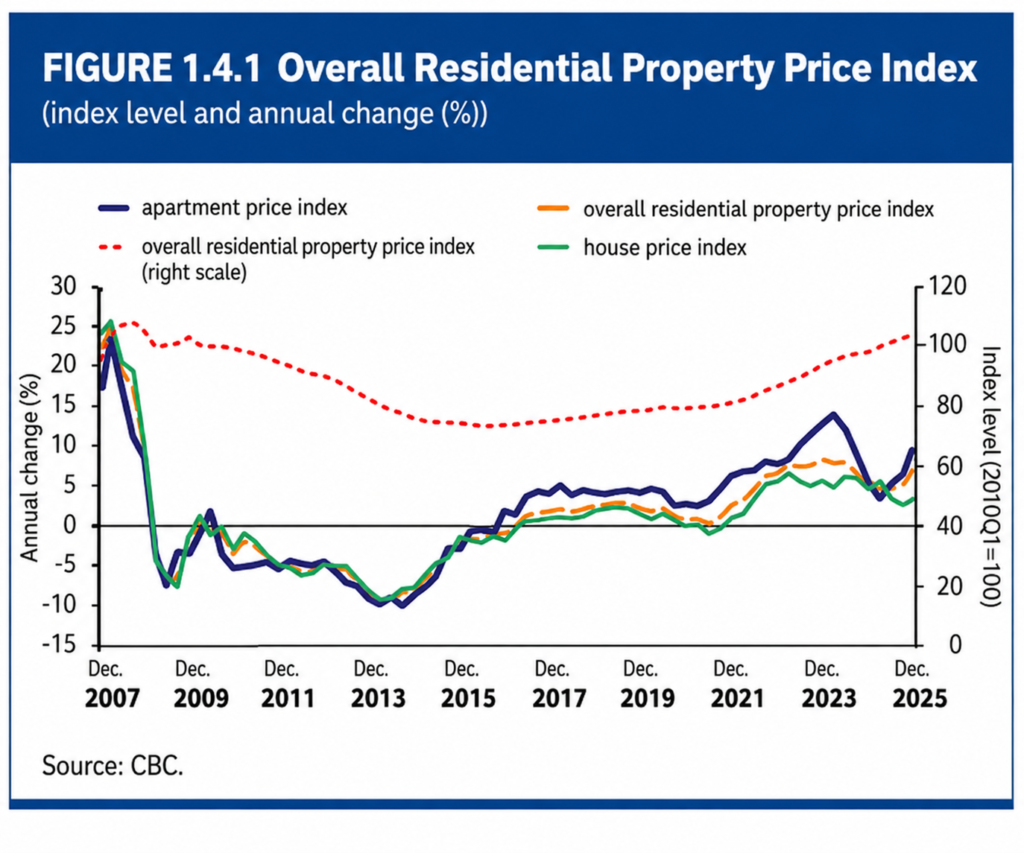
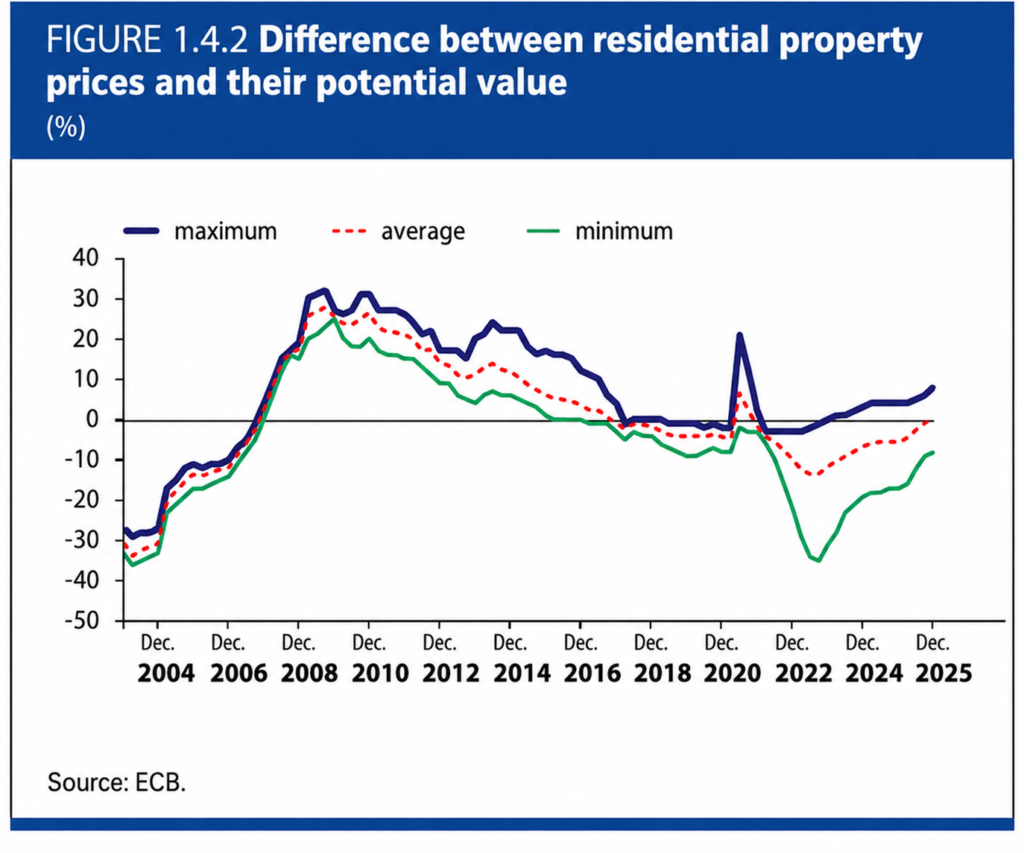
The CBC records a “significant cumulative increase” in residential property prices in recent years and notes that their overall level has moved close to the historic highs recorded in 2008–2009. This, it says, “suggests that vulnerabilities in the property market have increased”.
It clarifies, however, that “although there are currently no indications of broad-based overvaluation at national level, the prolonged rise in prices has made the market more vulnerable to a possible deterioration in financing or macroeconomic conditions”.
Prices rose faster than wages
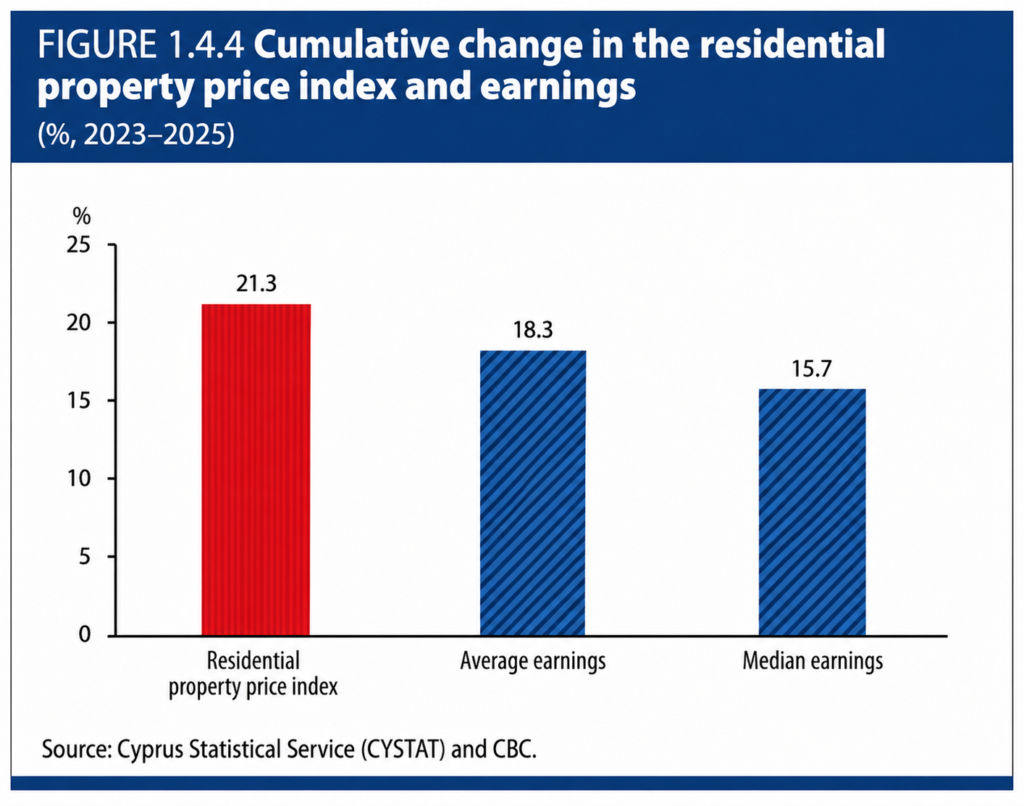
Between 2023 and 2025, the residential property price index increased cumulatively by 21.3%. Over the same period, average earnings rose by 18.3% and median earnings by 15.7%.
“The increase in residential property prices has exceeded the rise in median earnings, indicating growing pressure on domestic households seeking to purchase a home,” the CBC notes.
This development makes demand more sensitive to changes in financing conditions, disposable income and borrowing costs, while narrowing the base of sustainable domestic demand. Despite the market’s resilience to date, the CBC states that “the overall risk profile has deteriorated”.
Foreign demand in focus
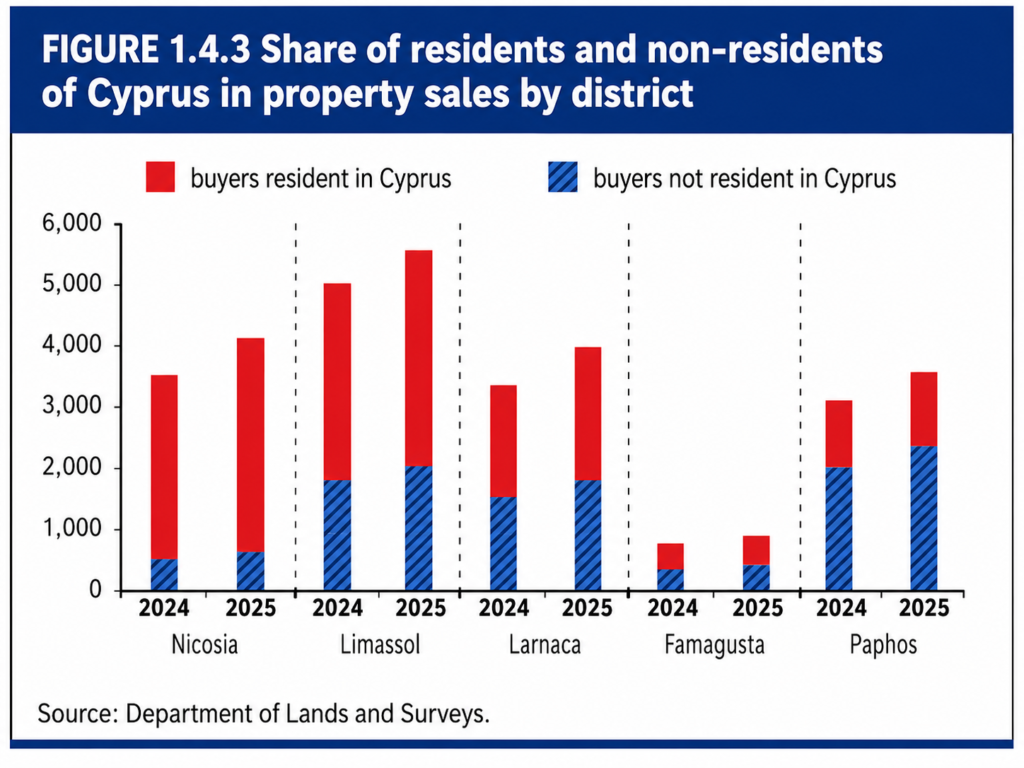
Dependence on foreign buyers is not evenly distributed across all districts. According to the CBC, Paphos displays the greatest relative vulnerability, while Limassol and Larnaca also depend significantly on external demand.
“A sudden or prolonged slowdown in external investment interest could reduce transaction volumes and place pressure on valuations, particularly in areas and property categories that are more dependent on foreign investors.”
The Central Bank also links this vulnerability to the geopolitical environment, as external shocks could affect the market both by limiting foreign demand and by increasing construction costs.
Property linked to 30.9% of the financial sector
The CBC’s mapping exercise, based on data as at 31 December 2025, shows that 30.9% of the financial sector’s total assets are directly or indirectly linked to developments in the property market.
Exposure reaches:
- 61.7% of the assets of credit-acquiring companies;
- 26.2% of the assets of credit institutions;
- 19.8% of the assets of investment funds;
- 12.5% of the assets of pension funds; and
- 6.6% of the assets of insurance companies, excluding unit-linked investments.
The CBC identifies the greatest systemic vulnerability in banks and credit-acquiring companies because of the scale of their exposure, their dependence on collateral values and the high domestic concentration of their portfolios.
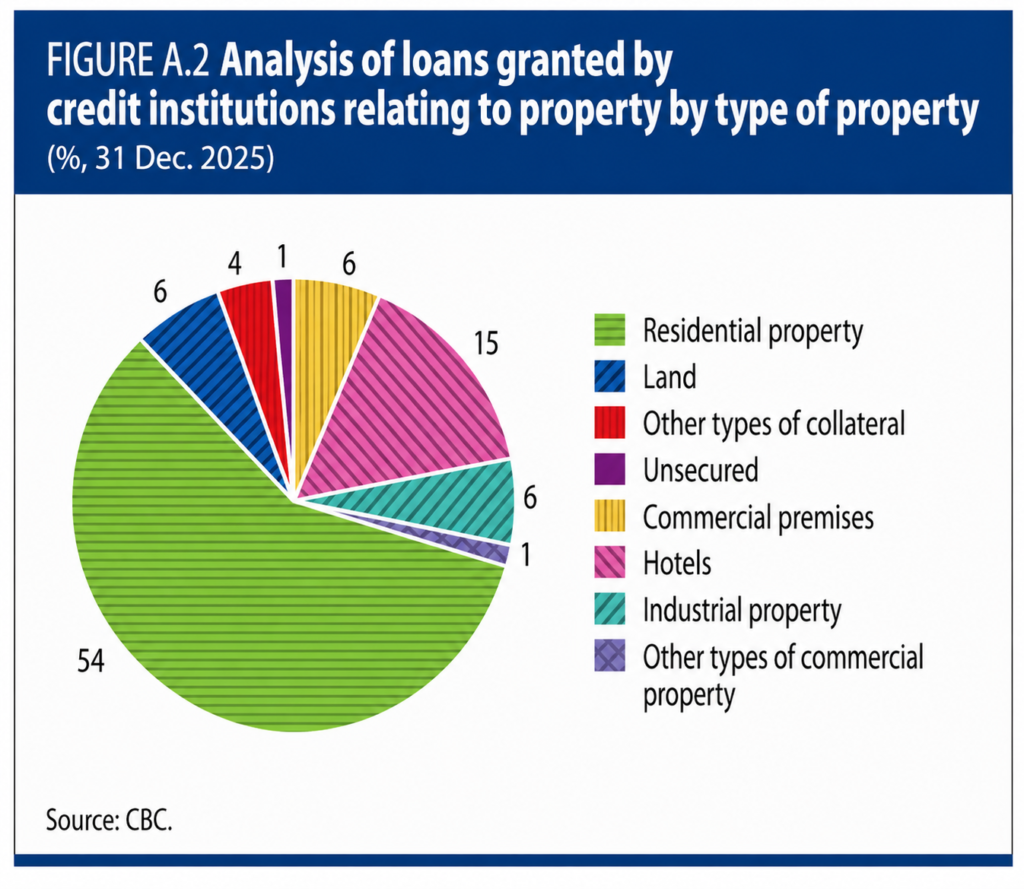
Within banks, residential property accounts for 54% of property-related lending, while hotels represent a further 15%. Some 95% of the relevant assets relate to the domestic market, while Nicosia and Limassol account for 60.3% of loans secured against property.
Among credit-acquiring companies, 39% of property investments concern residential property, 31% land and 11% offices. According to the report, the high proportion of land increases the risks associated with low liquidity and uncertainty over valuations.
The CBC currently sees no evidence of widespread property sales by credit-acquiring companies. It also notes that a significant share of their portfolios was acquired and valued after substantial write-downs, which helps mitigate the immediate impact of a possible market correction.
What a sharp correction would mean
“A sudden correction in prices or a significant slowdown in property-sector activity would constitute a material downside risk to financial stability, through the impairment of the value of properties held directly or indirectly by financial institutions, as well as through a weakening in the quality of collateral,” the CBC states.
Banks nevertheless maintain strong protective buffers. At the end of 2025, the Common Equity Tier 1 capital ratio stood at 25.8%, while the liquidity coverage ratio was 318.6%.
The average loan-to-value ratio was 42.9% for lending secured against residential property and 56.3% for lending secured against commercial property. According to the CBC, these ratios limit the potential impact of a correction on bank profitability and complement the sector’s strong capital adequacy.
Warning over shares and bonds
The report also warns of the possibility of an abrupt repricing in international markets, stating that “global financial markets remain vulnerable to sudden repricing because of persistently high valuations and the growing concentration of the market in specific companies”.
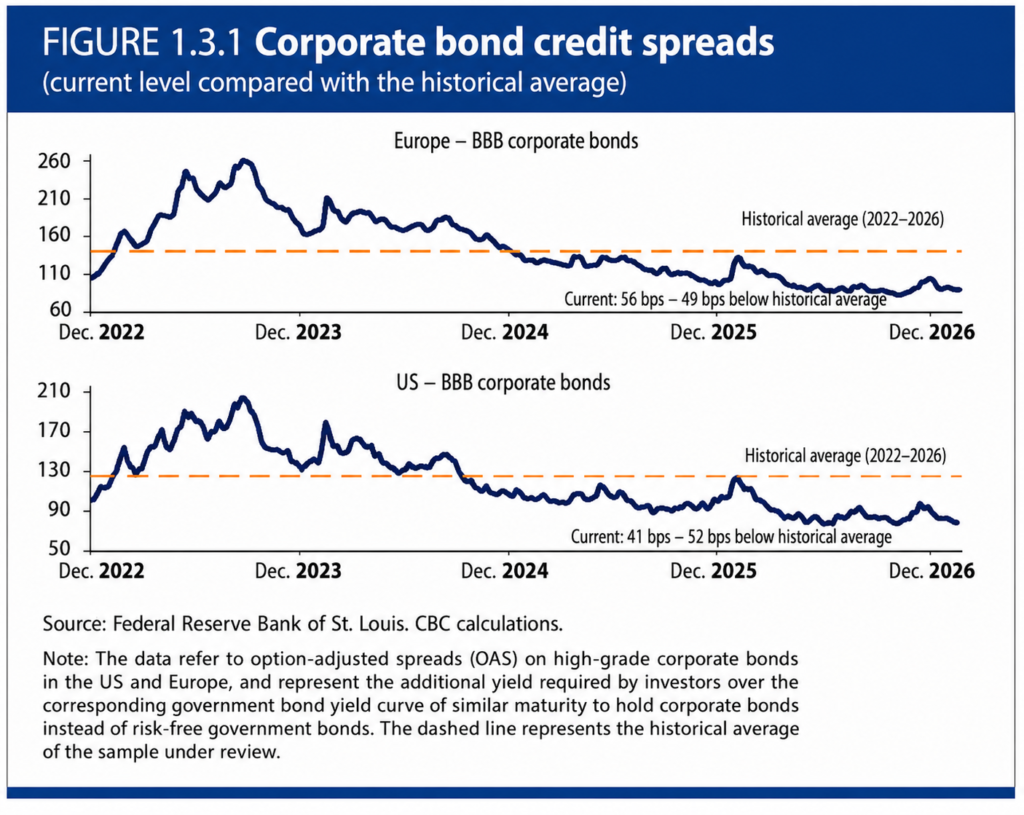
According to the CBC, the US stock market is trading at historically high levels, while credit spreads on investment-grade corporate bonds remain compressed compared with their historic averages.
Particular attention is drawn to the concentration of the US market in a small number of large technology companies, which “are trading at historically elevated valuations”. These valuations are based on expectations of strong future profitability and could, according to the report, prove vulnerable to risks associated with technological progress, the commercial exploitation of investments and competition, particularly in artificial intelligence.
How Cyprus could be affected
For Cyprus, a sharp fall in equity or bond markets could be transmitted through the portfolios of banks, insurance companies, investment funds and pension institutions. It could also affect foreign investment flows, the cost of raising capital and sectors that depend on external demand, including services, tourism, construction and property.
Around 74% of investment-fund portfolios are invested in shares and related securities. Pension funds hold 51% of their assets in investment funds, with 38% of those investments directed towards bond funds and 33% towards equity funds.
Cypriot banks’ exposure to bonds is equivalent to around 22% of their total assets, or 248% of their Common Equity Tier 1 capital. Around 60% of the bond portfolio consists of government securities, while approximately 96% is investment grade.
Despite the high credit quality of these securities, the CBC notes that a deterioration in international market conditions could lead to impairment losses.
Also read: Iran to get Chinese shoulder-launched missile systems in weeks
Source: Economy Today
