

The al-Manasra family rarely get enough water for both drinking and washing after their daily trudge to a Gaza distribution point like the one where eight people were killed on Sunday in a strike that Israel’s military said had missed its target.
Living in a tent camp by the ruins of a smashed concrete building in Gaza City, the family say their children are already suffering from diarrhoea and skin maladies and from the lack of clean water, and they fear worse to come.
“There’s no water, our children have been infected with scabies, there are no hospitals to go to and no medications,” said Akram Manasra, 51.
He had set off on Monday for a local water tap with three of his daughters, each of them carrying two heavy plastic containers in Gaza’s blazing summer heat, but they only managed to fill two – barely enough for the family of 10.
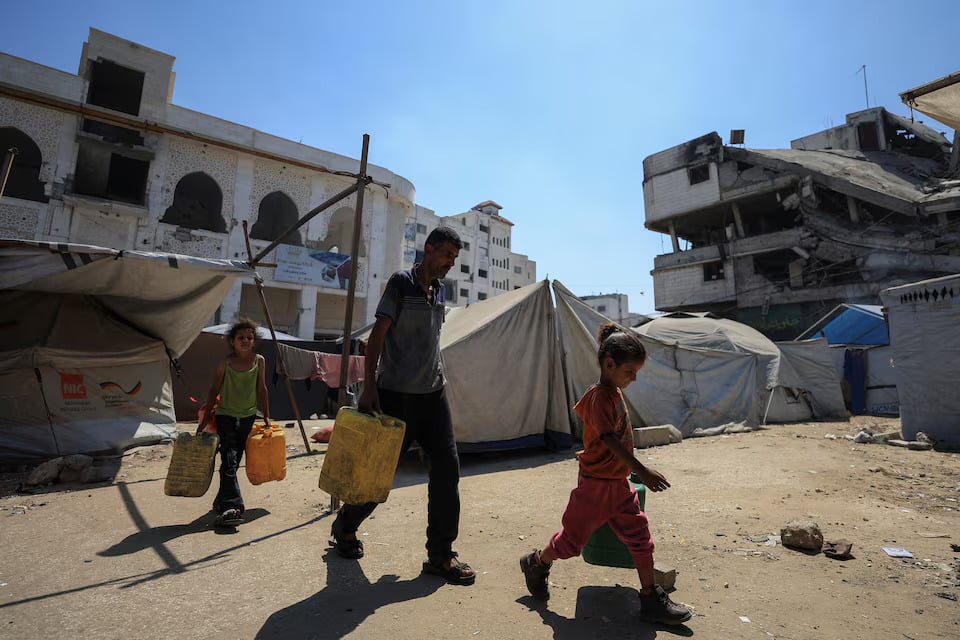
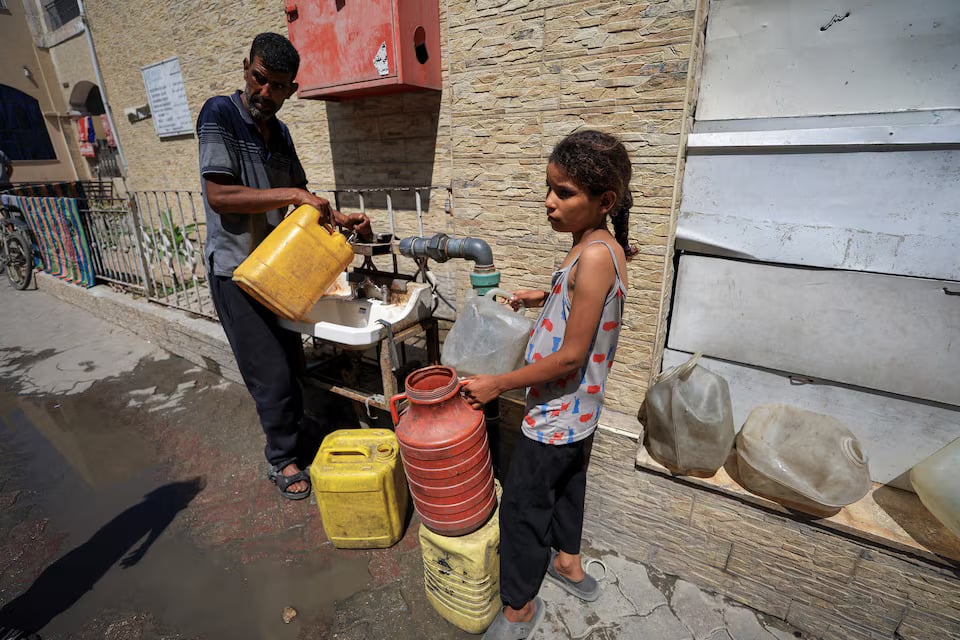
Gaza’s lack of clean water after 21 months of war and four months of Israeli blockade is already having “devastating impacts on public health” the United Nations humanitarian agency OCHA said in a report this month.
For people queuing at a water distribution point on Sunday it was fatal. A missile that Israel said had targeted militants but malfunctioned hit a queue of people waiting to collect water at the Nuseirat refugee camp.
Israel’s blockade of fuel along with the difficulty in accessing wells and desalination plants in zones controlled by the Israeli military is severely constraining water, sanitation and hygiene services according to OCHA.
Fuel shortages have also hit waste and sewage services, risking more contamination of the tiny, crowded territory’s dwindling water supply, and diseases causing diarrhoea and jaundice are spreading among people crammed into shelters and weakened by hunger.
“If electricity was allowed to desalination plants the problem of a lethal lack of water, which is what’s becoming the situation now in Gaza, would be changed within 24 hours,” said James Elder, the spokesperson for the UN’s children’s agency UNICEF.
“What possible reason can there be for denying of a legitimate amount of water that a family needs?” he added.
COGAT, the Israeli military aid coordination agency, did not immediately respond to a request for comment.
Last week, an Israeli military official said that Israel was allowing sufficient fuel into Gaza but that its distribution around the enclave was not under Israel’s purview.
Thirsty and dirty
For the Manasra family, like others in Gaza, the daily toil of finding water is exhausting and often fruitless.
Inside their tent the family tries to maintain hygiene by sweeping. But there is no water for proper cleaning and sometimes they are unable to wash dishes from their meagre meals for several days at a time.
Manasra sat in the tent and showed how one of his young daughters had angry red marks across her back from what he said a doctor had told them was a skin infection caused by the lack of clean water.
They maintain a strict regimen of water use by priority.
After pouring their two containers of water from the distribution point into a broken plastic water butt by their tent, they use it to clean themselves from the tap, using their hands to spoon it over their heads and bodies.
Water that runs off into the basin underneath is then used for dishes and after that – now grey and dirty – for clothes.
“How is this going to be enough for 10 people? For the showering, washing, dish washing, and the washing of the covers. It’s been three months we haven’t washed the covers, and the weather is hot,” Manasra said.
His wife, Umm Khaled, sat washing clothes in a tiny puddle of water at the bottom of a bucket – all that was left after the more urgent requirements of drinking and cooking.
“My daughter was very sick from the heat rash and the scabies. I went to several doctors for her and they prescribed many medications. Two of my children yesterday, one had diarrhoea and vomiting and the other had fever and infections from the dirty water,” she said.
Also read: Syria’s interim president says protecting Druze a “priority”
Source: Reuters
