

The Erimi-Pitharka site in the Limassol district has provided new evidence of its importance as a centre for agricultural production and processing during the Late Bronze Age.
The excavation uncovered new large areas of the architectural complex, indications of wine production, a possible pottery workshop, weaving-related activities and significant artefacts, including an almost complete bull figurine and a group of nearly intact vessels.
Excavations reveal production activities
The excavations took place between 20 April and 22 May under the direction of Lerke Recht from the Moesgaard Museum in Denmark.
An international team of students and specialists participated in this year’s research, which was funded through grants from the A.G. Leventis Foundation, the Curtiss T. and Mary G. Brennan Foundation and the Moesgaard Museum.
The findings provided further evidence of grape processing and possible wine production, while also pointing to local pottery manufacturing and textile-related activities.
Important Late Bronze Age settlement
The site mainly dates to the Late Cypriot IIC-IIIA period and is considered contemporary with important settlements in the Kouris Valley, including Alassa and Episkopi-Phaneromeni.
Previous excavations had already identified remains of an extensive building complex, which is believed to have had an administrative role or been linked to the control of production.
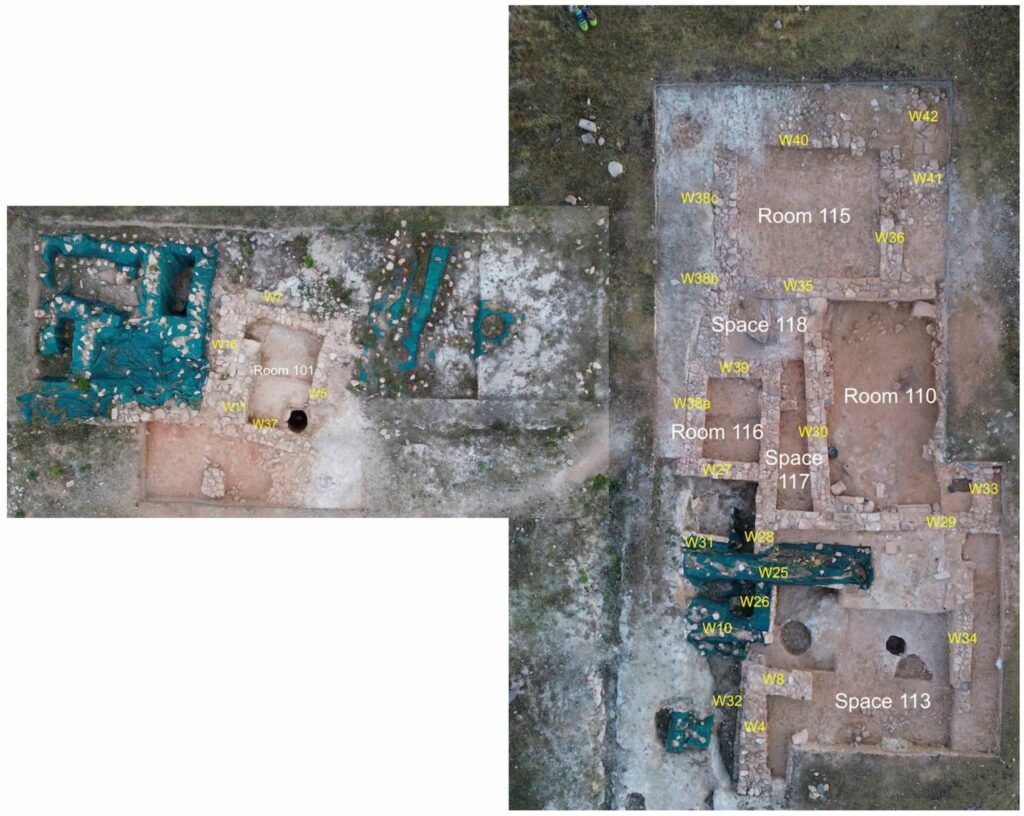
This year’s excavations showed that the complex extends further north and east than previously known, revealing new rooms and open areas.
In some sections, walls were built using carefully shaped stone blocks, while other areas followed traditional dry-stone construction with mudbrick upper structures. The natural rock was also carved to create basins, storage areas, spaces for large storage jars and floors.
Largest room uncovered so far
A significant discovery was Room 110, the largest space uncovered at the site so far, measuring 7 by 4.30 metres.
The room contains carefully constructed walls, work benches, thresholds, a stone-built storage area and a large stone weight.
Archaeologists also found deposits of unfired clay and weaving weights at different stages of production, strengthening the theory that the area was used for local pottery production and textile activities.
Evidence of wine production
Particular interest was drawn to discoveries in the southern section of the complex, where archaeologists found layers containing large quantities of pottery, grape seeds, waste-filled basins and limited animal remains.
Researchers believe these findings support the interpretation that agricultural products, particularly grapes, were processed at the site, possibly for wine production.
Valuable artefacts uncovered
Room 101 revealed a smooth and well-preserved lime plaster floor. A deep basin in its south-eastern corner contained a group of nearly intact vessels, including Aegean-style decorated pottery and reused containers.
A nearby deposit also contained an almost complete clay bull figurine, a bronze buckle and a fragmented vessel, which may be linked to the final phases of the site’s use.
Additional artefacts included bronze buckles, weaving weights and animal figurine fragments, including the head of a wild boar figurine made from Red Polished ware.
Earlier use of the area
The excavation also uncovered a small number of Neolithic pottery fragments, suggesting that the area had been used much earlier than the Late Cypriot period.
However, all architectural remains identified so far belong to the later Late Bronze Age phase.
Archaeologists estimate that the findings further strengthen the interpretation of Erimi-Pitharka as an important production and processing centre in the Kouris Valley during the Late Cypriot period.
Excavations will continue in order to clarify the full extent of the complex and the relationship between production areas, storage spaces and other activities carried out at the site.
Also read: Rare 2,500-year-old Cypriot coin found on Israeli beach
For more videos and updates, check out our YouTube channel
