

Cyprus property market top €2.5bn in 2025, apartments lead

Date:

Apartments dominate residential sales

Cyprus’ property market 2025 recorded strong performance, with the total value of new residential sale contracts exceeding €2.5 billion, according to the latest Landbank Analytics report.

The analysis, based on contracts submitted to the Department of Lands and Surveys throughout 2025, covered newly built apartments and houses, including off-plan developments across the island.

A total of 7,819 contracts were filed during the year. Apartments accounted for 6,382 transactions (81.6%) worth €1.77 billion, while 1,437 house sales (18.4%) reached €737.9 million.

District trends shape the market

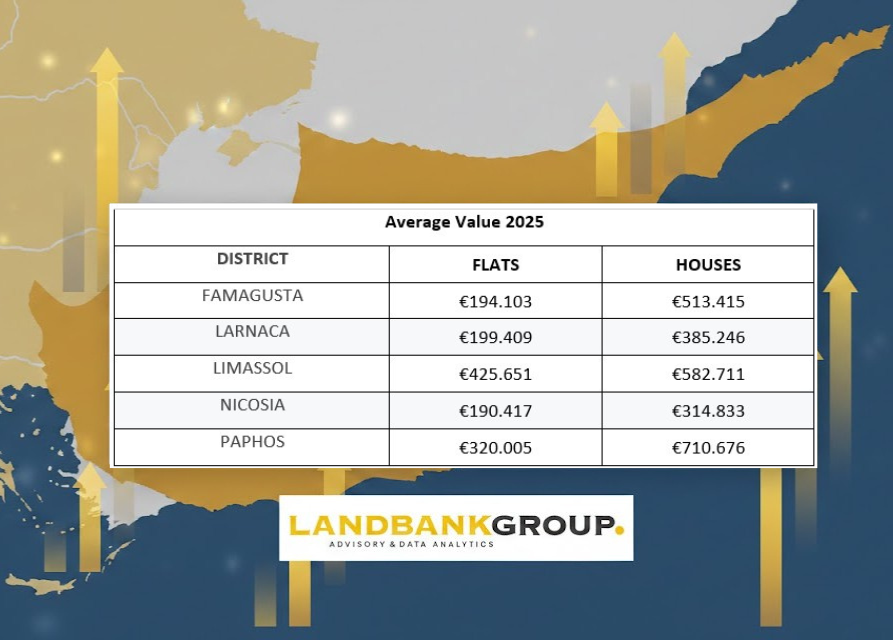
In Nicosia, 2,171 new residential sales were recorded, dominated by apartments with 1,836 transactions. Apartments generated €349.6 million, while houses reached €105.5 million. The district remained the most affordable, with average apartment prices around €190,000 and houses near €315,000.

Limassol led nationwide activity with 2,207 transactions and the highest overall values. Apartment sales produced €824.1 million, while houses reached €157.9 million. Average apartment prices exceeded €425,000 and houses averaged €583,000, reinforcing the city’s status as Cyprus’ main investment hub.

Larnaca posted 2,020 new transactions, with apartments again dominant. Apartment sales totalled €353 million and houses €96.3 million. Average prices stood near €200,000 for apartments and €385,000 for houses, highlighting the district’s competitive positioning.

Luxury and tourism influence coastal districts

Paphos recorded 1,078 transactions and ranked second in total value at €503.2 million. Unlike other districts, house sales value (€287.8 million) exceeded apartments (€215.4 million). Average house prices reached about €710,000, the highest in free Cyprus, while apartments averaged €320,000.

Famagusta showed the lowest transaction volume, with 343 sales. It was the only district where houses (176) outnumbered apartments (167). House values totalled €90.4 million compared with €32.4 million for apartments. Apartments averaged €194,000, while houses exceeded €513,000, reflecting strong demand for holiday and coastal properties.

Apartments remain the market’s engine

Commenting on the findings, Andreas Christophorides, chief executive of Landbank Group, said apartments clearly drive Cyprus’ residential sector, representing more than four-fifths of all transactions.

He noted that Limassol leads apartment pricing, Paphos dominates premium housing, and Nicosia remains the backbone of domestic demand due to affordability and stability. Larnaca continues strong activity with competitive prices, while Famagusta’s pattern reflects its focus on holiday residences and high-end coastal developments.

Christophorides added that Landbank Analytics closely tracks these trends to support informed and targeted investment decisions.

Also read: Non-performing loan ratio steady at 2.1% in November
For more videos and updates, check out our YouTube channel

Share post:

Popular

More like this
Related

Cyprus TV switches to DVB-T2 on 10 October: What viewers need to know

Cyprus is entering the next phase of its transition...

EU Parliament backs resolution against Muslim Brotherhood

The European Parliament reportedly approved a resolution targeting the Muslim Brotherhood on Thursday, 8 October 2026, calling for a European strategy to address what the EU describes as "Islamist entryism" and the influence of networks linked to the organisation. According to the voting figures provided, the resolution passed with 381 votes in favour, 167 against and 15 abstentions. Of Cyprus's six MEPs, only Geadis Geadi of ELAM was recorded as participating in the roll-call vote. He voted in favour, while the other five Cypriot representatives were not recorded as having voted. The distinction is important, as not participating in a vote is not the same as formally abstaining. What the resolution proposes The resolution calls for a common European approach to identifying practices described as "Islamist entryism", with particular emphasis on transparency in organisational funding, institutional partnerships and the potential use of EU programmes to gain political influence. The term "entryism" refers to a strategy whereby individuals or organised groups seek to influence established political institutions, organisations or social structures from within to advance their ideological objectives. The concept has its roots in political history, particularly the tactics employed by certain Trotskyist organisations during the 20th century. In this context, "Islamist entryism" is used to describe similar tactics allegedly employed by certain political Islamist networks. The European Parliament also calls on the Council of the EU to examine whether specific individuals and organisations associated with the Muslim Brotherhood meet the legal criteria for inclusion on the EU's terrorist list. The resolution does not automatically ban the Muslim Brotherhood and is not legally binding legislation. Controversy over Muslim youth organisations The resolution makes particular reference to FEMYSO, a federation of Muslim youth and student organisations in Europe that has faced questions concerning its funding and relationships with European institutions. The European Network Against Racism (ENAR), meanwhile, has rejected allegations of links to the Muslim Brotherhood. ENAR criticised the resolution as targeting Muslim organisations and groups working to combat discrimination. How the European political groups voted According to the figures provided, the Muslim Brotherhood resolution received most of its support from the European People's Party (EPP), the European Conservatives and Reformists (ECR), Patriots for Europe, Europe of Sovereign Nations (ESN) and a significant proportion of Renew Europe. The Socialists, Greens and the Left opposed the resolution. How Cyprus's six MEPs voted Geadis Geadi of ELAM was the only Cypriot MEP recorded as voting in favour of the resolution. The remaining five Cypriot MEPs did not participate in the roll-call vote: Loucas Fourlas Michalis Hadjipantela Costas Mavrides Giorgos Georgiou Fidias Panayiotou None of the five was recorded as formally abstaining. Six Greek MEPs voted in favour, three against Of Greece's 21 MEPs, nine participated in the roll-call vote. Six voted in favour: Vangelis Meimarakis, New Democracy Manolis Kefalogiannis, New Democracy Dimitris Tsiodras, New Democracy Galato Alexandraki, Greek Solution Emmanouil Fragkos, Greek Solution Nikolaos Anadiotis, Niki Three voted against: Lefteris Nikolaou-Alavanos, Communist Party of Greece (KKE) Kostas Papadakis, Communist Party of Greece (KKE) Maria Zacharia, Course of Freedom The remaining 12 Greek MEPs, including representatives of PASOK and SYRIZA, did not participate in the vote. No Greek MEP was recorded as formally abstaining. The European Parliament...

Cyprus Airways launches multilingual Website, making travel more accessible

Cyprus Airways has launched a multilingual version of its...

Sergey Portnov launches SP Ventures to back the next generation of technology companies

Sergey Portnov has launched SP Ventures, an investment and...