

In moments of geopolitical tension, facts can become casualties almost as quickly as infrastructure. The latest escalation in the Middle East, triggered by the recent US–Israel strikes on Iran and Tehran’s retaliatory responses, has pulled Cyprus into the international conversation. Yet alongside the serious security concerns, an unexpected phenomenon has emerged: a cascade of misconceptions, misstatements and mildly baffling commentary about the island itself.
For Cypriots, the past few days have been a strange mix of strategic anxiety and involuntary comedy.
When Cyprus suddenly matters
Cyprus sits at the crossroads of Europe and the Middle East, a reality that becomes particularly visible during regional crises. The presence of two British Sovereign Base Areas, Akrotiri and Dhekelia, means the island frequently plays a logistical role in Western military operations. When tensions flare in the Levant or the Gulf, Cyprus often finds itself mentioned in the same breath as aircraft deployments, evacuation corridors and radar systems.
This time has been no different. Iran’s warnings that states facilitating attacks could be considered legitimate targets immediately raised concerns about locations hosting Western military infrastructure. Although the British bases are legally distinct from the Republic of Cyprus itself, geography does not always care much for constitutional nuance.
Suddenly, Cyprus made the headlines.
And that is where the confusion began.
The NATO that never was
Among the more eyebrow-raising moments came from the United Kingdom’s Foreign Secretary, David Lammy, who stated during an interview that Cyprus is part of NATO.
It is not.
Cyprus is a member of the European Union but famously remains outside NATO, largely because of its complicated relationship with Turkey, a longstanding NATO member which illegally occupies more than 36% of the island. The Republic of Cyprus does participate in various EU defence frameworks and cooperates with Western partners, but formal NATO membership has never materialised.
In diplomatic terms, the difference matters. NATO membership carries explicit collective defence obligations under Article 5. Cyprus, by contrast, occupies a more ambiguous strategic position: closely aligned with Western partners, yet institutionally outside the alliance.
For Cypriots watching the interview, Lammy’s remark was the sort of mistake that prompts a collective national sigh.
Late-night geography
If Lammy’s comment produced sighs, Jon Stewart produced laughter.
During a recent episode of The Daily Show, the veteran satirist referred to Cyprus while discussing the regional implications of the Iran crisis, before pausing and quipping: “I don’t even know where that is.”
To be fair, the joke was clearly self-aware. Stewart’s humour has long thrived on highlighting the American tendency towards selective geography. Still, for viewers in Cyprus, an island with over 10,000 years of recorded human history, the moment landed somewhere between amusement and mild exasperation.
Being strategically important yet frequently misunderstood has long been part of the Cypriot experience.
And then there was the “port of Nicosia”
The most surreal moment, however, may have come courtesy of Greek television.
During a live broadcast about the regional security situation, Greece’s national broadcaster displayed a caption announcing that Greek naval frigates had arrived at “Nicosia port”.
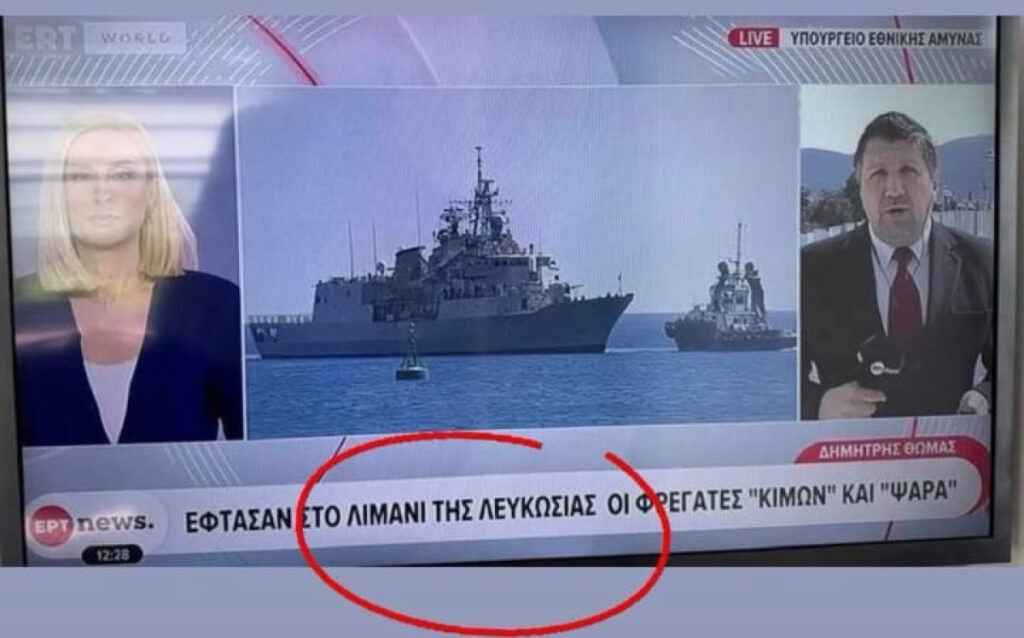
This would certainly have been impressive.
Nicosia, sits inland and is approximately 40 kilometres from the nearest coastline. While Cyprus has several ports, Limassol, Larnaca and others, Nicosia is obviously not among them and has never harboured a frigate.
The caption was quickly corrected, but screenshots travelled faster than the edit.
Why these details matter
Individually, these slips are harmless. Politicians misspeak, comedians exaggerate and television captions are written under pressure. Yet collectively they highlight a recurring issue: Cyprus tends to enter international discourse only during crises, and when it does, basic facts about the island are often fuzzy.
That fuzziness can obscure important realities.
Cyprus is not merely a convenient military outpost. It is an EU member state, a complex political environment shaped by the Turkish invasion in 1974, and a society that has spent decades balancing diplomacy, regional proximity and security concerns.
The British bases themselves are not British “bases in Cyprus” in the conventional sense; they are sovereign British territories established when Cyprus gained independence in 1960. The Republic of Cyprus does not control them, though it maintains practical cooperation with the UK.
Understanding these distinctions is essential when discussing whether the island could become entangled in wider regional conflict.
For Cyprus, the hope is that the current tensions in the Middle East de-escalate quickly. The island has no desire to become a frontline in someone else’s conflict.
If the world insists on talking about Cyprus, however, it might at least start with a map and a quick history lesson.
Also read: New test SMS rollout by district today – see timing details
