

The leader of the Roman Catholic church in England and Wales has said he definitely will not be the next pontiff, but is looking forward to the “intimidating” duty of choosing Pope Francis’s successor.
Following Pope Francis’s death, the next Pope will be chosen by the College of Cardinals, who will gather for a tradition known as the conclave.
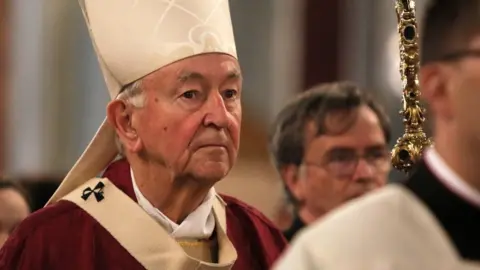
Cardinal Vincent Nichols will vote with more than 100 others, but almost missed out, as he is only a few months off his 80th birthday, the age limit for voting rights.
The Merseyside-born Archbishop of Westminster said he thought it would “pass me by” until he heard the Pope was seriously ill and thought: “Oh Lord, this is going to come my way.”
The conclave, which traditionally starts after a two-week mourning period, sees the College of Cardinals gather in the Vatican’s Sistine Chapel to cast a series of votes to choose the next pope.
Theoretically, any baptised man can be elected as pope, but a cardinal is usually picked.
There are currently 252 cardinals and while all can take part in the debate about who should be chosen, the voting age restriction means only the 135 who are under 80 can vote.
Cardinal Nichols, who leads six million Roman Catholics in England and Wales, exclusively told BBC North West he “never thought” he would be voting because Pope Francis “didn’t show many signs of slowing down” and appeared to be recovering from double pneumonia.
However, he played down any suggestion of remaining in the Vatican as the next pope himself.
“I’m coming home,” he said.
“You can be sure of that.”
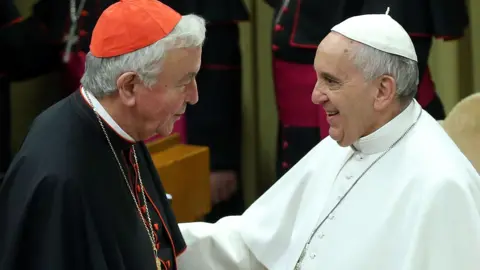
The 79-year-old archbishop, who was born in Crosby on the Merseyside coast, said he had met Pope Francis several times during high-level meetings in Rome, but had two abiding special memories.
“One particularly has never left me,” he said.
“He said to me: ‘From the moment of my election as Pope, my peace has never left me’.
“Despite the pressure of all he has to deal with, he has lived close to God.”
Cardinal Nichols also said he had fond memories of their last meeting two years ago.
He said an author had asked him to give a copy of their latest book to Pope Francis.
“I gave him the book and said the author was ‘very keen that you might have this’,” he said.
“He came back after lunch with a handwritten card and a copy of one of his own books for me to give as a return gift.
“That was quite astonishing.”
Following Pope Francis’s funeral on Saturday, Cardinal Nichols will join his fellow cardinals to vote for the 267th pontiff, who will go on to lead the world’s estimated 1.4 billion Catholics.
He said the prospect was “quite intimidating frankly”.
He added that he believed the cardinals would their “best work once the doors of the conclave have been shut”, as at that point, there would be “a peace and a prayerfulness between us”.
“I know I have got to get myself together and be a little nuanced to all the political manoeuvring and Paddy Power’s bets and all that and say ‘actually, this is a group of men trying to discern the will of God,” he said.
“That’s the only thing that matters.”
Also read: Nun breaks protocol to say farewell to Pope Francis
Source: BBC