

In the small corridors of neglected high schools, in teenage bedrooms, in storage rooms that smell of mildew, there, the beautiful flowers of artists grow and flourish. In some cases, these flowers find the Cypriot sun too harsh to bear, so they seek refuge in bigger fields: the fields of prestigious universities beyond their homeland, the fields of countries that appreciate their craft and reward them for it.
I had the opportunity to talk to one of those artists: 22-year-old student Valantis Panayiotou, a pianist who became an immigrant for his art.
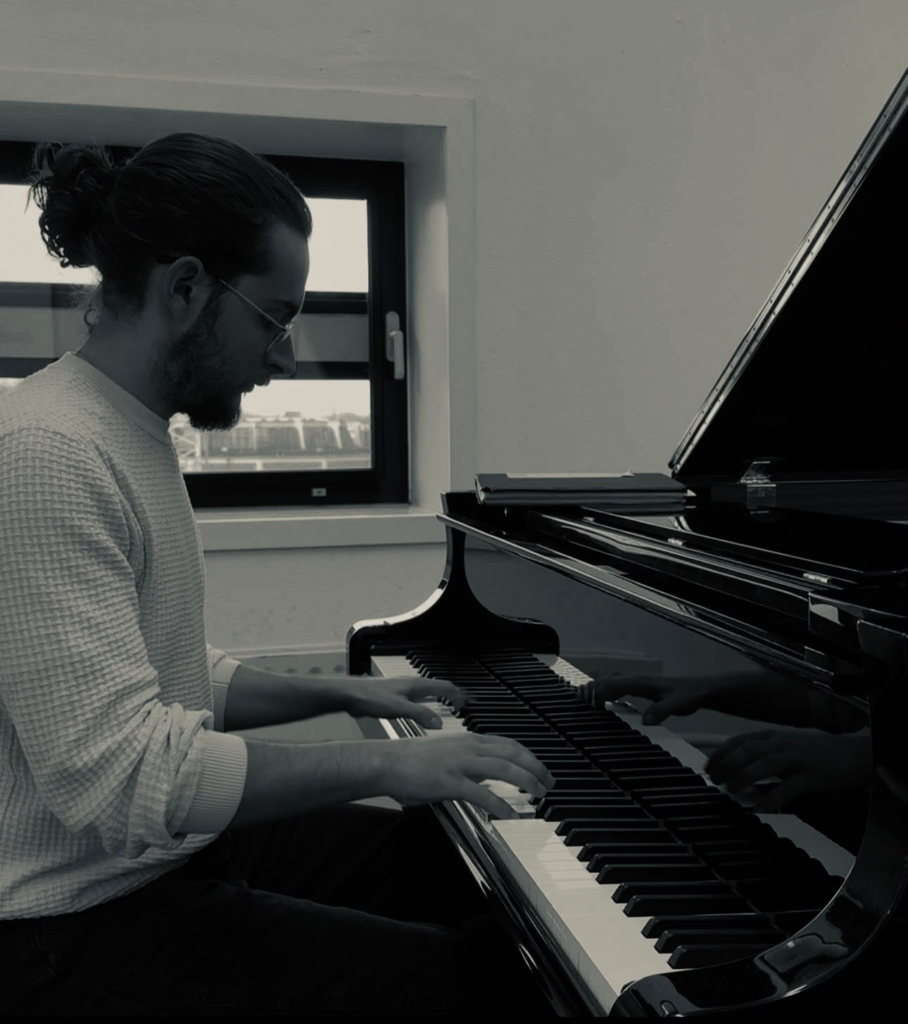
-First and foremost, what are you studying?
-I am doing my bachelor’s in classical music, more specifically classical piano, at the
Conservatorium of Rotterdam.
-I know that you attended a music high school and have followed the path of music since then. Can you pinpoint exactly when you started studying music academically?
-I started studying music, specifically piano, at the age of six, following my parents’ wishes. Then I joined the Music Gymnasium, but I think my full immersion in music came during the quarantine. I think that is where I first saw music more academically and more seriously.
-So, ironically, during a period of confinement, you found the utmost freedom through your music.
Thus, in your eyes, art liberates?
–Indeed, it was during that time that I felt the most liberated.
-Back to our thesis, which is “art immigration,” you are what I call an art immigrant. You chose to study an art in a completely foreign country, apart from your own, although it is funny, as you are mixed: half Cypriot, half Greek. Perhaps, there is no country that is truly your own. Nonetheless, you are now in a country where you have no connections. Do you feel like an immigrant?
-The Netherlands, and more specifically student life in the Netherlands, is extremely multicultural. I
meet people from different cultures and countries every day, but even when I am communicating
with Dutch people, if not 100% of them, then a great majority speak English fluently, so I never
really feel left out.
-So the lack of a language barrier makes it much easier.
-Absolutely. Although I am now starting to learn Dutch, I think it will be very helpful in the future.
-So you do not feel like an immigrant, not even culturally?
-When it comes to socializing, no, I do not feel like an immigrant in the traditional sense. The only time I actually feel foreign is when I see Dutch people eating lunch at 12:00 and dinner at 18:00. I
find it extremely weird. Also, the food they eat—they do not care enough about good food, like we
do. They eat bread with some kind of spread for lunch and fries for dinner. That is the cultural gap I
have identified so far.
-The perception of culture and its connection to food always amazes me. Good food is everywhere, in both the countries that are part of you, especially Greece. Greece, apart from its great food and familiar culture, also has good enough universities where you could study music.
-Indeed, both Cyprus and Greece have a music scene. A very small one, though. The Netherlands,
and more specifically Amsterdam, is the capital of jazz. Here, a serious classical artist is well
respected. You say, “I study classical piano,” and people are interested; people respect you and
your major. In Greece and Cyprus, respect for the arts is a very rare phenomenon. You do not see
people seriously respecting art and music, except if it is profitable. People want to see the youth
become doctors or lawyers and not pianists. They can play, but only as a hobby. And when music is
“respected,” it is only because it is commercial and profitable, not because it is serious.
-Can commercial art ever be serious?
-It is very difficult for commercial music to be serious. Serious art, for me, is art that is of great
quality, that is smart and witty, and of course enjoyable. It is very difficult for an artist to be
commercial, and thus need to mass-produce, while also maintaining quality. He or she needs to be
a genius in order to achieve that. I can only give you one name of a person who perhaps fits into
this very niche category—Bruno Mars. For me, he is a mass producer, but he is also a serious artist
of quality.
-You talked about a type of “genius.” I would assume you mean talent. Because I know for a fact that in our small high school in our small country you were considered a “piano prodigy”—and now perhaps you are one of many very talented pianists. Is the measure of talent different in the Netherlands? Is talent as important?
-In Cyprus, you are “the best,” and perhaps you share the title of the best with 15 more people. It is a very small scene and thus extremely easy to be seen. Here, I am good enough alongside 15,000 other people who are as good as me, and 15,000 more who are better than me. Talent absolutely matters; it is that genius we have talked about. But it takes a very rare skill in order to be considered “the best.” To be fair, there is no such thing as “the best.” There are so many categories. There are some people who are great composers, or music teachers, or great singers or pianists. There are many domains. There is not one objective “best” in art, perhaps because art itself is not objective.
-So art is purely subjective?
-That is a very difficult question. We could be talking about it for hours. There are rules and
measures for art, but on the most basic level, yes, art is subjective.
-How does it feel to navigate through something that can never allow you to be “the best,”
something that does not even have a “best”?
-There is “a best” subjectively. For example, if you ask around at the university, “Who do you think
is the best pianist?” they will most probably give you a name. That is perhaps what is considered “the
best,” but it also depends on the scale of your audience, how many people enjoy and follow your
work, etc. For me, I do not really care to “be the best” right now. I am not in my fifties; I am still a
student. I enjoy healthy competition. I think it makes me better. I think every serious artist thinks more about improvement and less about being “the best.”
-You shared two quite interesting views, Valanti, which push me to ask you two separate questions:
when you are in your fifties, would you want to be “the best” then? Is there a time frame?
-When I am in my fifties, I will perhaps reach my peak as an artist. Some things will definitely matter
more to me than they do now.
-And since you said, “A serious artist thinks more about competition and less about being ‘the
best,’” do you find the people who want to be “the best,” the most popular, etc., unserious?
-I find them more commercial. I do not know if I would characterize them as “unserious.” I think
being in healthy competition is the wisest approach in a field where there is no such thing as being
objectively “the best.” Although I believe it is equally fair to want people to listen to you and enjoy
your music, and to strive to create for a crowd.
-As an external observer, I find the most unserious artists to be the ones who say: “I love to play
music even if it is just for one person; that one person is the same to me as a thousand people.”
They lack an artist’s greatest aspect: their beautiful arrogance.
-Indeed, they are hypocrites.
-Exactly. You cannot tell me that you would not appreciate it if there were a huge crowd cheering for you, and that you would still enjoy it the same if there were only one person.
-Yes, they are hypocrites and liars. Everyone wants a big crowd. And yes, a serious artist is
arrogant. Of course they are arrogant; they are dreamers, and dreamers have to be arrogant. On
the other hand, I understand them. I understand why they say such things. They want to seem
humble, and they also want to minimize their expectations. They want to attribute it all to the love
they have for their craft, but they act as though they ignore the fact that the audience and the stage
are also part of that craft.
-The word “craft” signals that something is created. Do you think that serious artists are born or
created?
-I believe that serious artists are created. First and foremost, they have to be supported by their
parents. Unconditionally supported. Parents need to introduce the element of art into their children’s
lives from a young age, at the latest by the age of six. You can see a big difference between artists
who started later and were not supported by their parents. They lack something that is difficult to
pinpoint but is still extremely apparent.
-So unconditional love, like parental love, crafts serious artists. Is the relationship that serious
artists have with their craft unconditional? What is it like to love something unconditionally?
-Yes, serious artists love their craft unconditionally, and it is risky. It is not as risky as gambling; you
will perhaps not lose everything. But still, it is very risky.
-So you still believe it is unconditional? I believe that there is one
condition—the condition of “pathos,” that incredible pain that every amorous relationship offers you.
-I would say that the “pathos” is included in the love and not in the condition, but I understand where
you are coming from. I agree with you; it is like an amorous relationship. Perhaps the condition is
them wanting you back, or you becoming subjectively “the best.” If she does not want you back, you
might say, “I did not really want her that much in the first place,” but that is a soothing lie—a lie of
the same nature as saying, “I do not care for a big crowd.” I get it. I have said it before. It is very
soothing.
-“I did not really like her that much in the first place.” What a wonderful lie, the consolation of the unlucky…
-Indeed.
-I have something here in my questions that talks about luck. I called you, and all the other artists, “slaves to luck.” Do you believe you are a slave to luck?
-If you had asked me the same question last year, I would have told you yes, but not anymore. I
believe that luck does play a factor, especially when two people of the same skill level are
competing against each other. But I think that skill and passion are far more important. I think luck
does not play such a big role on larger stages, like the ones in the Netherlands. In Greece and
Cyprus, on the other hand, luck plays a different role. Luck, as well as envy and gossip, can all
make or break you.
-So luck, envy, and gossip—they are all Mediterranean characteristics? They need sun to flourish?
-Yes, I would say so. Mediterranean and close-minded characteristics. Whenever there is gossip,
you know that a Mediterranean person is involved. It is funny. Both you and I come from a place full
of close-minded people, in my opinion. Those of us who make the leap and go study in a foreign
country are different. We have vision. To be a serious artist, you need vision.
-So a serious artist is the one who leaves, risks, and works for the future.
-Absolutely. A serious artist is constantly living in the future.
-Last question: Do you believe that having a big ego damages your craft? Do you believe that serious artists cannot have a big ego?
-I believe that serious artists who produce great work most of the time have big egos because they
are smart enough to recognize that they are great. When you are great, having a big ego is
excused. Not only is it excused, but it is perhaps also part of your persona. It can make you more
commercial, and it can help you grow a larger fan base.
-Do you believe you have a big ego?
-I am smart enough to recognize that I am good, perhaps exactly in the same way that you are. If that means I have a big ego, then yes. I am not the kind of art student who thinks they are the best. I am definitely not the best. I am not studying 12 hours a day. I have a social life. I enjoy having beers with my friends and going out. I am not the kind of person who lives only for their craft, becomes antisocial, and completely isolates themselves. I could never be that kind of person.
-In all of its glory, here it is. You are an incredible artist, and you are also
beautifully arrogant, which I think is a prerequisite…
Also read: The yolk: A guide to summer reading
