

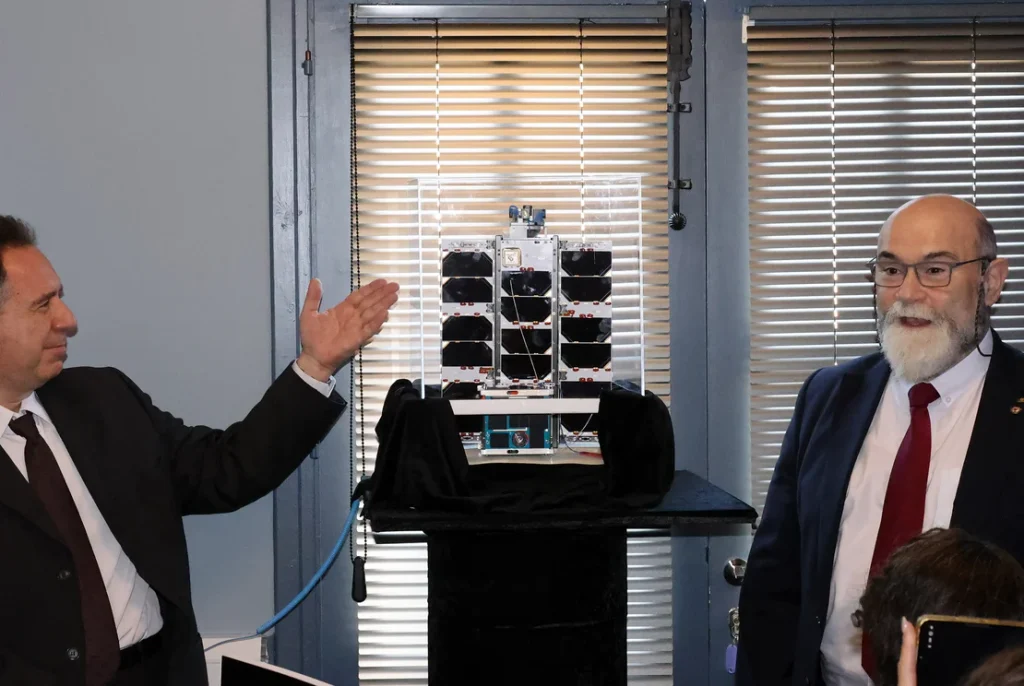
Cyprus has unveiled its first locally built satellite, Kyrenia 3, marking a major step in the country’s efforts to establish a presence in the international space industry. The announcement coincided with the activation of a new space weather operations centre in Nicosia.
The satellite was presented on Monday at the facilities of the Cyprus Space Exploration Organisation (CSEO), which hosts the International Cyprus Space Research and Innovation Centre (C-SpaRC), under the auspices of Chief Scientist Demetris Skourides.
The unveiling followed years of work to develop local satellite manufacturing capabilities, backed by an investment of approximately €2.5 million in specialised research infrastructure.
CSEO president George Danos stated that the occasion fulfilled an ambition he had pursued for more than a decade.
“I’m deeply moved,” he said, recalling how he had told members of the Cypriot diaspora in New York around 2018 that he wanted to build the country’s first microsatellite and name it Kyrenia 3.
Danos said the new facilities would allow Cyprus to move beyond individual research projects and establish an ongoing capacity to manufacture satellites and other space-related equipment.
“This infrastructure gives us the ability to produce not just one, not just the three satellites we presented, but to continue producing satellites and other mechanisms for space,” he said.
Cyprus builds its space technology capabilities
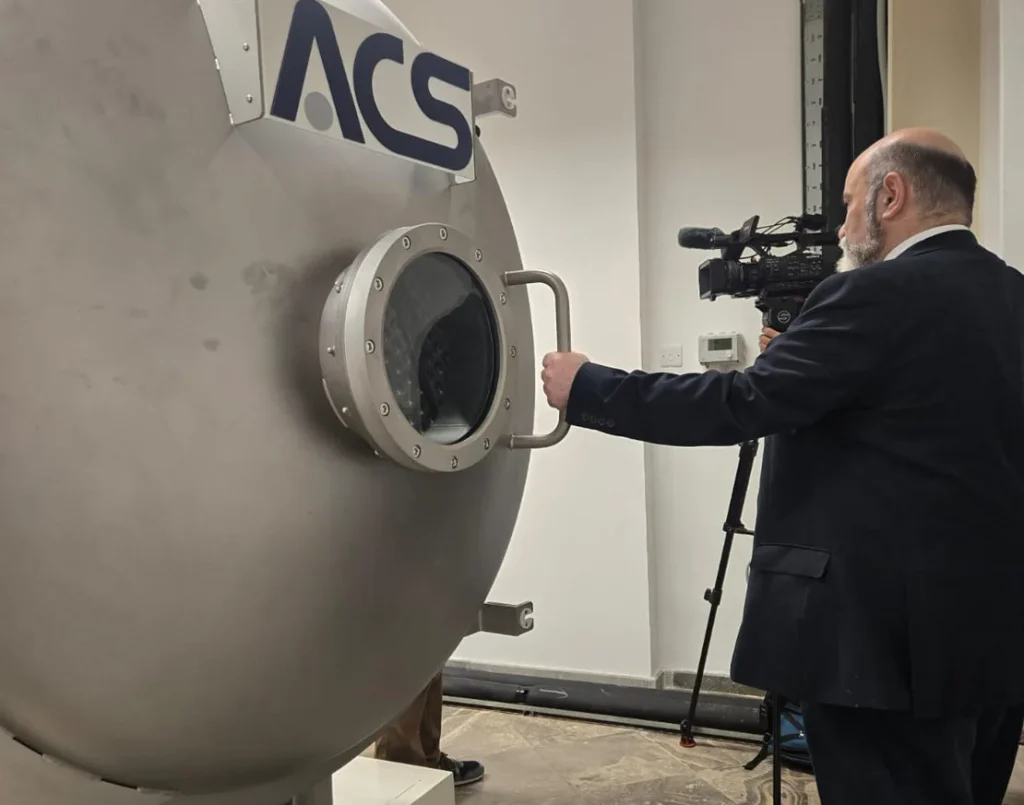
The centre brings together specialised equipment for satellite engineering, manufacturing and testing. Its facilities include a metal 3D printer, vibration testing equipment and an ISO 7 clean room used to assemble microsatellites.
Skourides said the project’s significance lay in enabling Cyprus to develop its own technological expertise, rather than relying exclusively on equipment and data produced abroad.
Although the country already has experience in Earth observation, the ability to manufacture microsatellites and specialised components locally represents a further step.
“You don’t have to be a large country to participate in this ecosystem,” he said, adding that it could create jobs and opportunities for young scientists.
Microsatellites are not intended to replace larger satellite systems, Skourides explained, but can provide complementary capabilities while helping Cyprus build independent technical expertise.
He also highlighted the centre’s metal 3D printer, which could help bring applied research closer to industry by allowing businesses and researchers to manufacture certain components locally.
The next priority is to make the facilities accessible to universities, researchers and businesses, in line with the principles of open science.
Kyrenia 3 launch date still pending
Although Kyrenia 3 has been unveiled, its launch date has not yet been confirmed.
Danos said CSEO was in advanced discussions with international partners over arrangements to launch the three satellites referred to during Monday’s presentation.
The process can take considerable time, with waiting periods potentially reaching 18 months even after a satellite has been completed and certified.
Research data collected by the satellites could be shared internationally, while other information would have more specific applications in Cyprus, including forest fire monitoring.
New centre to forecast solar storms
Monday also marked the official activation of a space weather operations centre, which uses artificial intelligence and machine learning to analyse solar activity and forecast potentially disruptive events.
Solar activity can affect telecommunications, satellite operations, navigation systems and electricity infrastructure, making accurate forecasts increasingly important.
Danos said the centre’s capabilities had attracted interest from NASA and other international organisations.
He explained that machine learning and artificial intelligence were being used to forecast when the Sun could expose Earth to potentially harmful radiation or particles.
The system has already generated approximately 110,000 forecasts, with results that Danos said demonstrated internationally competitive capabilities.
“The satellites are important for Cyprus,” he said. “But the results of space weather research are important for everyone.”
Space research could benefit human health
The centre is also involved in research into how conditions in space affect the human body, through cooperation with the Cyprus Institute of Neurology and Genetics and NASA’s Translational Research Institute for Space Health.
Danos said researchers had identified changes in the regulation of certain genes under space-related conditions, including microgravity. They had also examined whether existing medicines could be repurposed to help protect astronauts.
The findings could potentially have applications for healthcare on Earth, including research into neurological and cardiovascular conditions.
Skourides said future work could involve organs-on-chips technology, which uses miniature devices to reproduce aspects of human organ function.
This could allow researchers to investigate how organs such as the heart, stomach, skin and eyes respond to different conditions.
“Maybe in two or three years we could have this technology,” he said.
Satellite project aims to inspire schoolchildren
The initiative also aims to bring space exploration into Cypriot classrooms.
CSEO Director of Workforce Development and Global Partnerships Don Koulaouzos presented an educational programme encouraging students to build satellite receivers and antennas capable of receiving messages from space.
“With low-cost technology, we’re going to inspire the youth of Cyprus to embrace science, technology, engineering and mathematics,” he said.
With support from the Cyprus Amateur Radio Society, students will be able to compete for equipment kits and assemble receivers at their schools.
They will then be able to receive signals from the Kyrenia satellites, including messages from the President of the Republic and messages created by children themselves.
From the Kyrenia ship to space
The satellite’s name draws inspiration from the ancient Kyrenia ship, connecting Cyprus’ maritime heritage with its ambitions in space exploration.
Danos said the country’s role was now extending beyond its immediate surroundings and towards the wider world.
“Our role is no longer limited to the sphere of influence of our small but great homeland,” he said.
“Our role now extends outwards, to the wider planet.”
Also read: Ustel to unveil Varosha redevelopment plan promising major tourist hub
For more videos and updates, check out our YouTube channel
