

About this Summary
This summary was created with the help of artificial intelligence (AI) to help readers quickly understand the key points of the article.
It has been reviewed by our editorial team before publication. For complete information and full details, please read the full article.
- Seventeen of 19 environmental conditions from the March 2024 supplementary report remain unmet more than two years later.
- Two over-excavation conditions are now considered irreversible, with corrective measures no longer expected.
- Box culverts built in place of non-sealing structures were found to block riverbeds and hinder European eel movement.
- The report cites waste dumping, design changes and deviations from plans, and says environmental safeguards were often applied only after problems emerged.
The Audit Office has identified a series of problems in projects within the Akamas National Forest Park, including roads, hydraulic works, excavations and waste management.
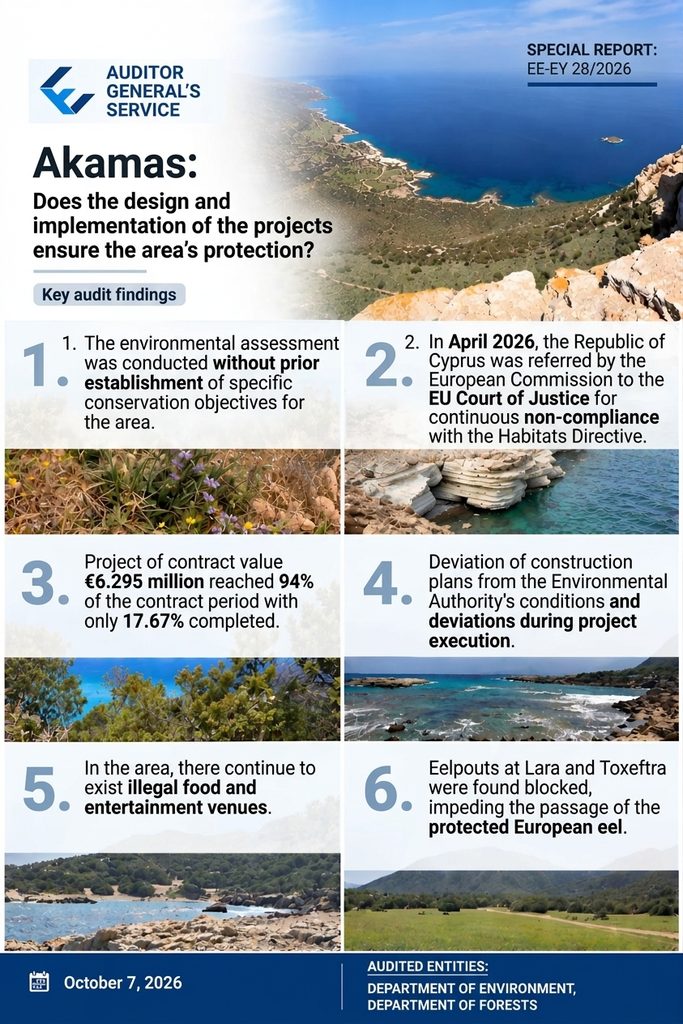
The most significant finding is that more than two years after the supplementary Special Ecological Assessment Report of March 2024, 17 of the 19 environmental conditions imposed have still not been fully met.
For two conditions concerning over-excavation, the situation is now considered irreversible, as corrective measures are not expected to be taken.
The Audit Office says the situation is prolonging problems within the Akamas National Forest Park and raises concerns over whether Akamas environmental safeguards are being applied effectively.
Problems with works affecting the European eel
The report also raises serious concerns about hydraulic works designed as part of the projects.
In areas where environmental conditions required structures that would not seal riverbeds, the construction plans instead provided for box culverts.
According to the report, these structures completely seal the riverbed and do not ensure the unobstructed movement of the critically endangered and strictly protected European eel (Anguilla anguilla).
The Water Development Department had previously raised the issue and requested changes to the design. It had also stated that it would not consent to the works if the design was not amended.
The concerns were later confirmed after the first winter floods, when problems were identified with the operation of the culverts and the continuity of the rivers.
The Audit Office says the potential cost of modifying or rebuilding the works remains unknown.
Excavations exceeded approved plans
The Audit Office also identified deviations in excavations carried out to widen existing roads.
During an on-site inspection on 18 November 2025, it found that excavation widths in some locations exceeded the limits set out in both the environmental conditions and final construction plans.
On the Aspros Potamos–Toxeftra–Lara road, the plans specified excavation depth limits depending on the location and bearing capacity of the ground, reaching up to 1.825 metres and, at specific points, 1.875 metres.
The Audit Office has called for an investigation into whether the additional excavations resulted in extra charges by the contractor and, if unjustified payments were made, whether they should be recovered.
Construction plans diverged from environmental conditions
A key issue highlighted by the report is the gap between environmental requirements and final technical designs.
The Audit Office stresses that environmental assessment cannot replace detailed technical planning. However, when a subsequent technical choice could substantially alter the environmental impacts assessed earlier, it should either be constrained by clear environmental conditions or be subject to a new assessment by the Environmental Authority.
In the case of Akamas, the Audit Office identified instances where final construction choices did not comply with the environmental conditions.
Waste found outside designated areas
Waste from excavation, construction and demolition is also examined in the report.
Environmental conditions required construction materials, machinery and solid waste to be stored exclusively within construction sites and in locations causing the least possible disturbance.
However, the Audit Office found cases of uncontrolled dumping of excavated materials and construction waste at various locations across Akamas.
These findings were recorded as deviations from the project’s environmental conditions.
Design changes created additional work
The report also records cases where original designs had to be changed during implementation.
One example concerns the water supply for infrastructure junctions. The original design provided for the Aspros Potamos and Avakas junctions to be supplied through the Peyia municipality water network, using a small underground tank and pressure pump.
Different infrastructure was subsequently pursued, creating the need for new interventions and ultimately a change in the proposed solution.
The Audit Office links such changes to additional costs and further environmental impacts resulting from the required works.
Audit Office criticises reactive approach
The overall conclusion of the report is strongly critical. According to the Audit Office, environmental safeguards did not always operate preventively.
In several cases, problems were identified only after interventions had already progressed.
Corrections, redesigns, additional works and further environmental interventions followed.
The Audit Office is calling, among other measures, for clear and measurable environmental conditions, their full incorporation into final construction plans and documented prior approval for any substantial change.
Questions over the implementation of the Akamas plan
The Sustainable Development Plan for the Akamas National Forest Park aims, among other things, to limit further environmental degradation, curb uncontrolled vehicle access and showcase the natural landscape.
The Audit Office’s findings raise questions over how the projects are being implemented and whether environmental protection is being treated as a fundamental requirement from the outset or whether, in some cases, corrections are being made only after interventions have already taken place.
Also read: Over 2,000 vessels detected in Cyprus’ marine protected areas by satellites
For more videos and updates, check out our YouTube channel
