

About this Summary
This summary was created with the help of artificial intelligence (AI) to help readers quickly understand the key points of the article.
It has been reviewed by our editorial team before publication. For complete information and full details, please read the full article.
- Public primary schools in Cyprus close in mid-June and reopen in September, creating a summer break of about 12 weeks.
- Secondary school holidays in Cyprus can reach 13 to 14 weeks, because regular lessons end before the examination period.
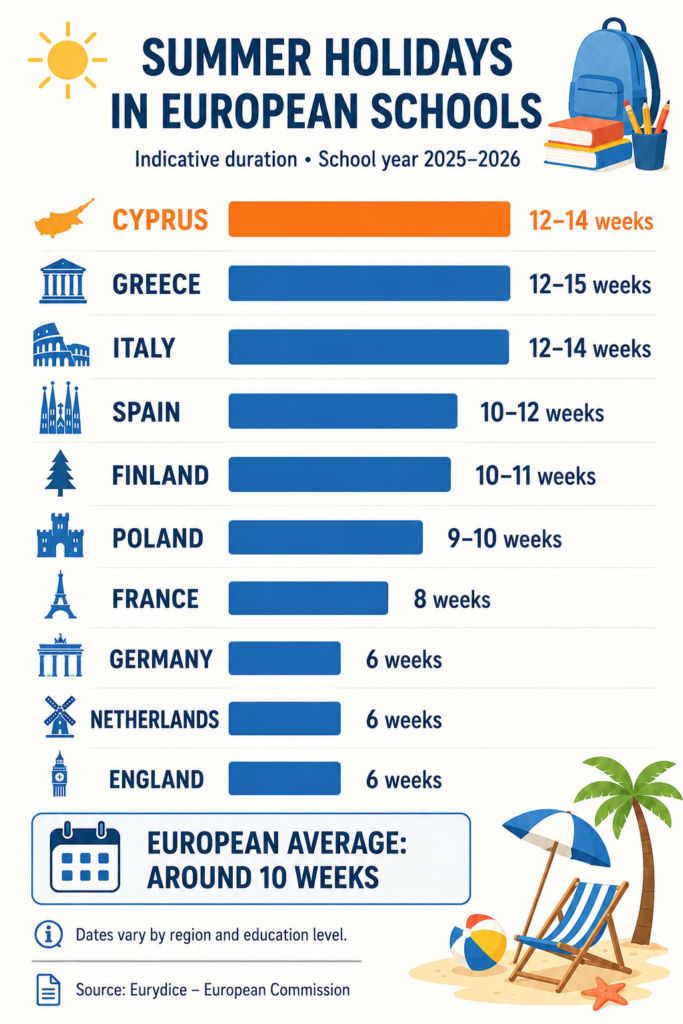
- Across Europe, summer holidays range from six to 14 weeks, with an average of around ten weeks, according to Eurydice.
- Germany, the Netherlands and England generally have about six weeks off, while Cyprus, Greece, Italy and Portugal have among the longest breaks.
The length of school summer holidays has sparked considerable debate in Cyprus in recent weeks, raising questions about how the island’s school calendar compares with the rest of Europe.
Asked about the issue, Education Minister Athena Michaelidou said school opening dates are determined by legislation and regulations rather than individual decisions by ministers, teachers’ organisations or parents’ associations.
“We know exactly when secondary schools, lyceums and technical schools begin, and the second Monday of September, which this year happened to be 14 September, for primary school children,” she said.
Michaelidou also noted that schools around the world close for a period during the summer months.
“The state offers many options. We have Summer Schools, which are being upgraded and expanded, and we are also working with local authorities on clubs,” she said.
“From a purely educational perspective, it would not be right for children to remain continuously within a structure, in a school environment, without spending time with their own people, their parents or grandparents.”
How long are school summer holidays across Europe?
There are significant differences in the length of school summer holidays across Europe. Depending on the education system, level of schooling and region, pupils can spend between six and 14 weeks away from the classroom, and in some secondary schools even longer.
The European average is around ten weeks.
Cyprus and Greece are among the countries with the longest summer breaks, alongside Italy, Portugal and other parts of Southern and Southeastern Europe.
At the other end of the scale, school summer holidays in Germany, the Netherlands and England generally last around six weeks.
When do schools close in Cyprus?
Classes at public primary schools in Cyprus finish around the middle of June and resume in September, giving children a summer break of approximately 12 weeks.
At secondary schools, regular classes usually finish earlier, towards the end of May or beginning of June, before the examination period.
Depending on the year group and school calendar, the period without regular lessons can therefore reach 13 or 14 weeks.
The end of lessons for pupils does not necessarily coincide with the end of the school year for teachers, who continue working on examinations, marking, registrations and other administrative duties.
Greece has a similar school calendar
In Greece, primary school classes finish on 15 June, or the previous working day when that date falls on a public holiday. Pupils return in September, resulting in summer holidays of approximately 12 weeks.
Regular teaching at secondary schools generally finishes towards the end of May, followed by examinations. The period without normal lessons can therefore approach 14 or 15 weeks.
Long summer breaks across southern Europe
Italian schools generally close between early and mid-June and reopen in September. Summer holidays last around 12 to 14 weeks, although precise dates are determined by regional authorities.
In Spain, classes generally finish in mid-to-late June and resume in early September, giving pupils around 10 to 12 weeks off.
Portugal’s school calendar varies according to year group. Older pupils may finish classes in early June, while younger children can remain at school until the end of the month.
Six weeks in Germany and the Netherlands
The picture is different in parts of Central and Northern Europe.
Germany has six weeks of school summer holidays, although they do not begin simultaneously across the country. Dates are staggered among the 16 federal states, with holidays beginning at different points between late June and early August.
The Netherlands operates a similar system, dividing the country into three geographical regions with different starting dates. The summer break nevertheless lasts around six weeks in each region.
Schools in England generally close in mid-to-late July and reopen in early September, also resulting in a summer break of about six weeks.
Around ten weeks off in Finland
Despite its northern climate, Finland has comparatively long school summer holidays. Schools finish in late May or early June and reopen in August, giving pupils around 10 to 11 weeks off.
Sweden’s summer break lasts approximately nine to ten weeks, while pupils in Denmark generally have six to seven weeks away from school.
Why school holidays vary so widely
The length of the summer break is influenced by the total number of teaching days, the distribution of holidays throughout the academic year, climatic conditions and the historical development of individual education systems.
Countries including France, Germany and the Netherlands have shorter summer holidays but more or longer breaks during the rest of the school year.
In several Mediterranean countries, by contrast, the extended summer break remains a central feature of the academic calendar.
The figures cover public primary and general secondary education and are indicative for the 2025-2026 school year. Dates can vary according to region, school and year group.
According to the European Eurydice network, summer school holidays across Europe generally range from six to 14 weeks, with an average of approximately ten weeks.
Also read: Temperatures hit 40°C again as yellow warning takes effect
For more videos and updates, check out our YouTube channel
