

The Brink’s-Mat heist: The day £26 million in gold vanished
In the early hours of 26 November 1983, what would soon be dubbed “the crime of the century” unfolded inside a warehouse near Heathrow Airport. Six armed men, with inside knowledge and a chilling level of precision, walked away with £26 million worth of gold bullion — around $40 million at the time — instantly becoming the masterminds behind the largest robbery in world history.
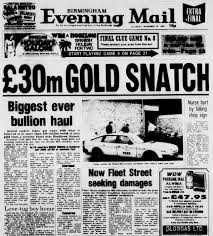
The heist
At around 6am, the gang forced their way into the Brink’s-Mat warehouse in the Heathrow trading estate. What began as a planned theft of cash quickly escalated into something far greater when the robbers discovered three tonnes of gold bars, stacked inside the vault.
With the help of a corrupt security guard, the gang:
- Tied up and doused staff in petrol to force compliance
- Loaded 6,800 gold bars onto a van
- Disappeared without leaving an obvious trail
Few crimes had ever demonstrated such audacity — or reward.
What was on the news at the time?
That Saturday, the gold heist dominated UK headlines and evening bulletins. Newsreaders described the scale of the robbery with disbelief. This was a period already marked by economic tension, rising unemployment, and debates about law and order under Margaret Thatcher’s government.
The idea that a heavily-guarded, internationally trusted vault at Heathrow could be breached sent shockwaves across the country.
Elsewhere in the news that week:
- The Cold War dominated global politics
- UK miners were bracing for battles over pit closures
- The Troubles in Northern Ireland remained a daily item
- British television was entering its festive scheduling season
But all of these stories were momentarily overshadowed by the staggering theft.
Public reaction
The public’s response was a mixture of fascination, outrage, and disbelief. People were stunned that such a vast quantity of gold could simply vanish. Newspapers described it as a Hollywood-style caper, with tabloids calling the thieves “criminal geniuses” and “ghosts”.
High street jewellers and pawn shops reported an influx of customers asking how to tell if gold was “Brink’s-Mat gold”, while TV and radio phone-ins buzzed with theories about where the bullion had gone.
Rumours spread rapidly:
- The gold was already being melted down
- It had been smuggled abroad
- Organised crime groups were involved
The heist gripped the national imagination for months.
What happened next?
The aftermath proved even more complex than the robbery itself:
- Only two of the original robbers were ever convicted.
- Most of the gold was never recovered, having been melted, laundered, and mixed into the legitimate gold supply.
- Vast amounts of money flowed into London property, contributing to what investigators later called the “Brink’s-Mat legacy” — a web of investments, corrupt deals, and organised crime links that lasted for decades.
- The robbery sparked multiple murders, betrayals, and disappearances as criminals fought over the fortune.
One coroner later referred to it as “the curse of the Brink’s-Mat gold”, because so many involved in handling or laundering it met violent or mysterious ends.
Highlights and legacy
- It remained the world’s largest ever gold robbery for decades.
- The case reshaped UK law, leading to stricter anti-money laundering regulations.
- The stolen gold is thought to have been mixed into jewellery still in circulation today.
- The story has inspired countless documentaries, books, and dramatisations, securing its place as one of Britain’s most notorious crimes.
Also read: ON THIS DAY: Premiere of Casablanca (1942)